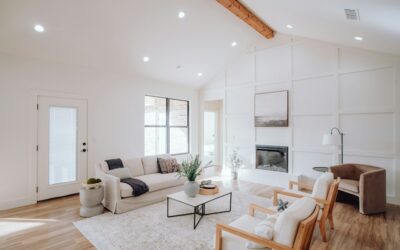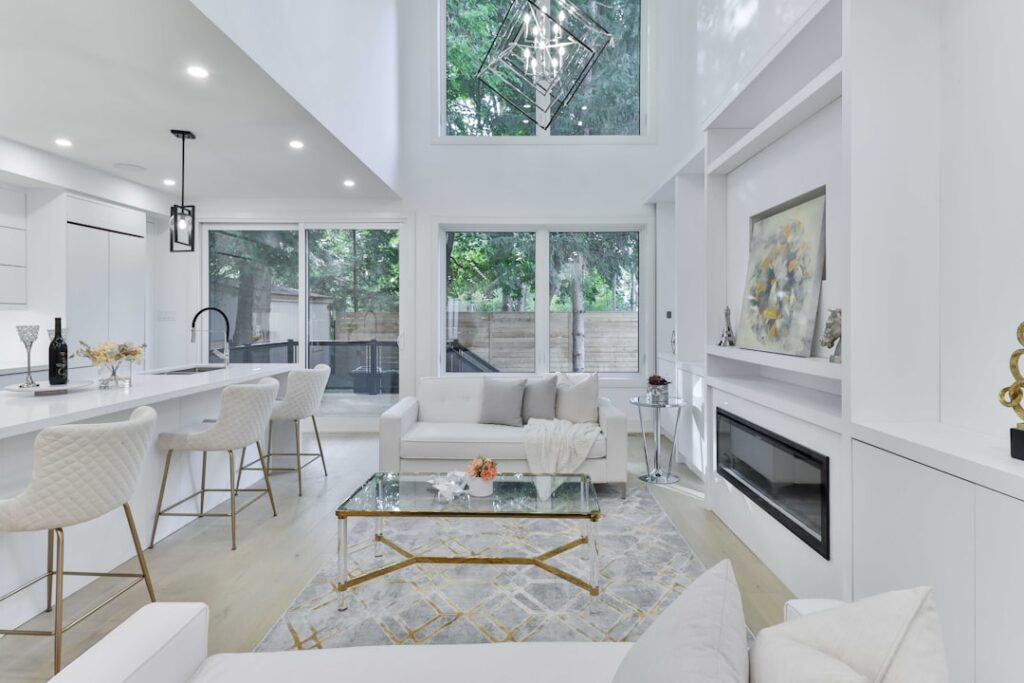
An open-plan living room, a great room with a cathedral ceiling or a finished basement family room can swallow the output of a typical bedroom humidifier without the hygrometer budging. A large room humidifier needs roughly 3 to 6 gallons per day of output and a tank big enough to keep up for a full day, not a few hours. Undersize it and the room stays dry; oversize it in a closed space and you get fogged windows and mold.
As a starting point, plan on about 3 gallons per day for 500 to 700 square feet and 4 to 6 gallons per day for 700 to 1,000 square feet, assuming standard 8-foot ceilings and average construction. Higher ceilings, drafty windows and forced-air heat push you toward the top of the range. The target is steady indoor humidity between 30 and 50 percent.
This guide focuses on a single big room or open living area. If you want to humidify an entire house, a console unit or a furnace-mounted whole-house system is a different conversation.
How to Size a Large Room Humidifier
Room size ratings on the box are helpful but often optimistic. Doing the math yourself gives a better match. Start with volume, not floor area: multiply length by width by ceiling height. A 25×30-foot great room with a 10-foot ceiling is 7,500 cubic feet, about the same air volume as a 940-square-foot room with an 8-foot ceiling. Rate your large room humidifier for the equivalent square footage.
Then adjust for how “tight” the room is:
- Tight construction (newer home, good windows, heat pump or radiant heat): use the lower end, around 3 gallons per day per 700 square feet.
- Average construction: about 4 gallons per day per 700 to 800 square feet.
- Loose construction (older home, single-pane windows, fireplace, forced-air furnace): 5 to 6 gallons per day or more, and consider two units or a whole-house solution.
Rooms that open to stairwells or hallways effectively share air with the rest of the house, so moisture drifts away. Count connected spaces you cannot close off.
Tank Size and Refill Frequency
A unit putting out 4 gallons per day with a 1.5-gallon tank needs refilling two or three times daily. For big rooms, look for tanks of 2 to 3 gallons or more, or models that accept a larger reservoir. Some large-capacity units use two tanks or a top-fill design so you can pour in water from a pitcher without carrying a heavy tank. A full gallon of water weighs over 8 pounds, so a 3-gallon tank weighs about 25 pounds when full.
Ultrasonic vs Evaporative for Big Rooms
Both technologies can humidify a large space, and each has a clear strength.
Large Room Ultrasonic Humidifier
A large room ultrasonic humidifier uses a vibrating plate to create a fine mist. It is quiet, energy-efficient (usually 30 to 60 watts) and good at hitting a humidity target quickly. The catch in a big room is minerals: an ultrasonic unit putting out several gallons a day of hard tap water can leave white dust across floors, furniture and electronics. Distilled water fixes it, but buying several gallons a day gets expensive. Demineralization cartridges help but need replacing.
Large Room Evaporative Humidifier
A large room evaporative humidifier blows air through a wet wick. Evaporation naturally slows as humidity rises, so these units are much less likely to over-humidify. They leave minerals behind in the wick instead of the air, which means no white dust. They are generally the better match for big rooms and hard water. The tradeoffs are fan noise, which is noticeable on high, and wicks that need replacing every one to three months.
Circulating whole room humidifier designs that pair an evaporative wick with a stronger fan push humidified air across a bigger space rather than letting it hang near the unit. That circulation helps even out humidity in long or L-shaped rooms.
Warm mist models are rarely practical at this scale. Boiling several gallons a day uses a lot of electricity and creates a large reservoir of hot water.
Choosing the Best Humidifier for Large Bedroom Suites
Primary suites with sitting areas, attached closets and vaulted ceilings can run 400 to 600 square feet. The best humidifier for large bedroom spaces balances output with quiet operation. Look for an evaporative unit with a low “sleep” fan speed or an ultrasonic unit with a humidistat and distilled water. Place it across the room from the bed so the airflow is not on you, and keep the bathroom door closed while showering so steam does not stack on top of humidifier output.
Placement for Even Humidity
Where you put a big unit determines whether the whole room benefits or just one corner. Follow these steps:
- Center it where air moves. A spot near the middle of the room or near a return air vent helps distribute moisture. Avoid tucking it into a corner.
- Lift it off the floor. A sturdy table or stand 2 to 4 feet high lets mist disperse before it settles. On hardwood or laminate, use a waterproof tray to protect the finish from drips and condensation.
- Keep clearances. At least 12 to 18 inches from walls, and a few feet from curtains, upholstered furniture, books, pianos and electronics.
- Avoid cold surfaces. Do not aim output at windows, exterior walls or glass doors where it will condense.
- Use a wall outlet. Plug directly into the wall and route the cord so it will not become a trip hazard in a busy living area.
- Run ceiling fans on low. Gentle air movement spreads humidity and reduces damp pockets.
Avoiding Over-Humidifying and Mold
Big output means big consequences if you overshoot. Signs of too much humidity include fogged or dripping windows, damp window sills, a musty smell, peeling paint and dark spots in corners or behind furniture. Wood floors can cup, and wood furniture or instruments can swell.
Prevent problems with a few habits:
- Place a digital hygrometer across the room from the humidifier, not next to it, to read true room conditions.
- Set the humidistat to 40 to 45 percent and drop to 30 to 35 percent in very cold weather to limit window condensation.
- Address existing moisture sources such as leaks, poor bathroom ventilation or basement dampness before adding humidity.
- Clean the unit weekly; a large tank of standing water is a strong breeding ground for bacteria and mold.
If you find mold, stop humidifying that space and fix the underlying moisture issue first. Small areas can be cleaned with detergent and water while wearing gloves and eye protection. Mold covering more than about 10 square feet or growth that returns needs a professional remediation contractor.
Troubleshooting Big-Room Units
Humidity will not rise. The unit is undersized, the wick is scaled and clogged, or the room shares air with too much of the house. Replace the wick, close doors where possible or size up.
White dust everywhere. An ultrasonic unit is running hard water. Switch to distilled water, add a demineralization cartridge or move to an evaporative design.
Humidity is high near the unit but low across the room. Improve circulation with a ceiling fan on low or move the unit toward the center.
Loud fan. Evaporative units are loudest on high. Run on medium with a humidistat, or choose a model with a quieter night mode.
Costs and When to Call a Pro
Large room humidifiers generally range from under $100 for basic evaporative consoles to a few hundred dollars for high-capacity ultrasonic or smart-controlled units. Operating costs are modest for ultrasonic and evaporative designs, typically a few dollars a month in electricity, plus wicks, filters or distilled water.
If you are running two or three big units to keep one level comfortable, a whole-house humidifier mounted on your furnace may cost less over time and needs no refilling. That job involves ductwork, a water supply line and electrical connections, so hire a licensed HVAC contractor, with a licensed plumber or electrician for new lines or circuits. Also call a pro when you see recurring condensation or mold, since the problem is usually ventilation, not humidity alone.
Frequently Asked Questions
How many gallons per day does a large room humidifier need?
Roughly 3 gallons per day for 500 to 700 square feet and 4 to 6 gallons per day for 700 to 1,000 square feet, adjusted up for high ceilings and drafty construction.
Is evaporative or ultrasonic better for a big room?
Evaporative is usually better with hard water because it will not spread white dust and it self-limits humidity. Ultrasonic is quieter and more efficient if you use distilled water.
Can one humidifier handle an open floor plan?
Often yes for 500 to 1,000 square feet if it is sized correctly and placed centrally. Larger or very leaky spaces may need two units or a whole-house system.
Where is the best place to put a large room humidifier?
Near the middle of the room on a stand 2 to 4 feet high, away from walls, windows, electronics and wood furniture, with a hygrometer on the opposite side of the room.
How do I keep a big humidifier from causing mold?
Keep humidity between 30 and 50 percent, lower in cold weather, clean the tank weekly and fix leaks or ventilation problems before you humidify.