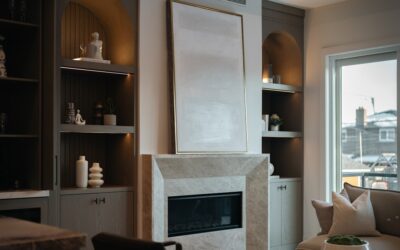
Hanging a mirror above fireplace seems simple until you realize the mantel hides a brick chimney chase and your stud finder is reading nothing but masonry. The placement is one of the highest-impact design moves in any living room, but it comes with real constraints — heat clearance, weight support, sightlines, and reflection angles all matter. Get them right and the mirror brightens the entire space.
Why a Mirror Works Above a Fireplace
The fireplace is already the architectural focal point. A mirror amplifies that focal point by reflecting whatever sits opposite it — usually a window, a chandelier, or another piece of art. Reflected light bounces twice as far as direct light, which is why mirrors over fireplaces make rooms feel larger and brighter.
The alternative — artwork — works too, but artwork doesn’t multiply light. In rooms with limited natural light or dark walls, a mirror is the better functional choice.
Correct Sizing
The single most common mistake is hanging a mirror that’s too small. A good rule: the mirror should span 60-75% of the mantel width. Anything smaller looks lost and underscaled.
- 5-foot mantel — mirror 36-45 inches wide
- 6-foot mantel — mirror 44-54 inches wide
- 7-foot mantel — mirror 52-63 inches wide
- 8-foot mantel — mirror 58-72 inches wide
Height varies based on ceiling. The mirror’s top edge should land 6-12 inches below the ceiling, leaving visual breathing room. Tall ceilings can support 30-40 inch tall mirrors; standard 8-foot ceilings work better with 24-32 inch heights.
Heat Clearance Matters
Before you hang anything, check the manufacturer’s clearance specs for your fireplace. Most modern gas fireplaces require 12-18 inches of clearance from the firebox opening to any combustible material — and that includes the wood backing on a framed mirror.
Wood-burning fireplaces produce more heat. Run a 30-minute test fire and feel the wall surface 6 inches above the mantel. If it’s warm to the touch, you need to either raise the mirror, reduce its weight, or choose a frameless beveled mirror that won’t trap heat against wood.
Antique or aged-glass mirrors are more vulnerable to heat than modern silver-back glass. The silvering can delaminate at sustained temperatures over 130°F.
Style Options to Consider
The mirror frame style sets the room’s tone as much as the mirror itself.
- Gilded ornate frames — traditional, formal. Pair with carved mantels and crown molding.
- Black metal frames — modern, industrial. Ground a contemporary stone fireplace.
- Reclaimed wood frames — farmhouse, rustic. Match shiplap or board-and-batten walls.
- Frameless beveled — minimalist, transitional. Lets the room speak.
- Sunburst or starburst — mid-century, eclectic. Pops against neutral walls.
- Convex (bullseye) — federal, traditional. Reflects entire room in distorted view.
Hanging Hardware That Holds
Most large mirrors weigh 25-80 pounds. The hardware must match.
For drywall over wood studs: French cleat or two heavy-duty D-rings into studs. A 2×4 stud can hold 100+ pounds in shear if the screw goes through the cleat into solid wood.
For brick or stone surrounds: drill into mortar, never the brick itself. Mortar is softer and won’t crack as easily. Use a 1/4-inch masonry bit and Tapcon screws or sleeve anchors rated for 50+ pounds each. Use two anchors minimum for any mirror over 30 pounds.
For drywall with no stud support: 75-pound rated toggle bolts. Snap toggles (Wing-It Anchors, $8 for a 4-pack) hold up to 75 pounds in 1/2-inch drywall and don’t damage the wall on removal.
Hanging Height Rules
The bottom edge of the mirror should sit 4-8 inches above the mantel surface. Closer than 4 inches looks crowded; farther than 8 inches looks disconnected.
Eye-level matters too. The mirror’s center should land between 57 and 65 inches from the floor for a typical room. Sitting in your sofa, you should see your face reflected — not just the ceiling.
Tilt the top forward slightly with felt bumpers or wedge spacers if your mirror reflects too much ceiling. A 5-degree forward tilt redirects the reflection downward toward seating areas.
Common Design Mistakes
Mirrors that reflect a blank wall waste their potential. Always check what sits opposite the fireplace before installing. If it’s a blank corner, position art or a chandelier across from the fireplace first, then hang the mirror.
Frame fighting with the mantel is another error. A heavily carved gold mirror over a similarly carved wood mantel creates visual chaos. Pick which element wears the detail.
Overscaling is rare but possible. A mirror as wide as the mantel itself looks like a window into another room and dwarfs everything else. Stay within that 60-75% width rule.
Cost Range
Decent decorative mirrors run $80-$500 depending on size and frame quality. Standout options:
- Wayfair’s Kelly Clarkson Home line — $150-$350 for 36-inch round mirrors
- Pottery Barn Eagan beveled mirror — $400-$700 for large rectangular
- HomeGoods finds — $80-$200 if you’re patient with inventory rotation
- Etsy custom reclaimed wood — $250-$600 for hand-built large mirrors
- Restoration Hardware oversized — $1,200-$3,500 for statement pieces
Hanging hardware adds $15-$50. Professional installation runs $75-$150 if you’re nervous about masonry drilling.
Hanging the Mirror Yourself
- Measure mantel width and mark center point with painter’s tape.
- Hold mirror in place (have a helper) and adjust height until it looks right.
- Mark hardware locations on the wall.
- Drill pilot holes — 3/16-inch bit for drywall, 1/4-inch masonry bit for brick or stone.
- Install anchors or screws into studs.
- Hang mirror, level, adjust felt bumpers behind for fine-tuning.
FAQ
How big should a mirror above fireplace be?
The mirror should span 60-75% of the mantel width. A 6-foot mantel pairs well with a 44-54 inch mirror. Going much smaller looks underscaled; much larger overwhelms.
Can heat from the fireplace damage a mirror?
Yes, if clearances are too tight. Sustained surface temperatures above 130°F can delaminate the silvering on modern mirrors and crack vintage silvered glass. Always honor manufacturer clearance specs and test wall temperatures during a fire.
Should the mirror match the fireplace style?
Match the era or aesthetic, but not detail-for-detail. A traditional mantel with a heavily carved gold mirror reads as too much. A traditional mantel with a beveled or simple gilded mirror lets each element shine.
How do I hang a mirror on brick?
Drill into mortar joints, not the brick face, using a 1/4-inch masonry bit. Use Tapcon screws or sleeve anchors rated for the mirror’s weight. Mortar holds anchors well and patches cleanly if you ever remove the hardware.