
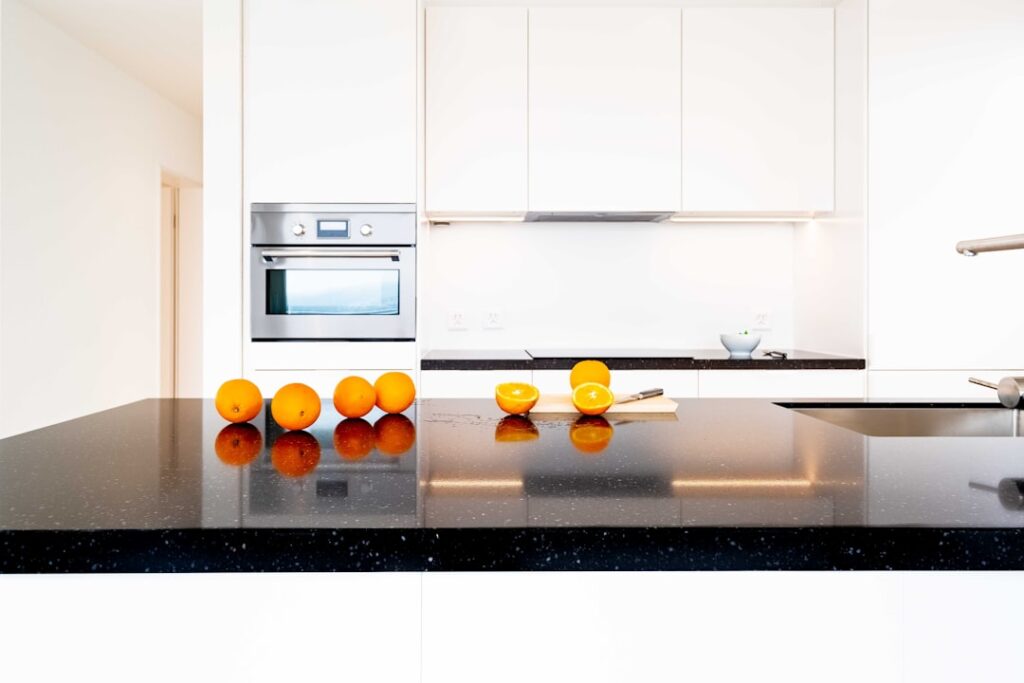
Granite did not go out of style. A specific version of granite did: the busy, polished, ogee-edged speckle of the 2005 builder kitchen. Modern granite countertops look nothing like that, and the difference has almost nothing to do with which color you pick. It comes down to finish, edge geometry, stone movement, and what surrounds the counter. Get those four decisions right and granite competes head-to-head with the quartz and porcelain surfaces dominating design magazines, while beating both on heat resistance and usually on price. This guide walks through exactly how designers are specifying granite in 2026, so you can buy a stone that reads current now and ten years from now.
Part of our Countertops guide — explore the full guide →
The Finish Is the Whole Game
The single fastest way to modernize granite is to kill the shine. High-gloss polish is what ties granite to its mid-2000s reputation, and the two finishes replacing it change the material completely.
Leathered
A leathered finish runs diamond brushes across the slab to create a soft, undulating texture with a low sheen, following the stone’s mineral structure. On dark stone the effect is dramatic: leathered Absolute Black looks like cast iron or soapstone, with a tactile surface that hides fingerprints, water spots, and crumbs far better than polish ever did. Leathering typically adds $10 to $20 per square foot over polished at most fabricators, and not every stone takes it well, so always approve a leathered sample of your actual slab. Fine-grained, dense stones leather beautifully; coarse crystalline stones can come out pitted.
Honed
Honing grinds the surface flat and matte, with no texture. Honed granite reads architectural and calm, closer to concrete or limestone than to traditional granite. It slightly mutes color, so black stone goes charcoal and grays go softer, which is usually exactly the effect you want. The one caveat: honed black shows oily fingerprints until it builds a patina, so ask your fabricator about an enhancing sealer, or wipe with a barely damp microfiber cloth for the first few months. Honing adds roughly $5 to $15 per square foot.
Choose Low-Movement Stone
Modern design favors surfaces that read as a single material, not a pattern. That means skipping the swirling golds and busy multicolor speckles and choosing granites with tight, quiet, consistent grain. Three categories deliver it.
First, the blacks. Absolute Black, quarried mainly in India, is a true uniform black with almost no visible grain, and in a honed or leathered finish it is the most convincingly modern stone in the entire granite family. Expect $55 to $90 per square foot installed depending on finish. Black Pearl offers a similar depth with a silvery mica shimmer for slightly less.
Second, the mid-grays. Steel Grey, another Indian stone, gives a uniform charcoal-gray field with fine texture and takes leathering exceptionally well; it runs $45 to $70 installed and is one of the best values in this whole category. Silver Cloud and Grigio-family stones offer subtle linear movement for kitchens that want a hint of direction without veining.
Third, the consistent whites and gray-whites. Fine salt-and-pepper stones such as Bianco Sardo types or Colonial White read as textured neutrals rather than patterns, and they carry Scandinavian-leaning kitchens well. If you want white with soft gray veining that nods toward marble, White Ice and Alaska White stay on the restrained end of the spectrum. Installed pricing for these runs $40 to $85 per square foot depending on origin and figure.
Edges: Square Is the New Ornate
Edge profile dates a countertop faster than color. The decorative profiles of the granite boom, ogee, dupont, and triple waterfall roundovers, signal traditional instantly. Modern granite uses exactly two ideas: the eased square edge and the mitered thick edge.
An eased edge is a crisp 90-degree profile with just enough of a micro-bevel to keep it from chipping and cutting. It is the default modern spec, it is usually free because fabricators include a standard edge, and it makes even a $45 stone look architect-specified. The mitered edge goes the other direction: the fabricator cuts the slab edge and a matching strip at 45 degrees and glues them into a seamless-looking thick front, turning 3cm material into an apparent 6cm or even 10cm slab face. A chunky mitered edge on an island reads as a monolithic block of stone and is one of the strongest looks in current kitchen design. Budget $30 to $60 per linear foot for mitered fabrication.
The Waterfall Island
Nothing announces a modern kitchen like a waterfall edge, where the countertop turns 90 degrees at the end of an island and runs down to the floor. Granite handles this detail as well as quartz does, with one advantage: a low-movement leathered granite waterfall looks like sculpted stone rather than printed pattern. The technical keys are a tight 45-degree mitered corner joint and grain that runs continuously down the vertical panel, so insist on a fabricator who will dry-fit and show you the corner before install. Each waterfall side adds roughly 15 to 20 square feet of material plus $400 to $900 in fabrication labor, so a double-waterfall island typically adds $1,500 to $3,000 to the project. On a stone like Steel Grey that money buys a centerpiece that would cost half again as much in branded quartz.
Full-Height Backsplashes, Not 4-Inch Strips
The 4-inch granite splash strip is another boom-era tell. Current design either drops the splash entirely in favor of a painted wall and floating shelves, or commits fully with a full-height panel of the countertop stone running from counter to upper cabinets or hood. Full-height granite is quieter than tile, has no grout lines to maintain, and makes the wall behind a range effectively stainproof and heatproof. Material and fabrication for a full-height splash run $40 to $80 per square foot, comparable to installed designer tile, and with a restrained stone the effect is seamless and calm. If you choose a stone with any movement at all, book-matching the splash panel to the counter is worth the upcharge.
Pair It with Matte Everything
Modern granite lives or dies by its supporting cast. Matte black plumbing fixtures and hardware are the natural partners for leathered dark stone, while brushed nickel, brushed brass, and gunmetal all sit comfortably against honed grays. Avoid polished chrome and high-gloss cabinet doors near a matte stone, because the sheen mismatch makes the counter look unfinished rather than intentional. Flat-panel and slab-front cabinets in matte paint, rift-cut white oak, or walnut complete the look; integrated pulls or simple bar pulls beat ornate knobs. Under-cabinet lighting deserves a mention too: raking LED light across a leathered surface highlights the texture beautifully, so spec 2700K to 3000K strips rather than cool blue-white.
What a Modern Granite Kitchen Costs
Here is a realistic budget picture for a 45-square-foot kitchen with an island. Honed or leathered low-movement granite runs $50 to $90 per square foot installed, so the base counters land between $2,250 and $4,050. Add a mitered thick edge on the island ($400 to $900), one waterfall side ($800 to $1,500 with material), and a full-height splash behind the range ($500 to $1,200), and a fully detailed modern granite kitchen totals roughly $4,000 to $7,500. A comparable spec in premium quartz typically quotes 25 to 50 percent higher, and quartz still cannot take a 450°F pan straight off the burner. Maintenance is the familiar granite routine: impregnating sealer at install, an annual water-drop test, pH-neutral cleaner daily, and resealing when water stops beading, which for dense blacks and grays may mean every three to five years rather than annually.
The Takeaway
Treat granite as a design material rather than a commodity and it slots into the most current kitchens being built today. Pick a quiet, consistent stone. Kill the gloss with a honed or leathered finish. Square up the edges or go boldly thick with a miter. Run it down a waterfall or up the wall. Do those things and your counters will not just keep up with the quartz next door; they will outperform it, at a price that leaves room in the budget for the rest of the room.


