
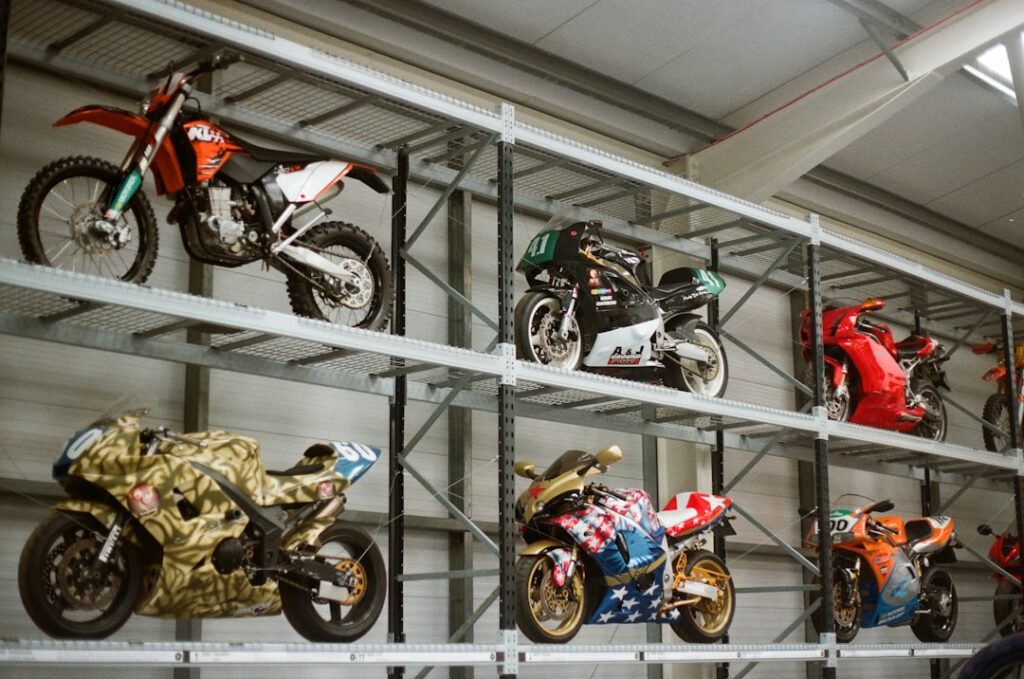
Good motorcycle garage storage is the difference between a bike you ride and a bike you trip over. After years of squeezing two-wheelers into single-car bays, I can tell you the winners all share one trait: they lift the bike off the busy floor and give every accessory a home. Get the layout right and a 400-square-foot garage swallows three bikes, a workbench, and a car with room to walk.
- Start With a Floor Plan, Not a Purchase
- Wheel Chocks: The Cheapest Upgrade
- Wall-Mounted and Vertical Storage
- Motorcycle Lifts and Platforms
- Overhead Storage for Gear and Seasonal Items
- Protecting the Bike and the Floor
- Climate and Moisture Control
- Organizing Tools and Consumables
- Security You Shouldn’t Skip
- Sample Layouts That Work
- Budgeting Your Build
Start With a Floor Plan, Not a Purchase
Before you buy a single bracket, tape out your garage on paper. A typical cruiser needs about 3 feet of width and 8 feet of length; a full dresser like a Road Glide runs closer to 9.5 feet nose to tail. Sport bikes are tighter — 6.5 to 7 feet long. Leave 30 inches between bars so you can walk and mount without knocking a mirror.
Measure your ceiling too. Standard garages sit at 8 feet, but many have 9- or 10-foot ceilings that open the door to overhead and vertical storage you’d otherwise ignore. Note the swing arc of your garage door opener rails — they steal the center bay you might want for a lift.
Wheel Chocks: The Cheapest Upgrade
A front wheel chock is the single best $60 to $150 you’ll spend. It holds the bike upright while you strap it down or just park it, so you stop leaning on the kickstand and eating into aisle space. Bolt-down chocks like the Condor Pit-Stop or a generic self-locking unit anchor with four concrete screws and take 20 minutes to install.
- Removable chocks ($60-$100) sit loose and travel to the trailer — good if you tow.
- Bolt-down chocks ($120-$180) never shift and hold heavier baggers securely.
- Trailer-style ratcheting chocks ($150-$250) grip the tire hands-free so you can strap solo.
Angle two or three chocks toward a shared wall and you can nose bikes in diagonally, fitting more machines across the same wall length.
Wall-Mounted and Vertical Storage
If you have a small dirt bike, dual-sport, or lightweight standard, a wall lift changes everything. Products like the FloorToWall or a hydraulic wall mount let you stand the bike vertically against the wall on its rear wheel, reclaiming the full footprint of the floor. Expect $200 to $400 for a hydraulic-assist wall unit rated to 500 pounds. This works beautifully for a 250 to 450cc bike; it’s not realistic for a 700-pound touring bike.
For gear, run a French cleat system or slatwall across one wall. Slatwall panels cost about $3 to $5 per square foot and accept hooks for helmets, jackets, chains, and tie-downs. Keep helmets on a shelf or dedicated helmet rack, never on a mirror or peg where the liner deforms.
Motorcycle Lifts and Platforms
A scissor or table lift does double duty: it stores the bike and turns any weekend into a service session. A motorcycle jack lift runs $150 to $400 and raises the bike 12 to 16 inches for chain, brake, and oil work. For long-term storage on a soft floor, a wheeled dolly ($80-$200) lets you slide a parked bike sideways into a corner, opening the aisle when you need to move the car.
Air-conditioned garage? A caster dolly under each wheel means one person can reposition a 600-pound bike without the engine running. That flexibility is what makes a two-car garage hold four bikes plus a daily driver.
Overhead Storage for Gear and Seasonal Items
Bikes belong on the floor or the wall; everything else can go up. Overhead racks bolted into ceiling joists hold 250 to 600 pounds and cost $150 to $350 for a 4-by-8-foot platform. Stow winter covers, spare tires, riding gear bins, and track-day leathers overhead so your wall space stays dedicated to daily-access items.
Keep fuel and battery tenders off overhead racks — you want those at working height. A trickle charger like a Battery Tender Junior ($30) plugged into a switched outlet keeps a stored bike’s battery healthy through winter without you climbing a ladder.
Protecting the Bike and the Floor
Concrete sweats. A cold slab pulls moisture up under a cover and rusts chrome and fasteners over a single winter. Park each bike on a rubber mat or a piece of carpet remnant, or better, coat the floor. An epoxy or polyaspartic garage floor ($2.50 to $5.00 per square foot DIY, $5 to $12 installed) seals the concrete, resists oil drips, and wipes clean.
For breathable protection, use an indoor cover with soft flannel lining rather than a plastic tarp that traps condensation. If you’re storing for months, stabilize the fuel, air the tires to spec plus a few pounds, and set the bike on stands to unload the tires and fork seals.
Climate and Moisture Control
Where you live shapes how hard you have to fight moisture. In humid regions, a stored bike wicks condensation onto every unpainted surface, and chrome pits fast. A small dehumidifier running to a drain, or even a few tubs of desiccant, keeps the ambient humidity below the level where rust starts. In cold climates, the freeze-thaw cycle is the enemy — batteries drain, fluids thicken, and seals dry out.
Insulating the garage door and adding weather stripping around it makes a bigger difference than most riders expect. A sealed, moderately conditioned garage lets you actually work on the bike in January instead of just staring at it. If full insulation isn’t in the budget, a fitted breathable cover plus a battery tender covers the essentials for winter layup.
Organizing Tools and Consumables
Storage isn’t just the bikes — it’s the ecosystem around them. Group your gear so a routine chore doesn’t turn into a scavenger hunt. Mount a pegboard or a rolling tool chest within arm’s reach of your lift or work zone. Keep chain lube, cleaner, rags, and tire gauges in a labeled bin, and store oil and filters together so an oil change is a grab-and-go.
- Tool chest or pegboard at the work zone for wrenches, sockets, and Allen keys.
- Fluids shelf for oil, chain lube, brake fluid, and cleaners — off the floor, out of kids’ reach.
- Consumables bin for rags, gloves, zip ties, and shop towels.
- Riding gear zone with hooks for helmets, jackets, and a shelf for boots and gloves.
A tidy tool wall pays off every single time you touch the bike, and it keeps small parts from vanishing into the clutter that plagues most garages.
Security You Shouldn’t Skip
Garage storage is only as good as the lock on the door. A ground anchor bolted into the slab ($40-$120) plus a hardened chain and disc lock ties the bike to the building. Add a motion-triggered light and a cheap Wi-Fi camera pointed at the door. If you keep the roll-up door open while you work, a $15 garage-door defender or C-clamp on the track stops a thief from lifting it from outside.
- Ground anchor + 14mm+ hardened chain: the core deterrent.
- Disc-brake lock with reminder cable: quick daily use.
- Battery disconnect or hidden kill switch: stops a fast rollaway.
Sample Layouts That Work
In a single-car bay (roughly 12 by 20 feet), park two bikes nose-in on bolt-down chocks along the back wall, run slatwall down one side for gear, and hang an overhead rack above the door for seasonal bins. You’ll still have a 4-foot aisle.
In a two-car garage, dedicate one bay to the car and the other to bikes: two chocks against the back wall, one lightweight bike vertical on a wall lift, and a rolling lift table in the corner for service. That’s three bikes and a car in a space most people use for one car and clutter.
Budgeting Your Build
A functional motorcycle garage storage setup doesn’t require a five-figure renovation. A realistic starter build — two bolt-down chocks, a slatwall panel with hooks, a battery tender, and floor mats — lands around $400 to $600. Add a wall lift and epoxy floor and you’re at $1,200 to $2,000, which still transforms the space and protects machines worth far more. Buy the chock and the floor protection first; every other upgrade builds on those two.


