A cramped garage doesn’t have to be a lost cause. The best small garage storage ideas aren’t about buying more furniture — they’re about using the space you already have more intelligently, especially the walls, ceiling, and corners that sit empty in most garages. With the right approach, even a single-car garage can hold your car, your tools, bikes, and seasonal gear without feeling like a maze. Here are the strategies and design ideas that actually work in tight spaces.
Think in Three Dimensions
The core mistake in a small garage is storing everything at floor level, where it competes with the one thing you need floor space for — your car and room to move. The fix is to think vertically and reclaim the volume above and around you. A typical garage has 8 to 10 feet of height and long stretches of bare wall, most of it unused. Getting items up onto walls and ceilings can easily double your effective storage without adding a single square foot of footprint.
The mantra for a small garage: if it can go on a wall or the ceiling, it should. Reserve the floor for the car and a clear working path, and push everything else up. Before you buy a single organizer, spend an afternoon actually clearing the garage out onto the driveway, sorting into keep, donate, and toss piles, and being honest about what you use. Small garages punish clutter, and the cheapest storage solution is owning less stuff. Most people find a third of what’s in the garage can go — and suddenly the space problem is half solved before you’ve drilled a hole.
Maximize the Walls
Your walls are the biggest untapped resource in a small garage, and there are several ways to use them.
- Slatwall or track systems: panels or rails that let you hang adjustable hooks, baskets, and shelves. They flex as your needs change and keep everything visible.
- Pegboard: the classic cheap solution for hand tools — outline each tool so you know where it goes and can spot what’s missing.
- Wall-mounted folding workbench: a bench that folds flat against the wall when not in use, giving you a work surface without a permanent footprint. Perfect for tight garages.
- Magnetic strips: hold screwdrivers, pliers, and metal tools on a narrow strip, using almost no space.
- Vertical bike mounts: hang bikes by the wheel against the wall, taking up a fraction of the space of standing them on the floor.
Anything bearing real weight must anchor into the studs (typically 16 inches on center), not just drywall — that’s non-negotiable for safety.
Use the Ceiling and Overhead Space
The ceiling is prime real estate for anything you don’t need every day. Overhead racks mounted to the joists hold seasonal bins, camping gear, and off-season items well above head height. In a small garage, this is often the single biggest space-saver.
Ceiling-mounted bike and kayak hoists use a simple pulley to lift gear up and out of the way. You can also hang lumber, ladders, and long items flat against the ceiling on sturdy hooks. The one rule: mind the clearance for your garage door as it opens along the ceiling track, and keep loaded racks above your car’s roofline. Even a foot of overhead storage across the garage adds enormous capacity.
Don’t Waste the Corners and Odd Spaces
Small garages are full of awkward gaps that a little creativity turns into storage.
- Corner shelving uses the dead space where two walls meet — great for cleaning supplies and small bins.
- The space above the garage door and along the ceiling near it often sits empty; a shelf or rack there holds light, rarely used items.
- Between and below wall studs in an unfinished garage, the stud bays themselves can hold narrow shelves or hold long tools clipped between studs.
- Behind the door swing and in the strip beside the car are spots for slim rolling carts or narrow cabinets.
Walk your garage and look specifically for these overlooked pockets — they add up fast. Even the space above the garage door tracks, in the ceiling cavity between the door and the front wall, often holds a shelf for light seasonal items. The trick in a small garage is to treat every empty surface and gap as potential storage, then decide what earns a spot there.
Make the Car Bay Work Double Duty
If you park inside, the walls flanking the car and the space in front of the hood are prime. A shallow cabinet or a fold-flat workbench in front of the parked car uses depth you’re not driving into — just mount a tennis ball on a string from the ceiling as a parking guide so you stop at the same spot every time and never crowd it. The narrow strip along the driver and passenger sides suits slim rolling carts you can pull out when the car’s gone and tuck back when it returns.
Go Vertical With Storage Furniture
When you do use floor space, choose pieces that build upward rather than outward. Tall, narrow shelving units use minimal floor area while offering many shelves. A vertical tool tower or a slim rolling tool cart tucks into a gap and stays mobile. Stackable clear bins let you build columns of storage and see what’s inside without unstacking — label them and store the heaviest at the bottom. Mobile, rolling units are especially valuable in a small garage because you can move them aside to work and roll them back.
Smart Bike and Sports Gear Solutions
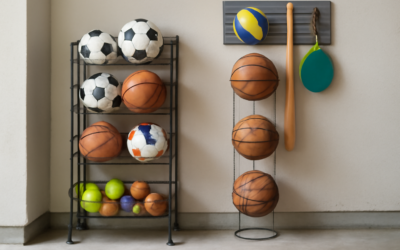
Bikes and sports equipment are bulky space-hogs, but there are compact answers. Hang bikes vertically by the front wheel on a wall hook, or horizontally on wall arms, to clear the floor entirely. A ceiling hoist lifts a bike overhead. For balls, helmets, and gear, a wall-mounted wire basket or a hanging organizer keeps it contained and visible. Long items — hockey sticks, skis, fishing rods — go on horizontal wall clips or in a tall corner bin. The goal is to get every piece of sports gear off the floor and onto a wall or ceiling.
Keep It Organized With Zones and Labels
In a small space, organization matters even more, because clutter has nowhere to hide. Group related items into zones: a garden zone, a tool zone, a sports zone, a seasonal zone. Store frequently used items at eye level and reachable, and push rarely used items up high or into corners. Clear, labeled bins mean you find things fast instead of pulling everything out. A little discipline here keeps a small garage functional instead of collapsing back into a pile.
Start Small and Build
You don’t have to solve everything in one weekend. Pick the biggest pain point — usually the floor clutter blocking the car — and tackle that first with a ceiling rack and some wall hooks. Live with it, see what’s still awkward, and add from there. This incremental approach spreads the cost and lets you learn how you actually use the space before committing to a full system.
Small-garage organizing is as much about habits as hardware. Once things have a home on a wall or hook, the discipline of returning them there is what keeps the space usable — a garage reorganizes itself into chaos the moment items start landing on the floor again. Label bins clearly, keep a small donate box going for things you stop using, and do a quick ten-minute reset every few weeks. The most effective small garage isn’t the one with the most storage products; it’s the one where every item has a defined spot and goes back to it.
With the right small garage storage ideas, a tight garage becomes surprisingly capable: walls covered in accessible tools, gear hoisted overhead, corners working hard, and the floor clear enough to actually park. Think vertically, anchor everything into the framing, use the odd spaces, and organize into zones — do that, and you’ll wonder how you ever managed with everything stacked on the floor.