
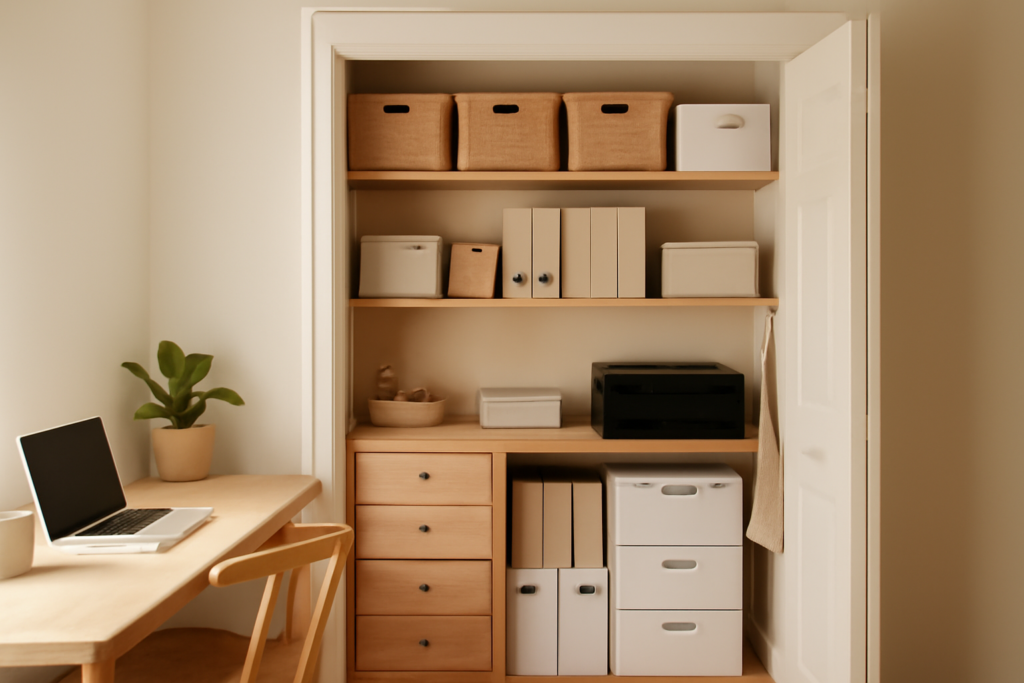
A home-office closet is often the most wasted 12 square feet in the house: a single high shelf, a rod nobody uses, and a floor buried under printer boxes and cables. The best office closet organization ideas reclaim that vertical space and turn a catch-all into a genuine productivity zone, whether you’re storing supplies, filing paperwork, or tucking an entire desk inside. With a weekend and a few hundred dollars, you can convert a dead closet into the hardest-working corner of your workspace. Here’s how to plan it and the ideas worth stealing.
Start by Deciding the Closet’s Job
Before you buy a single bin, decide what the closet needs to do. That single choice drives every other decision. Most office closets fall into one of three roles:
- Supply and storage: paper, ink, shipping materials, and reference books
- Filing and admin: documents, records, and a landing zone for mail
- Cloffice: a full mini workspace with a desk built into the closet
Mixing roles is fine, but rank them. A closet that’s mostly for supplies gets adjustable shelving top to bottom; a cloffice needs a desk surface, task lighting, and an outlet. Knowing the priority keeps you from buying the wrong hardware.
Go Vertical With Adjustable Shelving
The biggest mistake in closet organization is leaving air between shelves. Most closets ship with one shelf at 68 inches and call it done, wasting 5 feet of usable height. Replace it with an adjustable track-and-bracket or wire system and you can stack shelves 10 to 14 inches apart, tripling your storage.
Adjustable systems like the standard-and-bracket rails from any home center let you reconfigure as needs change. Set shelf spacing to match what you store: shallow spacing for reams of paper and binders, taller gaps for a printer or archive boxes. Reserve the highest shelf for things you rarely touch and keep the eye-level zone for daily items.
Contain the Clutter With Bins and Labels
Open shelves look tidy for exactly one week without containers. Bins and boxes group small items and hide visual noise, and labeling turns a guess into a grab. A few rules that work:
- Use matching bins in one or two colors for a calm, unified look.
- Choose clear or labeled fronts so you can find things at a glance.
- Group by category: cables in one, shipping supplies in another, backups in a third.
- Keep a small basket for the miscellaneous items that always accumulate.
Fabric bins soften the look and hide cords well; clear plastic bins win when you need to see contents fast. Either way, a label maker is the cheapest organization tool you’ll ever buy and the one that keeps the system from collapsing.
Solve the Filing Problem
Paperwork is the clutter that never quite goes away, so give it a permanent home. A closet is the perfect discreet spot for a two-drawer file cabinet or a set of hanging file boxes on a lower shelf. Keep active files in front and archived records in labeled banker’s boxes up high.
For a paperless-leaning office, a single hanging file folder for the documents you truly must keep on paper, deeds, warranties, tax records, is often enough. The goal is one predictable place so paper never migrates back to the desk.
Turn It Into a Cloffice
If your closet is deep enough, roughly 24 inches, and you can spare it, the cloffice is the ultimate use. Remove the door or swap it for a curtain or barn door, run a desktop across the width at 29 to 30 inches high, and you’ve got a workspace that disappears when you’re done.
A few details make a cloffice actually usable:
- A wall-mounted or bracket-supported desk surface to keep legroom clear
- Task lighting, since closets have no natural light, an LED strip or small lamp
- Power access, ideally an outlet inside or a cord run to a nearby one
- A shelf or pegboard above the desk for supplies within arm’s reach
The magic of a cloffice is that you can close it off at the end of the day, which does more for work-life separation in a small home than any productivity app.
Manage the Cables
Nothing undoes a clean closet like a nest of cords. Whether you’re storing electronics or building a cloffice, plan the cables from the start. Mount a power strip to the closet wall rather than leaving it on the floor, run cords through adhesive clips or a cable channel, and coil excess length with reusable ties.
Label both ends of every cable while you can still trace them. A charging drawer with a single power strip inside keeps phones, batteries, and gadgets topped up and out of sight, one of the small touches that makes a closet feel genuinely finished.
Making the Most of the Door and Walls
The back of the closet door and the side walls are storage most people forget entirely. An over-the-door organizer with clear pockets holds pens, sticky notes, chargers, and small supplies in plain sight, turning wasted door space into a visible inventory. For heavier items, a slim over-door rack with hooks handles bags, headphones, and cords.
The side walls take pegboard or slat wall beautifully. A pegboard panel lets you hang scissors, tape dispensers, cable coils, and clipboards, and rearrange them in seconds as your needs shift. Magnetic strips hold metal tools and small tins of paperclips. Even a couple of adhesive hooks on the wall beside the shelves give a home to the items that otherwise migrate to the desk. The principle is simple: in a small closet, every flat and vertical surface is potential storage, so use the door and walls, not just the shelves.
Organizing Supplies So You Actually Find Them
A closet can be beautifully built and still fail if you can’t locate anything. The fix is a logical system tied to how often you reach for things. Work from these habits:
- Put daily-use items, printer paper, current projects, at eye to waist level where they’re easiest to grab.
- Store backups and bulk supplies, extra ink, reams of paper, up high since you restock them rarely.
- Keep a single labeled bin for each category so like items live together and don’t scatter.
- Reserve one accessible drawer or basket for the miscellaneous small stuff, and clean it out monthly.
Label everything, and label it on the front where you’ll read it. A closet that’s organized but unlabeled slowly drifts back to chaos as household members guess where things go. With clear labels, the system enforces itself, and restocking becomes obvious because empty spots announce what you’re out of. This is the difference between a closet that stays tidy for years and one that looks great for a week.
Add the Finishing Touches
Once the function is solved, spend a little on the look. A coat of paint in a fun accent color makes opening the closet a small pleasure and costs under $30. Peel-and-stick wallpaper on the back wall does the same for renters. Under-shelf lighting removes the cave effect, and a small pegboard turns wall space into flexible hanging storage for scissors, tape, and headphones.
Budget shapes how far you take all of this, and the good news is that a dramatic improvement doesn’t require a custom system. A basic transformation using adjustable wire or laminate shelving, a set of matching bins, and a label maker runs well under $150 and delivers most of the benefit. Stepping up to a modular kit with drawers and a desk surface pushes the total to $300 to $600, and a fully custom closet build runs into the low thousands. For most home offices, the mid-tier modular route hits the sweet spot, giving you a built-in look and real flexibility without the custom price tag.
An office closet is one of those projects where a modest investment pays off every single day. Decide the job first, build up with adjustable shelving, contain everything in labeled bins, and give paperwork and cables a permanent home. Whether you end up with a tidy supply cabinet or a fold-away cloffice, you’ll reclaim square footage you forgot you had and make the whole office run smoother.


