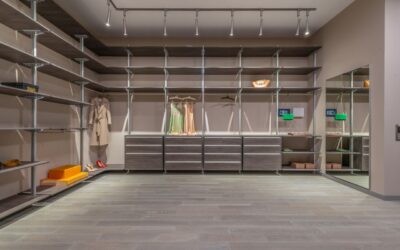
Stripping the doors off a closet sounds like a $50 weekend project, but the open closet concept done well requires real design thinking — wardrobe curation, lighting, ventilation, and hardware that earns its place in a room you actually see. Below I cover the configurations that work, the ones that don’t, real installed costs from IKEA hacks to full California Closets builds, and the practical considerations most Pinterest boards skip past.
Why Open Closets Took Off
The trend traces back to European urban apartments where bedrooms are too small for proper closets and walk-ins are unaffordable. Designers in Stockholm and Berlin began treating clothing displays as room features rather than hiding them, and the look migrated through hotel suites and boutique Airbnbs into American mid-century renovations. By 2025 the open closet concept appeared in roughly 18 percent of new high-end primary bedroom remodels surveyed by Houzz.
The appeal is partly practical. Open systems force wardrobe discipline — you literally cannot stuff a closet door shut on clutter when there is no door. The visual organization functions as both storage and decor, and the lack of doors saves 12 to 18 inches of floor swing space in front of the closet, which matters in small bedrooms.
Three Layouts That Actually Work
The configuration determines whether the open closet looks intentional or chaotic. Three formats that consistently photograph well and function for daily use:
- Single wall mounted rail with floating shelves — minimalist, best for capsule wardrobes under 60 garments. Pair with a single accent piece like a leather valet stand or a Eames rocking chair
- Walk-through dressing area between bedroom and bath — converts a deep closet or hallway into a passage with hanging on both sides and a window or skylight at the end
- Bedroom corner wardrobe wall — uses a 6 to 10 foot wall as a designed wardrobe with multiple zones — long hang, double hang, shelving, drawers — all visible
What does not work: trying to use an open closet for a household where someone owns 200-plus garments without rigorous discipline. The visual chaos of overstuffed open storage is worse than any closed door situation, and you end up either curating monthly or living with the mess.
IKEA PAX vs Custom: The Cost Reality
The market splits cleanly into three tiers:
- IKEA PAX system — $300 to $1,200 depending on width and accessories. The frame, doors (or no doors), and KOMPLEMENT interior fittings are all modular. Best value in the market when assembled carefully
- Wholesaler kits (Modular Closets, EasyClosets, ClosetMaid SuiteSymphony) — $800 to $2,500. Pre-cut panels, more finish options than IKEA, slightly more substantial
- Custom from California Closets, Inspired Closets, or local cabinetmakers — $3,500 to $15,000+ for a single-room build. Material is usually melamine or thermofoil over particleboard; the upcharge is for design, install, and edge-banding quality
For most open closet projects, the IKEA PAX system at $600 to $900 delivers 85 percent of the look of a $5,000 custom install. The trick is choosing the right combination: PAX frames in white or matte black, KOMPLEMENT mesh drawers, KOMPLEMENT pull-out trays for accessories, and the SKADIS pegboard panels for bags and belts. Add proper hardwood drawer pulls ($12 to $24 each from Schoolhouse Electric or Rejuvenation) to lose the budget-furniture vibe entirely.
Lighting Is the Make-or-Break Detail
An open closet is essentially a piece of furniture on display, and like any showcase it needs lighting. Three lighting moves transform the space:
- LED strip lighting under each shelf — Philips Hue Lightstrip Plus ($85) or budget LED tape from Govee ($35) cut to fit. Place strips at the front of each shelf to wash the hanging garments below with even light
- Motion-activated puck lights — Mr. Beams MB853 ($28 for three) install with peel-and-stick adhesive and trigger when you open the closet area
- Picture light or sconce above the unit — turns the wardrobe into a feature wall with intentional gallery-style lighting. Schoolhouse Electric Hodge ($389) is the design-magazine pick
The lighting upgrade matters most in walk-through dressing areas where natural light may be limited. A daylight 5000K color temperature is the right call for accurate color matching when getting dressed — warmer 2700K lighting makes everything look more flattering but you may walk out the door with mismatched outfits.
What to Show and What to Hide
The hardest part of open closet design is editing what is on display. Items that work visually in an open system: structured outerwear, shoes (in proper cubbies, not jumbled), handbags hung on hooks, and any folded item that can be stacked neatly. Items that almost always look messy: underwear and socks, gym clothes, seasonal jackets crammed in, and any item that wrinkles when folded.
The professional solution is a mix of open and closed storage within the same system. IKEA PAX accomplishes this with mesh drawer fronts ($45 each) or solid drawer fronts in the lower portion of each frame, with open hanging and shelving above. California Closets and similar custom builders use the same approach with hamper-style pull-outs for laundry and full-extension drawers for socks and underwear, all hidden below 36 inches and topped with the visible open zones.
Hardware and Hangers That Earn Their Place
If garments are on display, the hangers are visible too. Three categories of hangers, ranked by visual impact:
- Matching wooden hangers — Container Store Cedar Hangers ($20 for 6) or Bumerang from IKEA ($10 for 8). Uniform color, weight, and shape
- Velvet thin-profile (Joy Mangano Huggable) — slim, save 30 percent space, $0.70 each in 100-packs. Available in matte black, charcoal, or ivory
- Acrylic clear hangers — visually disappear, $30 to $40 per 20-pack. Best for ultra-minimalist looks where you want the garments to read as floating
Mix-and-match hangers — wire from the dry cleaner, plastic tube hangers from Walmart, two-tone velvet from a different supplier — is the single biggest visual quality killer in open closet installs. Commit to one type and replace everything in a single shopping trip.
Climate, Dust, and the Real Drawbacks
Open closets accumulate household dust roughly 4x faster than closed closets. In dusty environments — homes with pets, fireplaces, or near construction — this becomes a real maintenance issue. Plan to dust the entire system weekly with a microfiber duster, vacuum any open shelving monthly with a brush attachment, and wash exposed garments more frequently than you would items hidden behind a door.
Humidity matters too. Open closets in bathrooms or bedrooms without proper HVAC airflow can develop mildew on garments stored against an exterior wall in winter. Run a dehumidifier (the Frigidaire FFAD3533W1 at $279 is the value pick) to keep relative humidity below 55 percent if any portion of the open closet is on an exterior wall. Some homeowners add a ductless mini-split head specifically into a walk-in dressing area for both temperature and humidity control — a $2,500 to $4,500 install that pays for itself in preserved wool, leather, and silk garments over a decade.