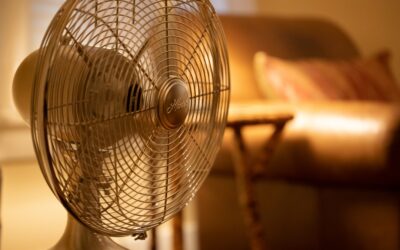
A standard ceiling fan pushes air straight down in a fixed column, which leaves the corners of a room stagnant and does little for oddly shaped spaces. An oscillating ceiling fan solves that by sweeping air across a wider area, moving the breeze the way a floor-standing oscillating fan does but from overhead. For sunrooms, patios, long rooms, and spaces where a single downdraft isn’t enough, this style delivers noticeably better air circulation. Here’s how they work and how to pick the right one.
How Oscillating Ceiling Fans Work
Instead of blades that only spin around a fixed vertical axis, oscillating models add movement that directs airflow across the room rather than straight down. Two main designs achieve this. Directional fans have a head that tilts and rotates on an adjustable mount, letting you aim the airflow. Dual-motor fans, sometimes called Gulf Coast or belt-driven fans, use two fan heads on a horizontal bar that can rotate, throwing air along the length of a room.
Types of Oscillating Fans
- Directional single-head: one tiltable, rotating head, good for aiming air at a specific area like a seating zone
- Dual-motor bar fans: two heads on a rod that oscillates, ideal for long rooms, porches, and sunrooms
- Rotational cage fans: industrial-style heads that turn side to side, common in workshops and garages
Dual-motor fans are the classic choice for covered porches and great rooms because their sweeping motion covers far more square footage than a single downdraft fan of the same size.
Where They Work Best
Oscillating fans shine in spaces a traditional fan struggles to serve. Long, narrow rooms benefit because the sweeping airflow reaches both ends. Sunrooms and enclosed porches, often warmer than the rest of the house, get more even cooling. Outdoor covered patios stay comfortable as the moving air discourages mosquitoes and spreads the breeze across a seating area. In a bedroom, a directional model lets you aim air at the bed without blasting the whole room.
Sizing and Coverage
Match the fan’s span to the room, just as you would a standard fan. Blade or bar span is measured tip to tip.
- Up to 75 sq ft: 29-36 inch span
- 75-175 sq ft: 42-48 inch span
- 175-350 sq ft: 52-56 inch span, or a dual-motor bar fan
- Large or long rooms over 350 sq ft: dual-motor bar fan or two fans
Because oscillating models spread air rather than concentrate it, a dual-head fan can cover a long room that would otherwise need two standard fans.
Indoor vs. Outdoor Ratings
If the fan goes on a porch, patio, or anywhere exposed to moisture, buy one rated for the conditions. Damp-rated fans handle humidity and covered outdoor spots, while wet-rated fans withstand direct rain and open exposure. Installing an indoor-only fan outside voids the warranty and risks motor failure and rust, so check the rating on the box before you buy.
Key Features to Look For
Beyond oscillation, weigh the motor type and controls. A DC motor runs quieter and uses up to 70 percent less energy than an older AC motor, worth the premium for a fan that runs long hours. Remote or wall controls make adjusting the oscillation and speed easy, and some models add a light kit. Look for a reversible function so you can run it clockwise in winter to push warm air down from the ceiling.
Installation Considerations
Oscillating and especially dual-motor fans weigh more and create more dynamic movement than a standard fan, so mounting matters.
- Confirm the ceiling box is a fan-rated support box, not a standard fixture box.
- Verify ceiling height, since blades must sit at least 7 feet above the floor and ideally 8 to 9 feet for good circulation.
- Ensure adequate clearance from walls so the head can rotate or oscillate without hitting anything, typically 18 inches or more from each side.
- Follow the manufacturer’s balancing instructions, as an unbalanced oscillating head wobbles more than a fixed fan.
For dual-motor bar fans, mount along the length of the room so the sweep runs the long dimension for maximum coverage.
Airflow Efficiency and CFM
When comparing models, look at the airflow rating measured in cubic feet per minute, or CFM, and the airflow efficiency, CFM per watt. A higher CFM moves more air, while better efficiency means it does so using less electricity. Because oscillating and dual-motor fans spread air over a larger area, they can feel effective at lower speeds, which saves energy. For a large porch or great room, prioritize a model with a strong CFM rating so the sweeping breeze actually reaches the far corners rather than fading out halfway across the room.
Maintenance and Balancing
Oscillating heads have more moving parts than a fixed fan, so a little upkeep keeps them quiet. Dust the blades and housing regularly, since built-up grime on one blade throws off the balance and causes wobble. If a head starts to wobble, use a balancing kit, small clip-on weights, to correct it, and check that all mounting screws stay snug, because the oscillating motion loosens hardware faster than a static fan. On dual-motor fans, verify the oscillation mechanism moves freely and lubricate it per the manufacturer’s guidance if it starts to bind. A well-maintained oscillating fan runs smoothly for years.
Cost and Value
Basic oscillating and directional ceiling fans start around $80 to $150, while quality dual-motor bar fans with DC motors and remotes run $250 to $600. The higher cost buys broader air circulation than a standard fan can provide, which pays off in comfort for large, long, or outdoor spaces. If your room has dead corners, an awkward shape, or a covered patio that needs a real breeze, an oscillating ceiling fan moves air where a fixed downdraft simply can’t reach. Match the span and rating to your space, mount it securely, and you’ll feel the difference across the whole room.