The fixtures flanking your front door do more work than almost any other lighting in your home. Good outdoor wall sconce lighting shapes your curb appeal, lights the way safely to your entry, and deters intruders who prefer to work in the dark. Get the size, placement, and rating right, and a pair of sconces can make a house look finished and welcoming; get them wrong, and they look undersized, cast harsh glare, or fail after one wet winter.
Part of our Windows & Doors guide — explore the full guide →
Choosing outdoor sconces involves more than picking a style you like. You need to match the scale to your entry, respect wet and damp location ratings, and think about the light quality and control. This guide walks through everything that goes into selecting and installing the right fixtures.
Why Outdoor Sconces Matter
Wall sconces serve three jobs at once, and the best fixtures balance all three. First is aesthetics: mounted at eye level beside doors and garage bays, they are a highly visible part of your home’s face and set the architectural tone. Second is safety, lighting steps, thresholds, and walkways so guests and family do not stumble in the dark.
Third is security. A well-lit entry removes the shadows burglars rely on, and studies consistently show that visible exterior lighting discourages break-ins. Because sconces accomplish all three roles from a single fixture, they are the workhorses of exterior lighting, far more impactful than a single overhead porch light doing everything alone.
Getting the Size Right
The most common mistake homeowners make is buying sconces that are too small. On a store shelf a fixture looks fine, but mounted on a big wall beside a tall door it shrinks visually. Use these proportion guidelines as a starting point.
- For a sconce beside a door, the fixture height should be about one-third the height of the door. A standard 80-inch door pairs with a sconce roughly 24 to 28 inches tall.
- When flanking a door with two sconces, they can be a bit smaller, around one-quarter the door height each.
- Mount the center of the fixture about 66 inches above the floor or threshold, near eye level.
- For garage doors, scale up: larger walls need larger fixtures to stay in proportion.
When in doubt, size up. An oversized sconce reads as intentional and grand, while an undersized one always looks like a builder’s afterthought.
Placement and Layout
Where you mount sconces matters as much as their size. At a main entry, a pair on either side of the door gives the most balanced, symmetrical light and eliminates the harsh shadows a single overhead fixture throws on faces. Where a door sits in a corner or space is tight, a single sconce on the handle side works, positioned so it lights the lock and threshold.
For garage doors, center a fixture between double doors or place one beside each single bay. Along a long wall or a path, space sconces evenly, roughly every 8 to 10 feet, so pools of light overlap without dark gaps. Keep fixtures clear of where doors swing and where they might get bumped by people carrying groceries.
Understanding Wet and Damp Ratings
This is the spec people ignore at their peril. Outdoor fixtures carry a UL rating for moisture exposure, and matching it to the location is essential for safety and longevity.
- Wet-rated: built to handle direct rain, snow, and sprinkler spray. Use these anywhere fully exposed to the weather, like an uncovered wall or beside an open patio.
- Damp-rated: designed for covered but humid or splash-adjacent spots, such as under a deep porch roof or a covered entry where rain does not hit them directly.
Installing a damp-rated fixture in a fully exposed location invites water intrusion, corrosion, and electrical failure. When unsure, choose wet-rated, since it is safe everywhere outdoors. Look also at the housing material: powder-coated aluminum, brass, copper, and stainless resist corrosion far better than cheap pot metal, especially in coastal salt air.
Bulbs, Brightness, and Color
The light source shapes both the look and the running cost. LED is the clear default now, using a fraction of the energy and lasting 25,000 hours or more, which matters for fixtures that may run dusk to dawn. Aim for a warm color temperature around 2,700K to 3,000K, which flatters most home exteriors and feels inviting; cooler light above 4,000K reads harsh and clinical on a house.
For brightness, entry sconces generally want 400 to 800 lumens each, enough to light faces and the threshold without blinding guests. Look for fixtures with frosted or seeded glass to diffuse the glare, since clear glass over a bright bulb creates hot spots. A high color rendering index makes your home’s brick, siding, and landscaping colors look true rather than washed out.
Controls and Smart Features
How the sconces turn on and off adds real convenience. The simplest upgrade is a dusk-to-dawn photocell, either built into the fixture or added at the bulb, which automatically lights the entry at nightfall and shuts it off at dawn with no thought required. Motion-sensing sconces flip on when someone approaches, saving energy and startling would-be intruders.
Smart sconces or smart bulbs take it further, letting you schedule lighting, adjust brightness, and control everything from your phone or by voice. A common approach is a wall sconce on a smart switch or with a smart bulb, set to a schedule that lights the entry every evening and randomizes while you travel to suggest someone is home. Choose the level of automation that matches how you actually live.
Matching Style to Your Home
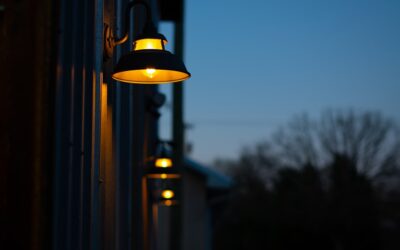
A sconce should feel like it belongs on your house, not like it wandered in from a different one. Start with your home’s architecture and let it guide the style. A craftsman bungalow suits mission-style lanterns with amber or seeded glass and dark bronze frames, while a modern home wants clean rectangular fixtures in matte black or brushed aluminum. Traditional and colonial homes look right with classic coach lanterns, and farmhouse exteriors pair well with gooseneck barn lights.
Consistency across the exterior ties everything together. Use the same fixture family or at least the same finish on the front door, garage, and side entries so the house reads as a coordinated whole. Pull the finish from another exterior element, like the door hardware, house numbers, or window frames, to make the choice feel deliberate. When in doubt, a simple, well-proportioned lantern in a finish that matches your trim rarely looks wrong.
Energy Use and Long-Term Cost
Because outdoor sconces often run from dusk to dawn, their efficiency adds up over the year. Two entry sconces with old 60-watt incandescent bulbs burning ten hours a night draw well over 400 kilowatt-hours annually. Swap in 9-watt LEDs producing the same brightness and that drops to under 70 kilowatt-hours, a savings you notice on every bill while the bulbs last 25,000 hours instead of 1,000.
Adding controls squeezes out more savings. A photocell shuts the lights off automatically at dawn so they never burn in daylight, and motion sensors keep security fixtures dark until someone approaches, cutting runtime dramatically while still providing protection. Over the life of the fixtures, choosing LED sources with smart controls saves far more than the modest price premium, which is why they have become the default for anyone thinking past the initial purchase.
Installation Basics
Replacing an existing sconce is a manageable DIY job for a confident homeowner, since the wiring and box are already there. Turn off the circuit at the breaker and confirm the wires are dead with a voltage tester. Remove the old fixture, connect the new one’s black-to-black, white-to-white, and ground-to-ground with wire nuts, and apply a bead of exterior-rated silicone caulk around the top and sides of the mounting plate to keep water out, leaving the bottom open to drain.
If there is no existing box, running new exterior wiring and cutting into the wall is a bigger job that many homeowners hand to an electrician to meet code. Either way, use a fixture with a proper mounting gasket and weatherproof box. Well-chosen and correctly rated outdoor wall sconce lighting rewards you every single evening with a safer, more secure, and better-looking home, making it one of the most satisfying exterior upgrades you can install.