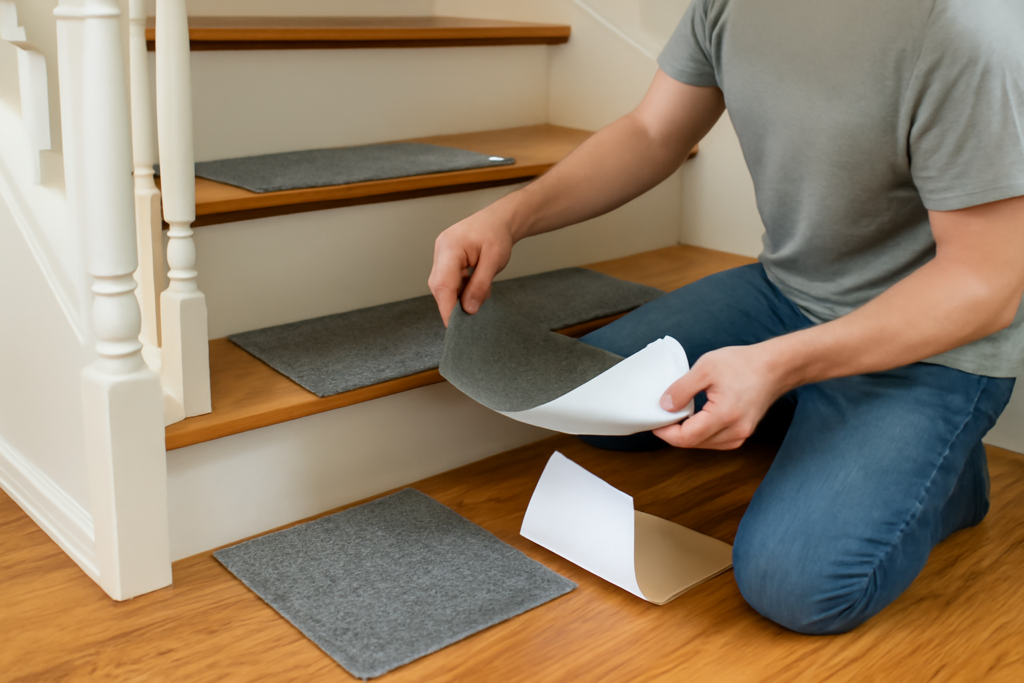
Staircases are the single most dangerous surface in a house, and a bare or slick tread is where most falls start. Peel and stick carpet for stairs promises a fast, tool-light way to add traction and cover worn wood without a professional installer or a truck full of stretching equipment. It genuinely delivers on the speed. Whether it delivers on safety and longevity depends entirely on how you prep the surface and which product you buy. This guide covers fitting the treads and risers, locking down the adhesion, and an honest look at how long these actually last.
Part of our Stairs & Stair Flooring guide — explore the full guide →
How Peel and Stick Stair Carpet Works
These products come as pre-cut carpet tiles or continuous rolls with a factory adhesive backing protected by a release liner. You peel the liner, position the piece, and press it into place. Most are sized for standard treads, roughly 8 to 9 inches deep and 24 to 30 inches wide, with matching bullnose pieces that wrap over the front edge of the step. Because the glue is built in, there is no separate adhesive to trowel and no drying time before the stairs are usable.
The category splits into two rough tiers. Lower-cost versions are essentially heavy-duty tape carpet marketed for quick refreshes. Better ones use a pressure-sensitive adhesive similar to what commercial carpet tiles rely on, which holds far more aggressively and tolerates foot traffic without creeping. The price gap is real, and on a staircase it is the wrong place to save five dollars.
Fitting Treads and Risers
Accurate measuring is the whole game. Measure each step individually rather than assuming they are identical, because older homes routinely have treads that vary by half an inch or more from top to bottom.
- Treads are the horizontal surface you step on. Cut the carpet to cover the full depth and wrap it snugly over the front bullnose edge.
- Risers are the vertical faces between steps. Covering them is optional and mostly cosmetic, but a matching riser piece hides scuffs and gives a finished look.
Work from the top of the staircase down so you are never kneeling on freshly stuck pieces. Dry-fit each cut before you peel the liner, then remove the backing gradually as you press from the back of the tread forward, smoothing out air as you go. A stiff hand roller or even a wallpaper seam roller forces the adhesive into full contact, which is where a lot of DIY jobs quietly fail. Around the nosing, press the carpet firmly into the crease so it does not tent up under a heel.
Making the Adhesion Safe and Slip-Free
Traction on a staircase is not negotiable, and a carpet piece that is only half stuck is more dangerous than bare wood because it slides underfoot. Two things determine whether the bond holds: the surface and the pressure.
Clean the stairs to bare, dust-free wood or paint. Vacuum first, then wipe each tread with a degreaser or denatured alcohol and let it dry completely. Peel and stick adhesive will not grab through a film of dust, floor polish, or old wax, and that film is the number one reason pieces lift at the corners. If the treads are sealed with a glossy polyurethane, scuff them lightly with fine sandpaper to give the glue something to key into.
After placement, roll every piece hard and then leave the staircase unused for the cure time the manufacturer lists, often several hours. Check the front edges of each tread weekly for the first month. A corner starting to curl is an early warning; press it back down or add a dab of carpet adhesive before it becomes a trip point. For extra security on high-traffic stairs, some installers add double-sided carpet tape along the leading edge in addition to the factory backing.
Honest Look at Durability
Here is the part the packaging photos skip. Peel and stick carpet for stairs is a mid-term solution, not a decade-long one. On a busy staircase in a household with kids or pets, expect the leading edges to show wear and the adhesive to weaken somewhere in the two to four year range. Budget tape-backed versions can start lifting in months if the prep was rushed. The better pressure-sensitive products hold longer but still cannot match a professionally stretched and stapled runner.
Heat and humidity also matter. In a sunroom stairwell or an un-air-conditioned space, adhesives soften and creep faster. If your stairs see direct afternoon sun, factor that into your expectations. None of this makes the product a bad choice; it makes it a good choice for the right reasons, which is a quick, reversible, tenant-friendly upgrade rather than a permanent installation.
Pros and Cons at a Glance
- Pro: Installs in an afternoon with no stretcher, staples, or tack strips
- Pro: Adds real traction to slick wooden treads
- Pro: Removable, which makes it ideal for rentals
- Con: Adhesive weakens over time, especially on the front nosing
- Con: Shorter lifespan than a sewn or stapled runner
- Con: Unforgiving of poor surface prep
Choosing a Quality Product
Not all peel and stick stair carpet is created equal, and the label rarely spells out the difference. A few things separate the products worth buying from the ones that will disappoint you within a season.
- Adhesive type: Look for a pressure-sensitive backing rather than a basic tape strip. The former grabs harder and resists creeping under repeated footfall.
- Pile height: A low, dense pile wears better on stairs and hides crushing from constant traffic. Deep, plush piles mat down fast on the leading edge.
- Backing thickness: A slightly cushioned backing feels better underfoot and grips the tread more fully than a thin, papery one.
- Bullnose pieces: Products that include or offer matching wrap-over nosing pieces give a cleaner, safer front edge than trying to fold a flat piece over the step.
Read reviews with an eye for how the product held up after six months, not how easy it was to install on day one. Installation ease is universal; long-term adhesion is where the cheap options fall apart. Spending a little more per tread on a reputable brand is almost always cheaper than redoing the whole staircase when the bargain version starts peeling.
Maintenance and Cleaning
Once installed, treat these like any low-pile carpet with one extra rule: never soak them. Vacuum regularly with a handheld or upright to keep grit from grinding into the fibers, since abrasive dirt wears the pile far faster than feet alone. For spills, blot rather than scrub, and use minimal moisture. Flooding a piece with cleaner or a carpet shampooer can seep under the edges and dissolve the adhesive from below, which is the fastest way to lift an otherwise solid installation. A damp cloth and a spot cleaner handle most messes without threatening the bond underneath.
Is It the Right Choice for Your Stairs?
Reach for peel and stick carpet for stairs when you want a fast safety upgrade, you are renting, or you plan to redo the staircase properly within a few years and just need to bridge the gap. Skip it if you want a permanent, heavy-traffic finish, in which case a bound runner over a good pad is the more durable investment. The trick with this product is honesty about what it is: an affordable, DIY-friendly improvement that rewards careful prep and rewards nothing about a rushed job. Prep the treads right, roll every piece hard, and watch the edges, and you will get safe, comfortable stairs for a fraction of the cost of a full installation.