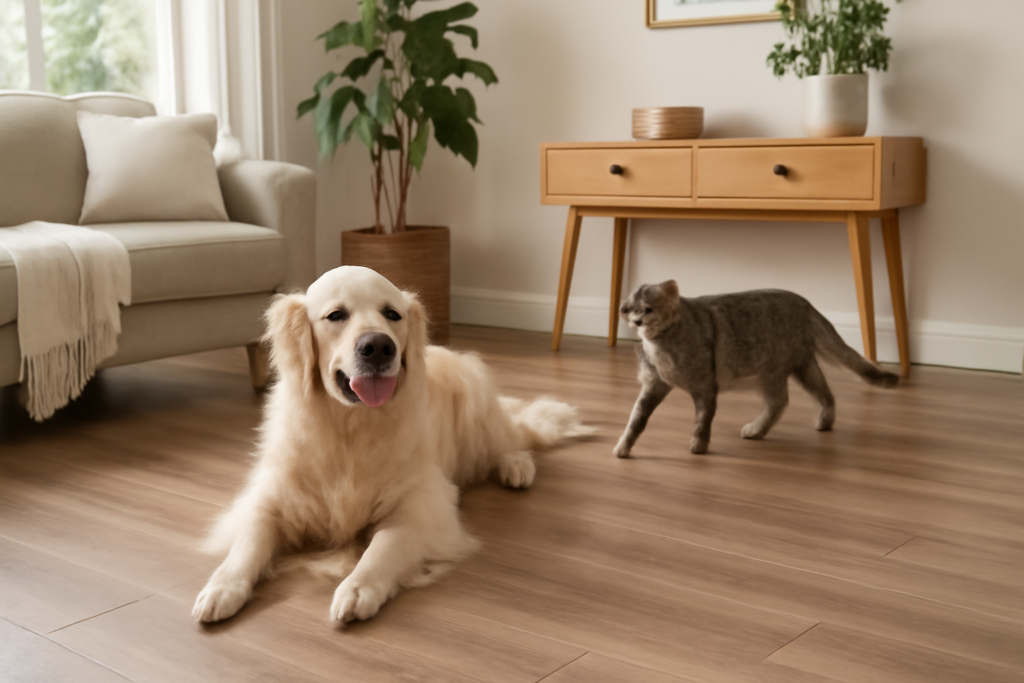
Anyone who has watched a large dog sprint across a wood floor, or cleaned up after a sick cat at 2 a.m., knows that “pet-friendly” flooring is not marketing fluff, it is survival. Pet proof vinyl flooring has become the default recommendation for animal households because it combines a waterproof core with a scratch-resistant surface at a reasonable price. But not all vinyl is equal, and the term “pet-proof” gets stretched. This guide explains which features actually matter when claws, accidents, and shedding are daily realities.
Part of our Roofing guide — explore the full guide →
- Why Vinyl Beats the Alternatives for Pets
- The Wear Layer Is Everything for Scratches
- Waterproof Core Handles the Accidents
- Texture, Finish, and Hiding Wear
- Odor and Stain Control
- Top Features Checklist for Pet Owners
- What It Costs
- Caring for Pet-Proof Vinyl
- Traction: The Overlooked Pet Feature
- Comparing Vinyl to Other Pet Flooring
- Frequently Asked Questions
Why Vinyl Beats the Alternatives for Pets
Hardwood scratches and stains from urine that soaks into the grain. Laminate swells if liquid sits on it. Carpet traps odor, dander, and stains no matter how often you clean it. Vinyl sidesteps all three problems: a good luxury vinyl plank is fully waterproof, its wear layer resists claw marks, and its non-porous surface cannot absorb pet odors the way carpet and wood can. That combination is why so many veterinary clinics and multi-pet homes run vinyl throughout.
Scratch-resistant flooring is half the battle — giving your pet their own space helps too. A sturdy dog crate keeps muddy paws contained, and a cat tree gives your cat somewhere to scratch that isn’t the new floor.
We may earn a commission when you purchase through our links.
The Wear Layer Is Everything for Scratches
The single most important spec for a pet home is the wear layer, the clear protective coating on top of the printed design. It is measured in mils (thousandths of an inch), and thicker is better for claws.
- 6 mil — builder-grade; fine for light foot traffic but too thin for big or active dogs
- 12 mil — a reasonable minimum for a single medium dog or cats
- 20 mil — the sweet spot for multi-pet or large-dog households; noticeably more scratch-resistant
- 28 to 40 mil — commercial-grade, for the toughest situations
Look also for an aluminum-oxide or ceramic-bead enhanced top coat, which many pet-focused lines add for extra abrasion resistance. Keep expectations honest, though: no vinyl is literally scratch-proof. A determined dog and enough grit will eventually show wear. A 20-mil layer simply hides and resists it far longer than a thin one.
Waterproof Core Handles the Accidents
For accidents, sickness, and muddy paws, you want a rigid, 100-percent-waterproof core. Two types dominate. SPC (stone-plastic composite) is denser, harder, more dent-resistant, and more dimensionally stable, which makes it the better pick for pets. WPC (wood-plastic composite) is a bit softer and warmer underfoot but slightly more prone to denting. Both keep liquid from ever reaching the subfloor, so a puppy accident that goes unnoticed for hours wipes up without staining or swelling.
The rigid core also resists denting from a dropped water bowl or a heavy crate, and its dimensional stability means seams stay tight even with big temperature swings by a sunny patio door.
Texture, Finish, and Hiding Wear
A matte finish with an embossed, textured surface hides scratches and dried paw prints far better than a glossy plank, which shows every mark. Textured “embossed-in-register” planks, where the surface texture follows the printed wood grain, also provide better traction so pets are less likely to slip, an underrated benefit for older dogs with hip issues. Mid-tone wood looks with visible grain variation disguise both scratches and shed fur between cleanings better than solid dark or very light colors.
Odor and Stain Control
Because vinyl is non-porous, it does not absorb odor the way carpet does, but the seams and the perimeter expansion gap can let liquid migrate underneath if a large accident is left too long. Some pet lines add antimicrobial treatments to inhibit odor-causing bacteria and mold on the surface. To fully protect against liquid wicking under the floor, you can seal the perimeter and, in bathrooms or laundry rooms, choose a glue-down install instead of a floating one so there is no gap for liquid to travel.
Top Features Checklist for Pet Owners
- A wear layer of at least 12 mil, or 20 mil for large or multiple dogs
- A rigid SPC waterproof core for dent and moisture resistance
- A matte, textured finish to hide scratches and add traction
- An enhanced top coat with aluminum oxide or ceramic beads
- An attached IXPE or cork pad for quiet, comfortable footing
- A solid manufacturer warranty covering pet scratches specifically
What It Costs
Pet-oriented luxury vinyl plank runs roughly $2.50 to $6 per square foot for materials, with 20-mil pet lines landing in the $3.50 to $5.50 range. Professional installation adds $1.50 to $4 per square foot, though the click-lock floating systems make DIY realistic. Brands with strong pet-focused lines include LifeProof, SmartCore Pet, Shaw Floorté with pet warranties, COREtec, and Mohawk. Several offer explicit pet warranties that cover claw scratching, worth reading closely before you buy.
Caring for Pet-Proof Vinyl
Sweep or vacuum frequently, since tracked-in grit is what actually abrades the wear layer over time. Damp-mop with a pH-neutral vinyl cleaner, and wipe accidents promptly even though the floor can handle them. Keep your pet’s nails trimmed, place mats under food and water bowls to catch splashes and dents, and add a walk-off mat at the door pets use to reduce the grit and moisture they carry in. Done consistently, these habits let a good vinyl floor look sharp for 15 to 20 years even in a busy animal household.
Traction: The Overlooked Pet Feature
Owners obsess over scratches and forget the feature their pets care about most: grip. Dogs, especially large breeds and aging animals, struggle on slick floors, and constant slipping stresses their hips and joints and can worsen conditions like arthritis and hip dysplasia. A glossy vinyl plank is the worst offender, sending paws sliding on every quick turn.
The fix is a textured, matte, embossed surface that gives claws and paw pads something to catch. Embossed-in-register planks, where the texture follows the printed grain, offer the best natural traction. For play zones, stairs, and the spots where dogs push off to run, adding low-pile washable area rugs with non-slip backing gives extra confidence, particularly for senior dogs. This single consideration can meaningfully improve an older pet’s mobility and comfort at home.
Comparing Vinyl to Other Pet Flooring
It helps to see where vinyl lands against the alternatives for animal households. Tile is even more durable and fully waterproof, but it is cold, hard, slippery, and unforgiving on joints, and the grout stains from accidents. Laminate looks similar to vinyl but swells if liquid reaches its fiberboard core, making it riskier for accidents. Sealed concrete is bulletproof but cold and hard. Carpet is the worst for pets, trapping odor, dander, and stains permanently. Against all of these, luxury vinyl plank hits the sweet spot: waterproof, warm, quiet, scratch-resistant, and comfortable underfoot, which is exactly why it has become the default recommendation for homes with dogs and cats.
Frequently Asked Questions
Is any vinyl flooring truly scratch-proof from dog claws?
No flooring is fully scratch-proof, but a 20-mil wear layer with an aluminum-oxide top coat resists and hides claw marks dramatically better than thin, glossy vinyl. Trimmed nails and regular sweeping extend that protection.
What wear layer do I need for a large dog?
Choose at least 20 mil for a large or very active dog, or for multiple pets. A 12-mil layer suits cats and smaller, calmer dogs, while 6-mil builder vinyl is too thin for pets.
Does pet urine damage vinyl flooring?
Not the plank itself, since a waterproof vinyl surface is non-porous and wipes clean. The risk is liquid seeping through seams or the expansion gap if left too long, so wipe accidents promptly and consider a glue-down install in high-risk rooms.
SPC or WPC core for pets?
SPC is the better pet choice. Its denser stone-composite core resists dents from dropped bowls and heavy crates and stays more dimensionally stable than the softer WPC core.
Is vinyl slippery for dogs?
A textured, embossed matte plank provides decent traction. Glossy vinyl can be slick, so choose a textured surface, especially for older dogs, and add area rugs in play zones for extra grip.
Pet-proof vinyl flooring is real when you buy on specs, not slogans. Prioritize a thick wear layer and a rigid SPC waterproof core, add a textured matte finish, and you will have a floor that shrugs off claws, accidents, and shedding for the life of your pet and beyond.
Prefer to explore on your own?
See how new flooring looks in your actual room in seconds — free, no signup.
Try the free Floor Studio →