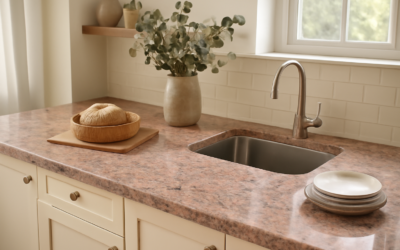
Many shoppers who ask for “pink quartz” actually want a natural stone, and the difference matters. Pink quartzite is a natural metamorphic rock formed when quartz-rich sandstone is heated and compressed over millions of years. Trace minerals such as iron oxides give it blush, peach, salmon or rose tones, often crossed with gray, white or burgundy veins. Engineered quartz, by contrast, is a manufactured slab made of crushed quartz bound with resin and pigment.
Part of our Countertops guide — explore the full guide →
True quartzite is very hard, typically harder than glass and harder than granite on many slabs, which makes it a strong candidate for kitchen countertops. It handles heat better than resin-based quartz and resists etching from acids better than marble. It is still porous, so it needs sealing, and every slab is different, so you choose a specific slab rather than a color code.
- Pink Quartzite Varieties at a Glance
- Pink Quartzite vs Pink Quartz Countertops
- Design Pairings for Blush and Rose Stone
- Thickness and Edge Profiles
- Tools and Materials for Care and Sealing
- How to Seal Pink Quartzite Countertops
- Fabrication and Silica Dust Safety
- Troubleshooting Common Problems
- Cost Ranges and When to Call a Pro
- Frequently Asked Questions
Pink quartzite shows up most in kitchens with white or green cabinets, bathroom vanities, waterfall islands, fireplace surrounds and feature walls. Lighter blush slabs read as warm neutral; strongly veined rose slabs are statement pieces.
Pink Quartzite Varieties at a Glance
Quarries and suppliers use their own trade names, and the same stone may be sold under different names in different regions. It is more reliable to shop by look and then confirm hardness and porosity for the specific slab. The table groups common looks.
| Look | Typical color and pattern | Best uses | Sealing needs |
|---|---|---|---|
| Soft blush | Pale pink base, light gray or white veins | Kitchen counters, vanities, backsplashes | Seal on install, then every 1 to 2 years |
| Peach or salmon | Warm orange-pink with cream bands | Islands, warm-toned kitchens | Seal on install, test yearly |
| Rose with burgundy veins | Medium pink with dark red or brown veining | Feature islands, bar tops, fireplace surrounds | Seal on install; more often if porous |
| Pink and white swirl | Flowing pink and white movement | Waterfall edges, shower walls | Seal on install, then every 1 to 2 years |
| Translucent rose | Crystalline, light passes through thin edges | Backlit bars, accent panels | Seal on install; protect from oils |
| Dusty mauve | Muted pink-gray with subtle veining | Modern kitchens, bathroom vanities | Seal on install, test yearly |
Pink tones in natural stone vary from slab to slab even within one block. If you need two or more slabs for a large kitchen, ask for sequential slabs from the same block and lay them out together before fabrication.
Pink Quartzite vs Pink Quartz Countertops
The names sound alike, but the materials behave differently:
- Origin: quartzite is quarried natural stone; quartz countertops are engineered slabs of about 90 percent ground quartz plus resin and pigment.
- Look: quartzite has natural, unrepeatable veining and depth. Engineered quartz offers consistent color and pattern, helpful when matching seams.
- Heat: quartzite tolerates heat better. Resin in engineered quartz can scorch or discolor under hot pans.
- Maintenance: quartzite needs periodic sealing. Engineered quartz is nonporous and does not.
- UV: quartzite works outdoors. Many engineered quartz products can yellow in direct sun.
If you love the pink look but want zero sealing, engineered quartz fits. If you want natural variation, heat tolerance and outdoor use, choose pink quartzite.
Beware of “soft quartzite”
Some slabs sold as quartzite are really marble or dolomite, which etch from lemon juice and vinegar. Ask the supplier for a sample and test it: a true quartzite scratches glass and resists a steel knife, and a drop of lemon juice left for a few minutes should not leave a dull etch mark. Do the test before you sign for a slab.
Design Pairings for Blush and Rose Stone
Pink stone is easier to design around than many people expect, because most slabs lean blush or peach rather than bright pink. A few pairings work consistently:
- White or cream cabinets. The simplest backdrop. The stone becomes the color in the room, and warm brass or champagne hardware picks up its tones.
- Sage or olive green cabinets. Green and soft pink are natural complements, especially with a rose slab that has gray veining.
- Navy or deep blue islands. A blush slab on a navy base gives contrast without looking loud.
- Light oak or walnut. Natural wood warms peach and salmon varieties and suits a relaxed, organic look.
- Matte black fixtures. Black faucets sharpen a soft pink slab in modern kitchens and baths.
For floors, keep it calm. Light oak, pale porcelain tile or a warm gray stone lets the countertop lead. Busy patterned floors compete with veining. In bathrooms, a blush stone vanity top looks good with white zellige or plain white subway tile and simple brushed metal fixtures.
Thickness and Edge Profiles
Quartzite slabs are commonly sold in 2 cm (about 3/4 in) and 3 cm (about 1 1/4 in) thicknesses. A 3 cm slab is standard for kitchen counters in much of the U.S. because it can span base cabinets without a plywood subtop. A 2 cm slab suits backsplashes, vanity tops and wall cladding, or can be laminated at the edge for a thicker look.
An eased edge, with slightly softened corners, is the most chip-resistant and shows off veining well. A mitered edge, where a strip is joined at 45 degrees, makes a thin slab look thick and is popular on waterfall islands; it requires skilled fabrication to match veining across the joint. Ornate ogee and bullnose profiles cost more and can chip on very hard stone if done poorly.
Tools and Materials for Care and Sealing
- Penetrating granite and quartzite sealer (impregnating type)
- Lint-free microfiber cloths
- pH-neutral stone cleaner
- Small applicator pad or foam brush
- Gloves and good ventilation
- Painter’s tape to protect cabinets and walls
How to Seal Pink Quartzite Countertops
- Run a water test. Drip a little water on several spots. If it darkens the stone within 5 to 10 minutes, it is time to seal. If it beads after 15 to 30 minutes, the existing seal is fine.
- Clean thoroughly. Use a pH-neutral stone cleaner, rinse with clean water and let the surface dry completely, ideally overnight.
- Protect surrounding surfaces. Tape off painted walls or wood cabinet edges that the sealer might touch.
- Apply the sealer. Work in small sections and apply an even coat with a pad or cloth. Keep it wet for the dwell time on the label, often 5 to 15 minutes.
- Wipe off the excess. Buff away all surface residue before it dries; leftover sealer leaves a hazy film.
- Add a second coat if needed. Porous slabs may need two coats. Follow the label for timing.
- Allow cure time. Avoid water and use for the period on the label, commonly 24 to 72 hours for a full cure.
Fabrication and Silica Dust Safety
Quartzite is very high in crystalline silica. Cutting, grinding or polishing it dry releases respirable silica dust, which can cause serious lung disease. Fabrication belongs in a professional shop with wet cutting, water-fed tools and dust controls.
If you must drill a hole for a faucet or trim an edge on site, use wet cutting and drilling methods, wear at least an N95 respirator (a P100 is better for longer work), wear eye protection and keep others out of the area. Clean up with a HEPA vacuum or wet wiping, never by dry sweeping or blowing with compressed air. For larger cuts, hire the fabricator.
Troubleshooting Common Problems
Dark spots after spills
Oil and water can darken unsealed areas. Water marks usually fade as the stone dries. For oil stains, a poultice made with a stone poultice powder can draw the stain out, then reseal.
Dull or etched spots
Etching suggests the slab contains calcite and may be a softer stone. A stone professional can hone and repolish the area.
Hazy film
Sealer left to dry on the surface causes haze. Reapply a small amount of the same sealer to reactivate it, then buff off immediately.
Chipped edge
Sharp square edges chip more easily. A fabricator can fill chips with color-matched epoxy. Eased or rounded edges reduce future chipping.
Cost Ranges and When to Call a Pro
Pink quartzite generally costs more than standard granite and often more than mid-range engineered quartz. Installed prices commonly fall in a broad range, roughly $70 to $200 or more per square foot depending on the slab’s rarity, thickness, edge profile, cutouts and local labor. Translucent and dramatically veined slabs sit at the top of that range. Sealer for DIY maintenance costs relatively little and lasts for several applications.
Leave templating, cutting, seaming and installation to a stone fabricator. Quartzite is heavy and brittle in long spans, overhangs over about 10 to 12 in need support, and seams on veined stone need careful matching. Call a stone restoration pro for deep etching, cracks or stains that a poultice cannot lift.
Frequently Asked Questions
Is pink quartzite natural?
Yes. Quartzite is a natural stone formed from sandstone under heat and pressure. Its pink color comes from trace minerals, not added pigments.
Does a pink quartzite slab need sealing?
Yes. Seal it at installation and test it with water periodically. Many kitchens reseal every 1 to 2 years, depending on porosity and use.
Is pink quartzite good for kitchen countertops?
True quartzite is hard, heat tolerant and resistant to etching, so it works well in kitchens when sealed. Confirm the slab is real quartzite before buying.
Can quartzite be used outdoors?
Generally yes. Natural quartzite handles UV better than resin-based quartz, though outdoor slabs need sealing and protection from freeze damage at edges.
Will the pink color fade?
The color comes from minerals in the stone, so it does not fade like a dye. Surface dirt or sealer haze can dull it, which cleaning resolves.