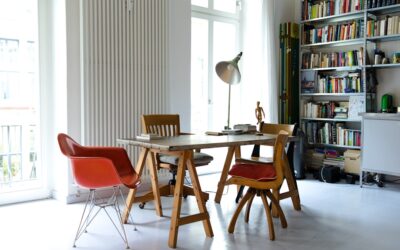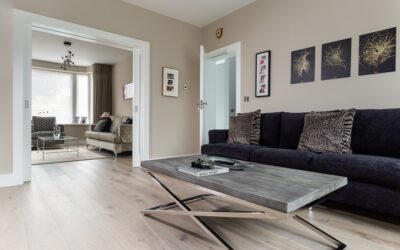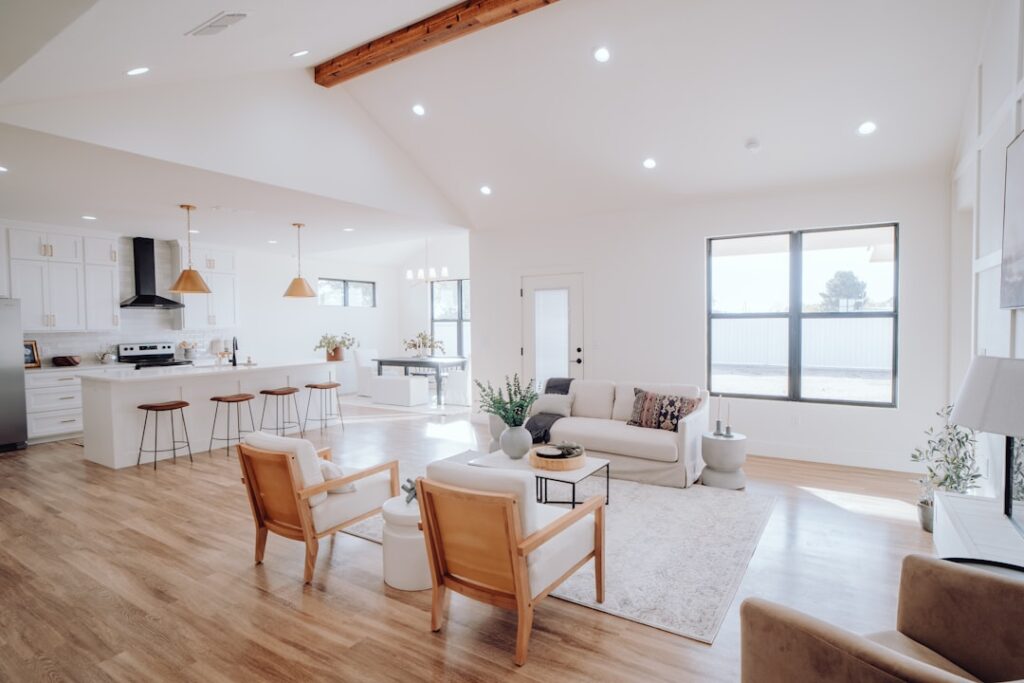
Two homeowners install the same oak plank and end up with floors that look completely different — not because of the wood, but because of how the planks are laid. The choice among plank flooring patterns dramatically affects room appearance, perceived size, installation labor, and material waste. Knowing the difference between straight lay, random offset, herringbone, chevron, and brick patterns helps you specify your project accurately and budget for the right amount of installation labor.
Straight Lay (Parallel Strip)
The most common pattern in American homes. Planks run parallel to one wall, typically the longest wall, with end joints staggered between rows. Simple, efficient, and uses less material than any other layout.
Material waste runs 5 to 8 percent for straight lay. Installation labor is at the low end — most installers charge $2 to $4 per sq ft for residential straight-lay engineered or solid hardwood. DIY is realistic for confident homeowners.
Best for: long narrow rooms (visually elongates), open floor plans, transitional and contemporary designs. Avoid in: nearly-square rooms where a stronger pattern adds visual interest.
Random Offset (Staggered)
A variant of straight lay where the end-joint stagger is randomized rather than uniform. Modern engineered hardwood often ships with mixed plank lengths specifically to encourage random offset installations. The result looks more natural than uniform stagger patterns.
Best practice is to stagger end joints at least 6 to 8 inches apart between adjacent rows, and to avoid any “stair-step” pattern where three consecutive rows show joints in close proximity. A simple system: pull from three or four cartons simultaneously and grab whatever plank length comes out next.
Material waste matches straight lay at 5 to 8 percent. Installation labor is identical.
Herringbone Pattern
Herringbone uses rectangular planks (typically 4″ or 5″ wide) laid at 90-degree angles to form a zigzag pattern. Classic European look that has surged in popularity in modern American renovations.
Material waste runs 15 to 20 percent — significantly higher than straight lay due to the angle cuts at walls. Installation labor doubles, with installers charging $5 to $9 per sq ft for proper herringbone work. The math on layout, dry-lay, and consistent angle alignment requires a wood floor specialist.
Best for: smaller rooms (the pattern adds visual scale), foyers, dining rooms, classic and transitional designs. Use longer planks for grander rooms (5″x24″ blocks) and shorter for tighter spaces (4″x18″).
Chevron Pattern
Chevron looks similar to herringbone at first glance, but the planks are mitered at the ends (typically 45 degrees) to form continuous V-shaped rows. Cleaner and more formal than herringbone.
Material waste is 20 to 25 percent due to the mitered end cuts. Installation labor runs $8 to $14 per sq ft. The miter precision required means even experienced installers slow down significantly on chevron projects.
Best for: formal living rooms, dining rooms, primary suites where the floor is meant to be a design feature. Premium pre-mitered chevron planks from Doma and European brands eliminate field cutting and save labor.
Brick Pattern (1/2 Offset)
Brick pattern stacks planks with end joints offset exactly 50 percent — creating a uniform brick-like grid. Common with tile, less common with hardwood, but increasingly used with wide-format LVP and large-format wood-look porcelain.
Material waste lands around 7 to 10 percent. Installation is straightforward but requires consistent measurement to keep the 50 percent offset visually clean. Variation of more than 1 inch becomes visible across a room.
Best for: large open-plan rooms with wide planks (7″ or wider) where uniform geometry reinforces a modern aesthetic.
Parquet and Geometric Patterns
Beyond herringbone and chevron, plank flooring extends into versailles parquet, basketweave, brick-mat, and custom geometric patterns. Most parquet today ships as pre-assembled panels (12″x12″ to 30″x30″) rather than individual blocks, which simplifies installation.
Material costs jump significantly — parquet panels run $14 to $35 per sq ft for the wood alone. Installation labor matches or exceeds chevron at $8 to $15 per sq ft.
Best for: foyers, libraries, formal dining rooms in traditional or transitional homes.
How to Choose the Right Pattern
Consider four factors when selecting a layout:
- Room shape — long narrow rooms benefit from straight lay parallel to long walls; square rooms benefit from herringbone or diagonal patterns
- Plank width — wider planks (7″+) work better in straight lay; narrower planks (4-5″) work better in herringbone and chevron
- Style — contemporary designs lean toward wide-plank straight lay; traditional and transitional designs accommodate herringbone and chevron well
- Budget — pattern complexity adds 50 to 200 percent to installation labor plus 10 to 20 percent extra material
Visual Tricks Each Pattern Creates
Straight-lay planks running parallel to the longer dimension elongate a room. The same planks running perpendicular shorten and widen it. Herringbone tends to make rooms feel larger by adding visual texture without strong directional lines.
Diagonal patterns (planks at 45 degrees to walls) make rooms feel larger but add 10 to 15 percent material waste. Best reserved for smaller rooms where the visual scale benefit outweighs the cost.
Installation Tips for Pattern Work
For any pattern beyond straight lay, dry-lay the full first row (or first chevron rows) before committing to glue or fastening. Center patterns on the most visible focal point — a fireplace, the main doorway sight line, or the center of the longest wall.
Order 15 to 25 percent extra material for herringbone and chevron projects, versus 8 to 10 percent for straight lay. Save the cutoffs from end-of-row cuts in a labeled bin for use in subsequent rows.
Use a chalk line to establish the centerline for symmetric patterns. Lay out the pattern in pencil on the subfloor before starting installation, especially for chevron and parquet.
Bottom Line
Choosing among plank flooring patterns is one of the biggest design decisions in a wood or vinyl floor project. Straight lay is the budget-friendly default. Herringbone and chevron add significant visual impact at 50 to 200 percent more in labor cost. Match the pattern to the room shape, plank width, and overall design style, and budget for the additional material and labor before committing.
Prefer to explore on your own?
See how new flooring looks in your actual room in seconds — free, no signup.
Try the free Floor Studio →