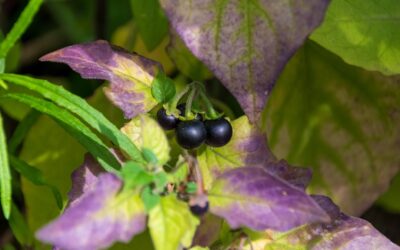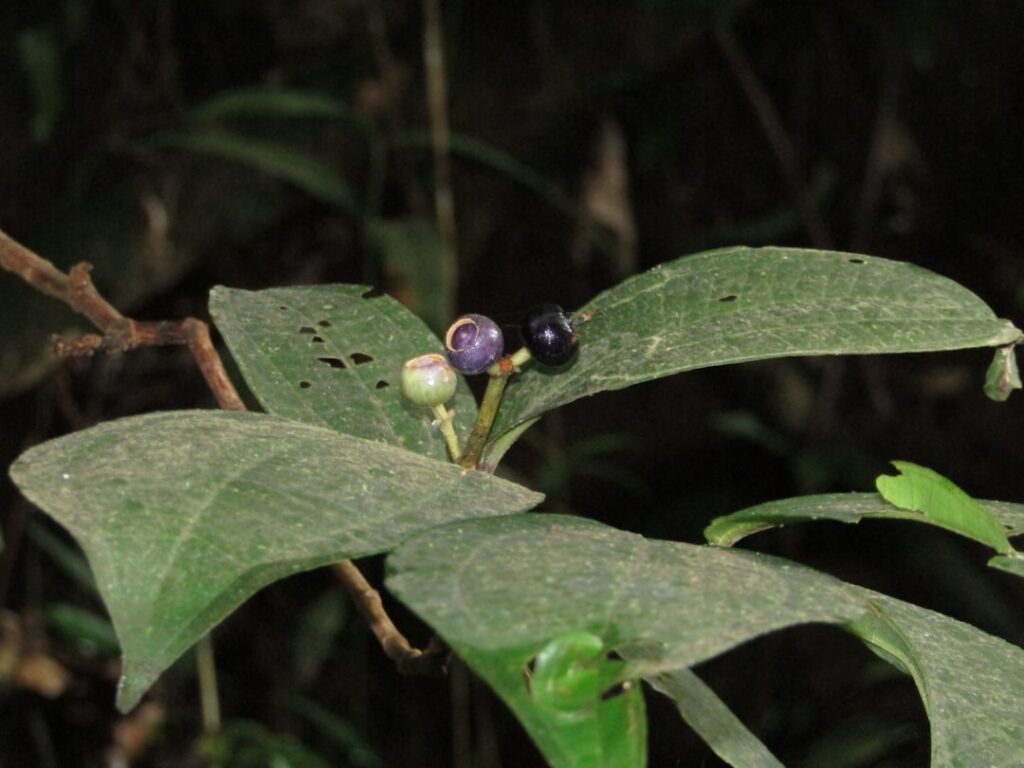
Finding an unfamiliar plant with glossy black berries near a child’s play area or a dog run is exactly the moment when accurate poisonous identification deadly nightshade knowledge matters most. Atropa belladonna, commonly called deadly nightshade, is one of the most toxic plants in the temperate world, and confusing it with a harmless look-alike can have serious consequences in either direction. This guide is strictly for identification and safety, so you can recognize the plant, distinguish it from similar species, and remove it responsibly. It is not a foraging guide, and nothing here should ever be read as encouragement to taste, test, or handle these berries casually.
What Deadly Nightshade Actually Looks Like
Mature Atropa belladonna grows as a bushy perennial roughly 2 to 4 feet tall, occasionally reaching 5 feet in ideal shade and rich soil. The stems are stout, often tinged purple, and branch outward rather than climbing. Overall the plant has a robust, slightly untidy shrub-like form rather than a vine or a low weed, which is one of the first clues that separates it from many impostors.
The leaves are the size that catches your eye first: dull green, ovate, and pointed, growing up to 7 or 8 inches long, and famously arranged in unequal pairs where one leaf is noticeably larger than its neighbor. They have smooth, untoothed edges and a soft texture. When crushed the foliage gives off an unpleasant, slightly sickly smell that most people find off-putting, another built-in warning sign.
Flowers and Berries: The Decisive Features
Flowering runs from about June through early September, and the blossoms are distinctive once you know them. Each flower is bell-shaped, roughly 1 inch long, and colored a muted purple-brown or dull violet, hanging singly from the leaf axils. Nothing about them is showy; the dusky, drooping bells are unlike the bright open stars of many harmless nightshade relatives.
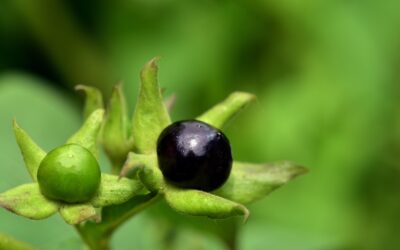
The berries are what earn the plant its reputation. They start green, then ripen to a shiny, jet-black sphere about 0.5 inch across, each sitting in a five-pointed green star (the persistent calyx) at its base. The berries are deceptively glossy and sweet-looking, which is precisely why children are drawn to them. A ripe belladonna berry hangs singly rather than in the dense grape-like clusters of some look-alikes, and that single-berry, star-backed presentation is one of the most reliable field markers.
Telling It Apart from Common Look-Alikes
Several harmless or lesser plants get mistaken for belladonna, and confident identification means ruling them out. Black nightshade (Solanum nigrum) is smaller and weedier, usually under 2 feet, with small white star-shaped flowers and berries carried in clusters, not singly. Bittersweet nightshade (Solanum dulcamara) is a scrambling vine with purple-and-yellow star flowers and egg-shaped red berries, so its color and growth habit are clearly different.
Pokeweed (Phytolacca americana) is a frequent source of panic: it grows tall, has striking magenta-red stems, and carries dark purple berries in long, drooping clusters on those pink stalks. Its clustered berries and vivid stem color separate it from belladonna’s single black berries on green-purple stems. When you cannot confidently match every feature, treat the plant as dangerous and consult a regional extension office or the Poison Control hotline rather than guessing.
Why It Is So Dangerous
Every part of deadly nightshade, including root, leaf, flower, and berry, contains tropane alkaloids, chiefly atropine, scopolamine, and hyoscyamine. These compounds block the parasympathetic nervous system, and even small amounts can be life-threatening. Historical and clinical accounts suggest that as few as two to five berries may be lethal to a child, and roughly ten to twenty to an adult, though sensitivity varies and no amount is safe.
Poisoning symptoms follow a recognizable pattern: dilated pupils, blurred vision, dry mouth, flushed skin, rapid heartbeat, confusion, hallucinations, and in severe cases seizures, respiratory failure, and coma. The old medical mnemonic captures it grimly: “hot as a hare, blind as a bat, dry as a bone, red as a beet, mad as a hatter.” Because effects can escalate quickly, any suspected ingestion is a medical emergency; call Poison Control or 911 immediately rather than waiting for symptoms.
The Danger to Children and Pets
The berries pose the greatest household risk because they look edible and taste mildly sweet, unlike many toxic plants that are bitter. Toddlers exploring a yard and dogs that mouth objects are the most vulnerable, and cats, horses, and livestock can also be poisoned by grazing the foliage. Because the plant thrives in the very places families overlook, a fence line, a shaded corner, an old compost pile, the hazard often sits unnoticed for a full season.
If you keep pets or have young children, scout the perimeter of your property each spring and again in mid-summer when berries appear. Photograph anything suspicious rather than picking it, and keep animals leashed near unidentified vegetation. Sound poisonous identification deadly nightshade skills are ultimately a supervision tool: knowing the plant lets you steer the people and animals you love away from it before curiosity turns into a crisis.
Where It Grows and How to Find It
Belladonna favors partial shade, disturbed ground, and moist, alkaline, chalky soils. In North America it is far less common than in Europe but does appear as an escaped ornamental and in scattered naturalized patches, typically along woodland edges, in neglected gardens, near old homesteads, on shaded slopes, and in the rubble of former building sites. It rarely dominates open lawns; instead it lurks at margins and in the transition zones you tend to walk past.
Check the shaded, damp, and forgotten parts of your property first, especially near stone walls, fence posts, and hedgerows where seeds are dropped by birds. Because birds eat the berries unharmed and spread the seed, an infestation can appear far from any planted source. Repeated seasonal inspection is the only reliable way to catch new plants while they are small and easy to pull.
Safe Removal Step by Step
When you have confidently identified deadly nightshade and choose to remove it, protect yourself first. The alkaloids can be absorbed through skin and through cuts, so wear long sleeves, and put on nitrile or heavy gardening gloves before touching any part of the plant, and keep hands away from your face and eyes throughout.
The plant regrows aggressively from its perennial root, so digging out the entire root crown is essential; cutting the top alone simply invites a comeback. Use a spade to lever out the full root system, then bag the entire plant, berries and all, in a sealed plastic bag for landfill disposal. Never compost it and never burn it, since the smoke can carry irritant compounds. Wash your gloves, tools, and clothing afterward, and keep children and pets clear of the work area. For large or repeated infestations, a targeted herbicide applied per label or a call to a professional removal service is the safer route.
Preventing Its Return
Removing one plant rarely ends the problem, because belladonna seed persists in soil for years and birds keep reintroducing it. After you clear an area, monitor that spot every few weeks through the growing season and pull any seedlings while they are only a few inches tall and their roots are shallow. Young plants come out easily with a hand fork, and catching them early prevents the deep taproot that makes mature specimens such a chore to extract.
Reducing the shaded, damp, disturbed conditions the plant loves also discourages it. Mulching bare soil heavily, keeping hedgerows and fence lines trimmed and dry, and clearing old rubble or brush piles all make your property less inviting. If deadly nightshade is common in your region, keep a labeled photo on your phone so anyone in the household, including older children, can recognize the flowers and berries on sight. The goal of good poisonous identification deadly nightshade practice is a yard where no one ever has to wonder whether a glossy black berry is safe, because the plant was spotted and removed long before it fruited.