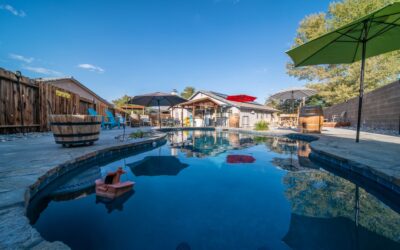
Walk across the wrong pool deck on a hot afternoon and you either burn the soles of your feet or slip on a wet patch and crack your head. Both outcomes are entirely preventable with the right surface choice. Pool area flooring has to handle UV exposure, chlorine splash, freeze-thaw cycles (in cold climates), barefoot comfort, and wet slip resistance simultaneously. Few residential floors face that combined stress. Choosing well means looking at DCOF slip ratings, surface temperature in direct sun, and how each material handles standing water.
Travertine: The Pool Deck Standard
Travertine has anchored the pool deck market for two decades because it stays cooler underfoot than concrete or porcelain in direct sun. The natural mineral porosity wicks water away from the surface, which helps slip resistance. Pricing runs $5 to $14 per sq ft material plus $7 to $12 per sq ft installation in mortar-set applications.
Look for “premium” or “select” grade travertine with minimal pitting and tighter color variation. Filled and honed travertine works best for pool decks because the filler reduces edge chipping at trip hazards. DCOF wet ratings typically fall between 0.42 and 0.65 depending on surface finish, well within the safe range.
After the flooring is sorted, the right furniture makes all the difference. A set of poolside lounge chairs and a gazebo for shade can turn a basic pool deck into something that actually feels like a backyard retreat.
We may earn a commission when you purchase through our links.
Concrete Pavers
Manufactured concrete pavers from Belgard, Techo-Bloc, and Unilock deliver pool deck performance at competitive pricing. Tumbled or textured surface finishes provide grip wet or dry. Pricing runs $3 to $8 per sq ft material plus $6 to $11 per sq ft installation for sand-set or polymer-sand systems.
Modern concrete pavers offer color options from warm sandstone tans to cool gray blues. Look for pavers rated to ASTM C936 for paving units, with compressive strength above 8,000 PSI and water absorption below 5 percent. The integrated coloring through the full thickness prevents fading when the surface eventually wears.
Porcelain Pavers Rated for Exterior
Exterior-rated porcelain pavers in 20mm thickness from MSI Arterra, Mirage Outdoor, and Belgard Mirage handle pool decks beautifully when specified correctly. Pricing runs $7 to $14 per sq ft material with $5 to $9 per sq ft installation. The 24 by 24 or 24 by 48 inch format produces clean, modern aesthetics.
Critical specs include DCOF wet rating above 0.42 (look for 0.55+ for premium safety), frost resistance per ASTM C1026 for cold climates, and water absorption below 0.5 percent. Pedestal-set installations on rooftop and elevated pool decks allow easier access to substructure plumbing and drainage.
Sandstone, Bluestone, and Flagstone
- Sandstone: Warm beige to rust colors. Naturally slip-resistant texture. $4 to $9 per sq ft material.
- Bluestone: Steel blue to gray-brown tones. Cool underfoot. $10 to $18 per sq ft material.
- Flagstone (irregular): Random shapes for rustic appearance. $4 to $12 per sq ft material.
- Quartzite: Premium dense stone. Excellent slip resistance. $12 to $25 per sq ft material.
- Limestone: Honed or brushed finish. Stains from chlorine if unsealed. $6 to $14 per sq ft material.
Composite and Wood Decking
Composite decking from Trex Transcend Lineage, TimberTech AZEK Vintage, and Fiberon Concordia stays cooler than dark concrete in direct sun and provides excellent slip resistance with the integrated grain texture. Pricing runs $4 to $9 per sq ft for boards plus $4 to $7 per sq ft for installation including framing fasteners.
Pressure-treated wood and tropical hardwoods like ipe and cumaru work as pool decking but require annual maintenance. The wood stays cooler than stone or porcelain but absorbs water and chlorine over time. Plan for biannual sealing with marine-grade sealers like Sikkens Cetol or Cabot Australian Timber Oil.
Surface Temperature Reality
The thermal comfort difference between materials is dramatic. In 95 degree F ambient air with full sun, dark concrete reaches 145-160 degrees F, dark porcelain hits 140-150 degrees F, and dark composite decking can reach 130-140 degrees F. All three are too hot for prolonged barefoot contact.
Lighter colored materials run 20-30 degrees cooler. Travertine in cream or beige tones stays around 110-120 degrees F in the same conditions. Bluestone runs 115-125 degrees F. Light gray concrete pavers stay around 120-130 degrees F. For barefoot comfort, light colors matter more than material choice within most categories.
Chlorine and Salt Water Compatibility
Chlorine pool water doesn’t typically damage modern flooring materials when splash exposure is brief and the surface drains properly. Standing chlorinated water on porous stone like limestone, soft sandstone, or unsealed travertine causes etching over time. Annual sealing with penetrating sealers like Aqua Mix Sealer’s Choice Gold prevents most chemical damage.
Salt water pools accelerate corrosion of any metal components, including fasteners on composite decking, steel pool ladder supports, and aluminum window frames near the deck. Use marine-grade stainless steel (316 grade) fasteners and hardware throughout salt-water pool installations.
Drainage Slope and Grading
Pool decks need 1/4 inch per foot slope away from the pool (minimum), or 1/8 inch per foot if drainage is to surface drains. Building codes typically require this slope plus a positive drainage path to either a yard low point, a drywell, or a stormwater connection.
Channel drains (linear drains) like NDS Mini Channel or ACO Drain installed at the pool deck edge intercept water before it pools. Pricing for a 30-foot channel drain run with grates and installation is $400 to $1,200. The drains keep surface water moving and prevent the standing puddles that create slip hazards.
Coping and Pool Edge Detail
The pool coping is the cap stone that wraps the pool edge, transitioning from deck to water. Most pool installations use bullnose-edged coping in a contrasting or matching material to the deck. Pricing runs $20 to $60 per linear foot for natural stone coping or $8 to $25 per linear foot for concrete coping.
The coping needs to overhang the pool wall by 1 to 1-1/2 inches to provide a comfortable grip for swimmers entering and exiting. The deck flooring abuts the back side of the coping with a slight slope away from the pool. A 1/4 to 3/8 inch sealed joint between coping and deck handles thermal movement.
Cost Range for Real Projects
For a 400 sq ft pool deck installation: Concrete pavers $3,500-$7,500. Travertine $5,500-$10,000. Premium porcelain pavers $5,000-$9,500. Bluestone or quartzite $9,000-$17,000. Composite decking on a frame $4,500-$8,500. Stamped concrete $4,000-$7,500.
Pool area flooring rewards careful selection because the surface sees more environmental stress than any other floor in the home. Match the material to your climate, sun exposure, and barefoot tolerance, then install with proper slope and drainage. Done right, the deck will look as good in twenty years as the day it was poured.
Prefer to explore on your own?
See how new flooring looks in your actual room in seconds — free, no signup.
Try the free Floor Studio →