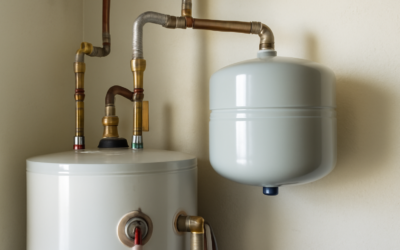
That football-shaped tank mounted above your water heater has a specific job most homeowners never think about — until the TPR valve starts dripping or the pipes bang when a faucet shuts off. A pressure tank for water heater (more accurately called a thermal expansion tank) absorbs the extra volume created when water heats up, protecting your plumbing from damage and satisfying modern plumbing codes in most US jurisdictions.
Why Thermal Expansion Is a Real Problem
Water expands roughly 2% in volume as it heats from 60 degrees F to 140 degrees F. In a typical 50-gallon water heater, that is about 1 gallon of extra volume with nowhere to go once the heater fires up. In older homes, that expanding water simply pushed back into the city main through the service line and disappeared harmlessly.
Modern systems include a backflow preventer, check valve, or pressure reducing valve at the main shutoff — components that create what plumbers call a “closed system.” In a closed system, expanding water has no escape route, and pressure inside the tank and supply pipes spikes from a normal 50-60 psi to 125-150 psi within minutes of the burner firing.
What the Expansion Tank Does
The tank is a simple pressure vessel divided by an internal rubber bladder. One side holds air precharged to match your home’s water pressure (typically 40-60 psi). The other side connects to your hot water plumbing. When hot water expansion raises the pressure, water pushes through the inlet and compresses the air cushion. When hot water cools or gets used, the air pushes the water back out.
The result: system pressure stays stable, the temperature-and-pressure relief (TPR) valve on your water heater does not weep, pipes do not bang, and the water heater tank itself lives longer because it cycles through less stress.
When Code Requires One
Most jurisdictions following the International Plumbing Code or Uniform Plumbing Code require an expansion tank whenever a closed system exists. Practically, that means nearly every home built or re-plumbed since the late 1990s. The code trigger is any of the following:
- A pressure reducing valve (PRV) on the main service line
- A backflow preventer on the irrigation system or water service
- A check valve anywhere downstream of the meter
- Any municipality that requires dual check valves on new residential services
If you installed a new water heater in the last 10 years and your installer skipped the expansion tank, your install likely does not meet current code and your TPR valve is probably leaking intermittently. Resale home inspectors flag this routinely.
Sizing the Tank Correctly
Expansion tanks are sized based on your water heater capacity and your static water pressure. The rule of thumb most plumbers use:
- Water heater up to 50 gallons: 2-gallon expansion tank (models ST-5, ST-12)
- Water heater 51-80 gallons: 4.4-gallon expansion tank (model ST-25V)
- Water heater 81-120 gallons: 8.5-gallon expansion tank (model ST-45V)
- Commercial heaters above 120 gallons: engineered sizing calculation required
Brand-wise, Watts, Amtrol Extrol, Zurn, and American Water Heater all make reliable tanks. Prices run $45-$90 at home centers for residential sizes. Oversizing slightly is always safer than undersizing — a 4.4-gallon tank on a 50-gallon heater costs $20 more and provides a longer service life margin.
Install Location and Orientation
The tank installs on the cold water inlet line to the water heater, within a few feet of the tank. Most installers tee off the cold line between the shut-off valve and the water heater, using a simple brass or stainless tee fitting. Some installations mount the tank directly onto the cold inlet port using a threaded nipple.
Orientation matters less than people think. Vertical with the water connection on the bottom is preferred, but horizontal mounting is acceptable for most residential tanks. Support heavier tanks with a strap or bracket — the weight of water inside a 4.4-gallon tank is 30+ pounds, and a tee fitting alone cannot safely support that over years of service.
Setting the Pre-Charge Pressure
This is the step most DIY installers miss. Before installing, check your home’s static water pressure with a $15 gauge threaded onto an outdoor hose bib. Write down that number. Using a bicycle pump or air compressor, adjust the tank’s Schrader valve (the one covered by a little plastic cap on top of the tank) until the air charge matches your system pressure within 2 psi.
An improperly charged tank does nothing. The bladder sits either fully extended or fully collapsed, and the tank behaves like a plain pipe — no thermal expansion control at all. This is why many installed expansion tanks fail to prevent TPR valve leaks even when physically present.
Signs Your Expansion Tank Is Failing
A failed expansion tank typically shows up as a waterlogged tank — the internal bladder has ruptured, and the whole tank fills with water. You can diagnose this two ways. First, tap the top of the tank and then the bottom. A healthy tank sounds hollow on top and solid on the bottom. A failed tank sounds solid throughout. Second, press the Schrader valve briefly with a fingernail or tool; you should hear air hiss out. If water sprays out instead, the bladder has failed.
Other symptoms include TPR valve weeping, pressure fluctuations at faucets, banging pipes when appliances stop drawing water, and a water heater that trips its high-temperature limit on older models. Replace the tank rather than trying to repair it — the bladder is not serviceable.
Expected Lifespan and Replacement Cost
Expansion tanks typically last 5-10 years in residential use. Factors that shorten life include chlorinated municipal water (chlorine degrades the rubber bladder), high water pressure above 80 psi, and frequent pressure cycles in homes with irrigation systems that cycle multiple times daily.
DIY replacement runs $60-$100 in materials and takes about 45 minutes with basic plumbing skills. A licensed plumber charges $250-$450 for the same job, with cost driven mostly by the service call minimum. If the existing tank is already leaking water, plan to replace soon — a failed tank offers no protection, and your water heater warranty is typically voided by operating in a closed system without a functioning expansion device.
Do Tankless Water Heaters Need One?
Most tankless water heaters do not require a thermal expansion tank because they do not store a large volume of standing heated water — the volume in the heat exchanger is small enough that expansion pressure stays minimal. Check your specific model’s installation manual, though, because a few high-flow commercial units do call for one. For conventional tank-type water heaters, if you have any closed system components on your main line, add an expansion tank. The $65 part pays for itself by extending your water heater’s life by 3-5 years and preventing emergency plumber visits for a dripping TPR valve.