The right pressure washer hose adapter is the small brass part that decides whether your new hose, gun, or surface cleaner actually connects, or sits useless in the box. Manufacturers deliberately mix thread standards and quick-connect sizes to sell you their accessories, but with a $10 handful of adapters you can run almost any hose on almost any machine. The confusion clears up fast once you understand the three connection types you’ll actually meet.
- The Three Connections You’ll Encounter
- The M22 Trap: 14mm vs. 15mm Bore
- Why 3/8-Inch Quick Connect Is Worth the Swap
- Cross-Brand Compatibility Cheat Sheet
- Adapters Every Owner Should Keep on Hand
- How to Identify What You Have
- Common Adapter Problems and Fixes
- Installation and Leak-Free Sealing
- Choosing Quality That Lasts
The Three Connections You’ll Encounter
Every pressure washer link is one of these three, and telling them apart is the whole game:
- M22 threaded: A 22mm metric screw fitting, the near-universal standard on hose ends, pumps, and guns. It comes in two internal bore sizes that matter (more below).
- 3/8-inch quick connect (QC): A push-and-click stainless coupler with a pull-back collar, common on gas units and premium hoses. Fast and leak-free.
- Proprietary click-lock: Plastic bayonet fittings on entry electrics like Karcher K-series and some Sun Joe models. These need a brand-specific adapter to reach M22 or QC.
Identify what’s on both ends of your connection, then bridge the gap. That’s all an adapter does.
It helps to picture the whole water path. Cold water enters at the inlet through a garden-hose thread (GHT), passes through the pump, and exits under pressure at the outlet, which is where your high-pressure hose attaches. The other end of that hose connects to the trigger gun, and the gun accepts the lance and nozzles. Every one of those four junctions, inlet, outlet, gun, and lance, is a potential adapter point, and each can use a different standard on the same machine. Once you see the water path as a chain of connections rather than one mysterious hookup, choosing fittings becomes obvious.
The M22 Trap: 14mm vs. 15mm Bore
Here’s the detail that trips up almost everyone. M22 fittings come with two different internal bore diameters: 14mm and 15mm. The threads are identical 22mm, so a 14mm hose will screw onto a 15mm outlet and appear to fit, but the small center pin and seat won’t seal or, worse, the wrong bore restricts flow on a gas machine.
- M22-14mm: Standard on most consumer electric units (Ryobi, Sun Joe, Greenworks) and rated to around 2,700 PSI.
- M22-15mm: Found on gas and higher-pressure machines, wider bore for greater flow.
When you buy an M22 adapter or hose, always confirm the bore. Product listings that only say “M22” without stating 14mm or 15mm are a coin flip. Measure the recessed pin depth or ask the seller before you order.
Why 3/8-Inch Quick Connect Is Worth the Swap
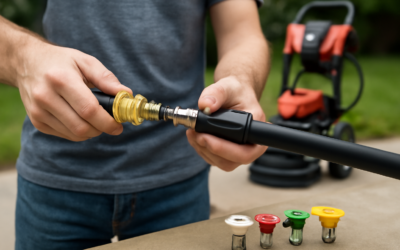
If you own a gas unit or wash frequently, converting everything to 3/8-inch quick connect is the best upgrade you can make. Instead of cross-threading brass fittings in the cold, you snap the hose on in one second. A conversion set gives you an M22 male-to-QC-plug on the pump and an M22 female-to-QC-socket on the gun, so both ends become instant.
The standard 3/8-inch QC uses stainless plugs and sockets rated to 4,000-plus PSI, which is why every pro pressure-washing rig runs them. A basic brass-and-stainless conversion kit costs $12 to $20 and takes five minutes to install with two adjustable wrenches and a wrap of thread-seal tape.
Cross-Brand Compatibility Cheat Sheet
The good news: most brands share the M22 standard underneath their marketing. A well-chosen pressure washer hose adapter lets these machines share hoses and accessories freely, so you rarely have to buy a brand’s overpriced first-party hose.
- Ryobi (electric): M22-14mm at the pump and gun. Accepts any M22-14 hose or an M22-to-QC kit directly.
- Sun Joe: Most use M22-14mm; a few entry SPX models use a proprietary snap. Check yours before buying.
- Karcher K-series: Proprietary click-lock. Needs a Karcher-to-M22 adapter to use standard hoses and guns.
- Simpson, Generac, Ryobi gas: M22-15mm or 3/8-inch QC. Ideal candidates for a full QC conversion.
- Craftsman / Briggs gas: Usually M22-15mm at the pump. Match bore carefully.
Adapters Every Owner Should Keep on Hand
Stock a small kit and you’ll never be stranded mid-project. These are the fittings worth keeping in a zip bag on the shelf:
- M22-14mm male to 3/8-inch QC plug for converting a pump outlet.
- M22-14mm female to 3/8-inch QC socket for the gun end.
- M22-14mm to M22-15mm converter to bridge consumer and gas bore sizes.
- Garden hose (GHT 3/4-inch) to inlet in case a supply fitting cracks.
- 3/8-inch QC to 1/4-inch QC reducer for smaller accessory nozzles and foam cannons.
A complete brass adapter assortment like this runs $15 to $30. Buy solid brass or stainless, not zinc pot-metal, which strips and corrodes within a season. Reputable makers to look for include Tool Daily, M MINGLE, MATCC, and Twinkle Star; their kits pair machined brass bodies with 304 stainless quick-connect couplers rated well above consumer PSI. Keep the whole assortment in a labeled zip bag beside the machine so you’re never hunting for the one fitting you need mid-job.
How to Identify What You Have
Before buying a single adapter, spend two minutes identifying your existing fittings so you order the right bridge. Work through this quick sequence:
- Look for threads. If the fitting has visible screw threads roughly 7/8 inch across, it’s M22. No threads and a push-collar means quick connect. A plastic bayonet that twists a quarter turn is proprietary.
- Measure the bore. On M22, peer inside. A narrow center pin recessed deep signals 14mm; a wider, shallower seat signals 15mm. A caliper across the internal opening confirms it.
- Check both ends. Your pump outlet, hose ends, and gun inlet can each differ. Note all of them before ordering.
- Read the manual’s parts diagram. Most list the exact thread spec, saving you the guesswork.
Photograph each fitting next to a tape measure. It makes matching a replacement online far faster and spares you a second trip.
Common Adapter Problems and Fixes
When an adapter misbehaves, the cause is usually one of a few predictable things:
- Constant drip at a threaded joint: Missing or old thread-seal tape. Disassemble, clean the threads, and re-wrap with three to four fresh turns of PTFE tape.
- Quick connect won’t lock: Debris in the collar or a bent plug. Rinse the coupler, check the ball bearings seat, and confirm the plug is the matching 3/8-inch size, not 1/4-inch.
- Fitting spins but won’t seal: You’ve mismatched a 14mm hose to a 15mm outlet. The threads engage but the seat can’t seal. Add the correct bore converter.
- Adapter blew off under pressure: A plastic fitting used above its rating, or a coupler not fully seated. Replace with brass or stainless rated to your machine’s PSI.
Installation and Leak-Free Sealing
Threaded fittings seal on the threads, so they need PTFE thread-seal tape; quick connects seal on an internal O-ring and need none. When you assemble threaded adapters, wrap three to four turns of tape clockwise around the male threads, then hand-tighten plus a quarter turn with a wrench. Over-torquing brass cracks the fitting; under-tightening lets it weep at pressure.
Inspect O-rings on quick-connect fittings regularly. A worn O-ring is the number-one cause of a QC coupler that sprays sideways or won’t hold. A pack of assorted nitrile O-rings costs a few dollars and fixes most drips instantly. Keep a spare set with your adapters.
Upgrading Your Whole Setup at Once
If you’re tired of chasing mismatched fittings, standardize everything to 3/8-inch quick connect in a single afternoon. Fit a QC plug to the pump outlet, a QC socket to the gun, and QC ends to both the high-pressure hose and any lance extensions. From then on, hoses, foam cannons, surface cleaners, and gutter wands all snap on interchangeably regardless of brand. Kits from Tool Daily, M MINGLE, and Twinkle Star bundle the plugs, sockets, and O-rings for $18 to $30. It’s the single cheapest upgrade that makes a pressure washer genuinely pleasant to use.
Choosing Quality That Lasts
Not all adapters are equal, and the price difference is small enough that cheaping out makes no sense. Look for forged brass bodies, stainless steel quick-connect plugs, and a stated PSI rating that meets or exceeds your machine’s output. Avoid plastic-threaded adapters on anything over 1,600 PSI; they flex, leak, and eventually blow off. Spend the extra few dollars on stainless and brass and a single adapter set will outlast several pressure washers, letting each new machine plug straight into the hoses and tools you already own.