Search for r8 insulation and you’re almost always looking at ductwork, because R-8 is the number building codes attach to ducts running through unconditioned attics. It’s a modest R-value — a fraction of what walls and ceilings get — but on the surface of a supply duct pushing 55°F air through a 130°F attic, r8 insulation is the difference between delivering cooling and delivering lukewarm disappointment. I’ve crawled enough attics to tell you duct insulation is the most neglected efficiency item in American housing. Here’s what the code asks for, which products deliver it, and the smaller role R-8 plays in board form elsewhere in the house.
- Why Ducts Get Their Own R-Value Rule
- What R-8 Duct Products Look Like
- Wrapping Ducts Right: The 25 Percent Rule and Other Details
- The Better Question: Should the Ducts Be in the Attic at All?
- R-8 in Board Form: Walls, Rim Joists, and Garage Doors
- What R-8 Is Not For
- How to Tell What Your Ducts Have Now
- Bottom Line
Why Ducts Get Their Own R-Value Rule
The IECC energy code requires supply and return ducts in attics to carry at least R-8 insulation (ducts 3 inches in diameter and larger; smaller runs may be allowed at R-6), while ducts in other unconditioned spaces like crawl spaces and garages generally need R-6. The logic is brutal arithmetic. An attic in July can sit at 120°F to 150°F while your AC supplies air at about 55°F — a 65 to 95 degree difference across a thin sheet-metal wall. Bare or poorly wrapped ducts in that environment can lose 10 to 30 percent of the system’s cooling capacity before air reaches a register. Field studies of typical duct systems (losses plus leakage) routinely find 25 to 40 percent of conditioned air energy wasted. R-8 wrap cuts conductive duct loss dramatically, and the vapor-barrier jacket that comes with it stops the summer condensation that rusts metal ducts and stains ceilings.
What R-8 Duct Products Look Like
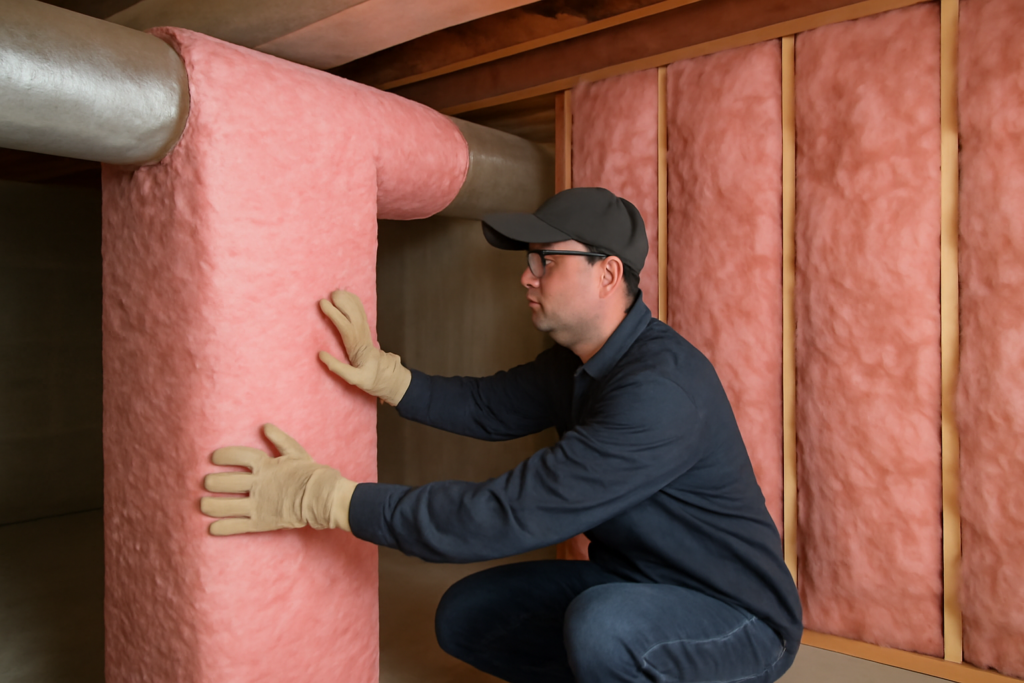
- R-8 duct wrap: fiberglass blanket, typically 3 to 3.5 inches thick at full loft, bonded to a foil-scrim-kraft (FSK) vapor-barrier facing. Sold in rolls 48 inches wide by 25 to 50 feet, roughly $50 to $110 per roll — figure $0.90 to $1.60 per square foot of duct surface. Johns Manville Microlite, Owens Corning SOFTR, and Knauf duct wraps are the common names at supply houses.
- Pre-insulated R-8 flex duct: flexible duct with the insulation and jacket built in, sold in 25-foot bags by diameter — a 6-inch R-8 flex runs about $45 to $80 per bag, an 8-inch about $65 to $110. For new runs, buying R-8 flex outright beats wrapping R-4.2 flex after the fact.
- R-8 duct board: rigid fiberglass board (usually 2-inch, around R-8) with FSK facing, used to fabricate plenums and trunk lines; about $2 to $3 per square foot.
- Fittings note: elbows, takeoffs, and boots need the same R-8 treatment — a bare 4-square-foot boot in a hot attic undoes a lot of neatly wrapped trunk.
Wrapping Ducts Right: The 25 Percent Rule and Other Details
DIY duct wrapping is entirely doable in a weekend, and the details determine whether you get real R-8 or theatrical R-4:
- Seal before you wrap. Insulating a leaky duct locks in the leaks. Brush mastic (a $20 gallon covers a typical system) or UL 181 foil tape on every joint, seam, and takeoff first. Never cloth “duct tape” — it fails in months.
- Cut with stretch-out allowance. Measure duct circumference, then add roughly 6 inches plus twice the insulation thickness so the wrap closes without crushing. Compressing R-8 wrap to half thickness yields something like R-5 — the fluff is the insulation.
- Facing out, seams stapled and taped. Foil faces the attic, fiberglass faces the metal. Pull snug, staple the flap every 6 inches, then seal every seam with foil tape so the vapor barrier is continuous. Any gap in the jacket is a condensation site in August.
- Support without strangling. Re-hang flex and wrapped duct with 1.5-inch-wide straps at 4-foot intervals; skinny wire saddles cut into insulation and pinch airflow.
- Don’t forget returns. Return ducts in attics need R-8 too under current code — they’re pulling in attic-adjacent heat all day.
A typical single-story home has 300 to 500 square feet of attic duct surface. Materials for a full seal-and-wrap land around $400 to $800; hiring it out runs $1,500 to $3,500. Energy modeling and utility-program data commonly show 10 to 20 percent HVAC savings from sealing plus insulating attic ducts, which puts DIY payback at two to four cooling seasons in hot climates.
The Better Question: Should the Ducts Be in the Attic at All?
Worth stating plainly: R-8 is a band-aid on a design problem. Ducts buried under 12+ inches of blown attic insulation, moved into conditioned space, or enclosed in a sealed attic assembly outperform any wrap job. If you’re re-roofing or renovating anyway, ask your contractor about burying ducts (allowed by code in many climates when ducts are R-8 and deeply covered) or spray-foaming the roof deck. For everyone else, R-8 wrap on sealed ducts is the practical 90 percent solution.
R-8 in Board Form: Walls, Rim Joists, and Garage Doors
Outside ductwork, R-8 shows up wherever someone needs meaningful insulation in about 1.5 inches of depth:
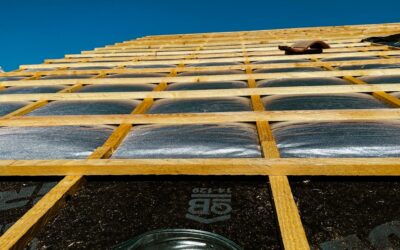
- Polyiso board: 1.5-inch polyisocyanurate rates about R-8 to R-9 (roughly R-6 per inch as labeled). As continuous exterior sheathing over studs, an R-8 layer breaks thermal bridging and can lift a 2×4 wall assembly from whole-wall R-11 to roughly R-19 — a bigger jump than upgrading the cavity batts.
- XPS foam: 1.5-inch extruded polystyrene delivers about R-7.5 — close enough that it competes for basement wall and rim joist duty, where its moisture tolerance beats polyiso.
- Rim joists: cut-and-cobble 1.5-inch foam sealed with canned foam gives each bay about R-8 against a notorious leak zone; add a batt over it in cold climates.
- Garage door kits: most vinyl-faced fiberglass kits ($60 to $120 per door) advertise around R-8 — a noticeable improvement on an uninsulated steel door if you work in the garage, though panel kits at R-12+ exist for colder regions.
What R-8 Is Not For
Keep the number in context. R-8 does not satisfy code for exterior wall cavities (R-13 to R-21 territory), attic flats (R-38 to R-60), or floors (R-19 to R-30). If a contractor quotes “R-8 walls” on a heated addition, that’s a red flag, not a spec. Its legitimate jobs are duct systems, continuous-foam layers within larger assemblies, and tight-space retrofits where 1.5 inches is all the geometry allows.
How to Tell What Your Ducts Have Now
Before buying anything, spend twenty minutes in the attic with a flashlight and a phone camera. Flex duct usually prints its rating on the jacket — look for R-4.2, R-6, or R-8 stamped every few feet; if you find R-4.2, that’s the pre-2009 standard and a prime upgrade candidate. Metal trunk lines wrapped in thin, compressed, blackened fiberglass with torn foil are effectively R-2 to R-3 regardless of what they started as — squeeze the wrap gently; if it’s packed to under an inch thick, its loft and its R-value are gone. Bare metal ducts, still common in homes built before the 1990s, are the jackpot finding: wrapping those delivers the fastest payback in residential insulation. While you’re up there, put a hand near joints with the system running — feeling airflow means sealing comes before wrapping, and a duct-blaster test from an energy auditor ($250 to $450) quantifies it if you want numbers.
Check for condensation evidence too: rust streaks on duct exteriors, water-stained insulation, or drips on the ceiling below all point to jacket gaps letting humid attic air reach cold metal. Those spots get priority, because they’re costing you drywall repairs, not just efficiency. Photograph everything and measure total duct length by section; a materials list built from real measurements beats the guess-and-return cycle at the supply house by a full weekend.
Bottom Line
Treat R-8 as the duct number first: seal with mastic, wrap to full loft with FSK-faced R-8, tape the jacket airtight, and include the returns and boots. For a few hundred dollars and a hot Saturday in the attic, it’s one of the highest-return insulation projects in the house — and one of the few where the code minimum and the smart choice are the same number.