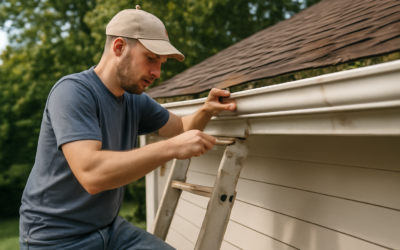
Functional gutters move roughly 1,900 gallons of water off an average roof during a single inch of rainfall. A failed gutter dumps that water against the foundation, where it erodes landscaping, soaks into basements, and eventually causes $15,000+ in structural damage. Most rain gutter repair jobs cost under $75 in materials and take less than an afternoon if you catch problems early.
Part of our Roofing guide — explore the full guide →
Spring and fall are the two critical inspection windows. Walk the perimeter during the next steady rain and watch where water actually flows. Overflow at inside corners, drips at end caps, and gushers at downspout elbows all point to specific failures you can address directly.
Fixing Leaky Seams
Seams between gutter sections are the most common leak points. The original sealant dries out and cracks after 8 to 15 years. To repair, clean the inside of the gutter at the seam with a wire brush and isopropyl alcohol, let dry completely, then apply a generous bead of gutter sealant like Geocel 2300 Tripolymer or DAP 3.0 ($8 to $12 per tube). Smooth with a gloved finger. Let cure 24 hours before the next rain.
Silicone caulk is tempting but fails within 2 years because it does not bond well to the wet cycle of gutters. Stick with tripolymer or butyl-based sealants specifically labeled for gutters.
Patching Small Holes
Rust-through in steel gutters or puncture damage from a falling branch can be patched. Sand the area with 80-grit sandpaper, clean with mineral spirits, then apply a patch using flashing tape like EternaBond RoofSeal ($35 per roll) or a fiberglass patch kit with asphalt mastic. For holes larger than 2 inches, replace the entire gutter section rather than patching.
Re-Hanging Sagging Gutters
Sagging gutters pond water, which adds weight and accelerates the sag. The fix depends on the hanger type. Spike-and-ferrule systems work loose over time; pull the spike, rotate the ferrule to a fresh spot, and drive a 7-inch screw-shank spike back through. Hidden hanger systems (the modern standard) use hex-head screws into fascia; tighten loose ones with a 1/4-inch nut driver or replace any that spin freely by upsizing to a longer screw or relocating 2 inches away.
Proper gutter pitch is 1/4 inch of drop per 10 feet toward the downspout. Use a level with string stretched along the top lip to check. Re-adjust hangers until pitch is correct, then run a hose test to verify flow.
Clearing Clogs
A clogged gutter is not usually a repair so much as maintenance, but clogs cause most leaks by forcing water over the front lip. Scoop out debris with a gutter scoop ($6) or a gloved hand, then flush from the upstream end with a garden hose. For stubborn downspout clogs, feed a plumber’s snake down from the top or disassemble the lowest elbow and flush backward.
Gutter guards reduce cleaning frequency but do not eliminate it. Expect to rinse guards once a year in tree-heavy yards and clean under-guard sludge every 3 to 4 years.
Downspout Repairs
Downspouts separate at elbow joints under freeze-thaw stress. Reconnect with three 3/8-inch sheet metal screws per joint and seal with gutter sealant. If a downspout has crushed from a ladder or falling debris, cut out the damaged section and splice in a new piece with sheet metal screws. Replacement downspout sections run $12 to $25 at Home Depot.
Extend downspouts at least 6 feet from the foundation. A 3-foot flex elbow ($9) plus a 6-foot splash block or buried drain line directs water well beyond the foundation footprint.
Replacing End Caps
End caps leak because the original factory seal fails. Remove the old cap, scrape off dried sealant with a putty knife, apply a thick bead of fresh gutter sealant around the cap’s inside rim, and snap it back into place. Seal the visible seam on the outside as well. Replacement caps cost $3 each and are worth having on hand.
When to Replace Instead of Repair
Gutters have a finite lifespan: aluminum lasts 20 to 30 years, galvanized steel 20 to 25 years, copper 50+ years, and vinyl 10 to 15 years. If you are patching multiple sections, dealing with widespread rust, or seeing paint peel and pitting, replacement is more economical than repeated repair. New seamless aluminum gutters installed by a pro run $7 to $14 per linear foot, or $1,400 to $2,800 for a typical 200-foot installation.
Safety First on the Ladder
Ladder falls are the single biggest danger in gutter work. Use a fiberglass extension ladder rated at least Type II (225 pounds) and set it at a 4-to-1 angle (1 foot out for every 4 feet up). A ladder standoff or stabilizer ($35) keeps the ladder off the gutter itself, preventing crush damage and improving stability. Never stand on the top 3 rungs. If the work is above 18 feet or the roof is steep, hire a pro.
Cost Comparison: DIY vs Hiring Out
DIY gutter repair typically costs $20 to $150 in materials. Professional gutter repair runs $200 to $600 depending on scope, and full gutter replacement $1,400 to $4,000 for average homes. Pros are worth the cost on two-story houses, complex rooflines with multiple valleys, and homes where the fascia has rotted and needs replacement along with the gutters.
Preventive Maintenance
Clean gutters twice a year: once in late spring after oak tassels and maple seeds fall, and once in late fall after leaf drop is complete. Inspect seams and hangers during each cleaning. Tighten any loose hardware and reseal seams showing hairline cracks before they become active leaks. Five minutes of maintenance prevents the $2,000 foundation repair down the road.