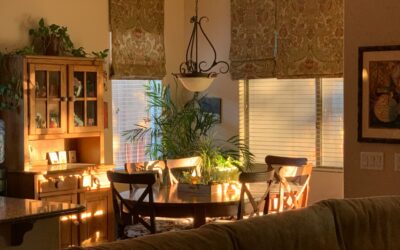
Most roman shades fold into crisp, flat pleats. Relaxed roman blinds do something different: the bottom edge dips into a gentle smile-shaped curve, so the shade looks draped rather than tailored. Designers also call the look a European fold or a soft fold roman shade, and it is the easiest way to add softness to a window without the bulk of curtains.
The style works because the shade has no stiffening rods along the bottom. The lift cords run only near the outer edges, so the center fabric sags slightly as the shade rises. That simple construction brings trade-offs, though. Relaxed roman shades need the right fabric weight to curve evenly, they look best within certain widths, and they suit decorative settings more than rooms that demand full privacy or blackout.
- How Relaxed Roman Blinds Differ From Flat and Hobbled Folds
- Choosing Fabric Weight for an Even Curve
- Width Limits and Sizing
- Lining Choices
- Best Rooms for Relaxed Roman Shades
- Layering and Styling Relaxed Roman Shades
- Cord Safety: Choose Cordless Relaxed Roman Shades
- Installation and Care
- Troubleshooting and Cost Ranges
- Frequently Asked Questions
If you like a casual, lived-in look for a bedroom, living room, or breakfast nook, soft roman blinds are a strong choice. If you want crisp lines or full light control, a flat or hobbled fold is usually a better fit.
How Relaxed Roman Blinds Differ From Flat and Hobbled Folds
All roman shades raise by gathering fabric into horizontal folds, but the fold construction changes the look completely.
| Style | Look When Lowered | Best For |
|---|---|---|
| Flat fold | Smooth panel; folds stack neatly when raised | Modern rooms, bold patterns |
| Hobbled (teardrop) fold | Soft loops cascade even when lowered | Traditional rooms, extra fullness |
| Relaxed (European) fold | Flat panel with a curved, dipping hem when raised | Casual, cottage, coastal spaces |
A flat roman uses horizontal dowels or battens across the full width, so each fold sits straight. A hobbled shade stitches extra fabric into permanent loops. A relaxed roman usually has no battens across the bottom portion, which lets the lower edge swag into its signature curve. Many relaxed designs are purely decorative and stay in one raised position, while others operate like a standard shade.
Choosing Fabric Weight for an Even Curve
Fabric makes or breaks a soft fold roman shade. Too stiff, and the curve looks lumpy or refuses to form. Too thin, and it droops unevenly and shows wrinkles.
- Light to medium weight works best: Linen, linen blends, cotton, lightweight velvet alternatives, and soft drapery fabrics fall into a graceful curve.
- Avoid stiff materials: Heavy canvas, stiff jacquards, woven wood, and thick upholstery fabric resist draping.
- Watch pattern placement: Stripes and large prints bend along the curve. Vertical stripes curve attractively; horizontal stripes can look warped.
- Consider drape direction: Fabric cut on the straight grain hangs more evenly than fabric with a lot of stretch.
A good test is to hold a length of fabric by two points about 3 feet apart. If it sags into a smooth curve without folding sharply, it will likely work.
Width Limits and Sizing
Relaxed roman shades have a practical width sweet spot. On narrow windows, under about 24 inches, the curve barely forms and the shade just looks crooked. On very wide windows, beyond roughly 60 to 72 inches, the center sags too far and the fabric can pull unevenly.
- For windows roughly 24 to 60 inches wide, a single relaxed shade typically gives a balanced curve.
- For wider openings, use two or three shades side by side, which also makes operation easier.
- Inside mount gives a neat framed look but needs enough frame depth; outside mount lets the curve sit above the glass and makes windows look taller.
- Measure width at top, middle, and bottom for inside mounts and use the narrowest; for outside mounts, add a couple of inches per side.
- Plan for the dip. The center of the hem hangs several inches below the sides when raised, so mount a bit higher if you want the full view clear.
Lining Choices
Lining affects how the curve hangs as much as how much light passes through.
- Unlined: Airy and softly translucent, with the most fluid drape. Best for decorative valance-style shades.
- Light-filtering lining: Protects fabric from sun damage, adds modest privacy, and gives the curve more body.
- Blackout lining: Adds stiffness that can flatten the curve, and light still leaks around the edges because of the dip. Pair with a separate blackout roller behind the relaxed shade if you need darkness.
- Interlining: A soft flannel layer adds fullness and insulation for a luxurious look.
Best Rooms for Relaxed Roman Shades
These shades shine where the goal is atmosphere rather than strict function:
- Living rooms and dens: A relaxed hem softens hard lines from built-ins and large windows.
- Bedrooms: Pair with a blackout roller underneath for sleep.
- Breakfast nooks and dining areas: Perfect for a cottage or farmhouse feel.
- Kitchens: As a fixed decorative valance above the sink, choose a synthetic fabric that resists steam.
- Bathrooms: Only with moisture-tolerant fabrics and good ventilation.
They are less suited to high-use windows you raise and lower several times a day, since the fabric needs dressing to keep the curve neat.
Layering and Styling Relaxed Roman Shades
Because the curved hem already reads as decorative, relaxed roman shades pair naturally with other window layers. Side panels hung on a rod a few inches wider than the window frame showcase the curve and add warmth in winter. A plain white or linen-colored shade under patterned curtains keeps the window from feeling busy, while a patterned relaxed shade looks best with solid panels or no curtains at all.
Proportion matters too. On tall windows, a longer shade with a deeper curve balances the height; on short, wide windows, keep the dip shallow so the shade does not swallow the view. Trim details such as a contrasting border tape along the hem or a narrow banded edge highlight the curve and give a custom look without extra cost in hardware. Matching the shade color to the wall or trim makes the window recede, while a contrasting color turns it into a focal point.
Cord Safety: Choose Cordless Relaxed Roman Shades
Traditional roman shades use exposed lift cords on the back that create a strangulation risk for young children and pets. The U.S. Consumer Product Safety Commission recommends cordless window coverings, or products with inaccessible cords, in homes where children live or visit.
Cordless relaxed roman shades lift by pushing or pulling the bottom rail and keep internal cords enclosed. Motorized versions work well for tall or hard-to-reach windows. For fixed decorative relaxed valances, the shade is set at one height and has no operating cord at all, which is another safe choice.
Installation and Care
You need a tape measure, pencil, level, drill, screwdriver, and the included brackets. Use a stable step ladder, set on level ground, and avoid standing on the top step.
- Mark bracket locations near each end and in the center for wider shades.
- Level the marks, pre-drill, and use wall anchors when mounting into drywall.
- Attach brackets and secure the headrail.
- Raise the shade and dress the folds by hand so the curve falls evenly on both sides.
- Leave it raised for a day or two so the fabric trains into shape.
Vacuum with a soft brush attachment regularly. Spot-clean with mild soap and water. Many relaxed shades are dry-clean only because the lining and face fabric can shrink at different rates.
Troubleshooting and Cost Ranges
- Uneven curve: Lift points are set unevenly or cords need adjustment; dress folds by hand and check that both sides raise equally.
- Curve too deep: The shade is too wide or the fabric too light. Consider splitting into two shades.
- No curve at all: The fabric is too stiff or the lining too heavy.
- Fading on the hem: Add a light-filtering lining or UV-protective window film.
Ready-made relaxed shades in standard sizes are the most affordable. Custom relaxed roman blinds with designer fabric, interlining, and cordless or motorized lifts cost substantially more per window, and professional measuring and installation adds a service fee. Call a professional for large or unusual windows, bay windows, hardwired motorization, or high windows on second-story stairwells where ladder work becomes risky.
Frequently Asked Questions
What is a relaxed roman blind?
A relaxed roman blind is a fabric shade whose bottom edge curves downward in a soft smile shape when raised. It lacks the full-width stiffening rods of a flat roman, so the center fabric dips naturally.
Are relaxed roman shades the same as soft fold roman shades?
Mostly, yes. Relaxed, European, and soft fold are common names for roman shades with an unstructured, curved hem, though some makers use soft fold for hobbled styles as well.
Can relaxed roman blinds block out light?
Not completely. The curved hem leaves gaps, and blackout lining can flatten the curve. Layer a blackout roller shade behind the relaxed shade if you need darkness.
How wide can a relaxed roman shade be?
Most look best between roughly 24 and 60 inches wide. Wider windows usually look better with two or more shades side by side.
Are soft roman blinds safe for homes with children?
Choose cordless or motorized versions, or fixed decorative shades with no operating cord. Exposed lift cords pose a strangulation risk, and the CPSC recommends cordless products for homes with kids.