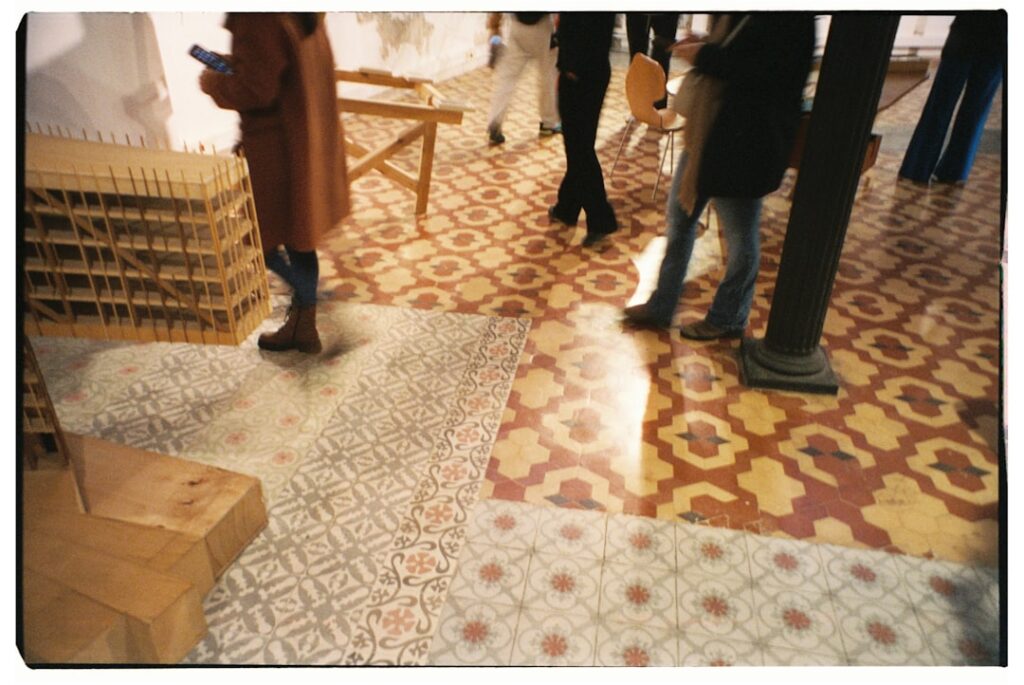
Checkerboard kitchens, marbled swirls, and candy-colored 1950s patterns are back in force, driven by everyone restoring bungalows and mid-century ranches. The catch is that shopping for reproduction vintage linoleum flooring drops you straight into a century of confused terminology: most of what Americans call “linoleum” is actually vinyl, true linoleum is still manufactured but sold mostly under one brand name, and the original floor you are trying to replicate may contain asbestos. Sorting those three facts out first will save you money and possibly your lungs.
True Linoleum vs. Vintage-Style Vinyl: Not the Same Thing
Real linoleum is a natural product invented in the 1860s: linseed oil oxidized into a cement, mixed with wood flour, cork dust, limestone, and pigments, then pressed onto a jute backing. It is biodegradable, naturally antibacterial, and the color runs through the full thickness of the material — scratches reveal more of the same color rather than a different layer. Vinyl, which conquered the market after World War II, is a petroleum-based PVC product with a printed pattern layer; wear through the print and the design is gone.
Both can deliver a vintage look, and both are legitimate choices — but they are different purchases. True linoleum costs more, lasts 25 to 40 years, requires occasional sealing, and offers that unmistakable matte, slightly mottled period-correct surface. Retro-patterned vinyl costs less, installs easier, shrugs off water, and reproduces bolder printed patterns true linoleum cannot. Any retailer who uses the words interchangeably is telling you they do not know the products.
Buying True Linoleum Today
Genuine linoleum survives mainly through Forbo’s Marmoleum line, with Tarkett and Gerflor also producing linoleum for commercial markets. For a vintage restoration, Marmoleum is the realistic default, and it comes in three useful formats:
- Sheet linoleum: The historically correct format, in 6-foot-7-inch widths, best professionally installed with full-spread adhesive. Marbled colorways closely echo the originals from the 1920s-1950s. Material runs roughly $4 to $7 per square foot, plus $3 to $7 for installation.
- Linoleum tiles: The restoration workhorse — cut two colors into 12-inch squares and you have an authentic checkerboard kitchen. Glue-down tiles reward careful DIYers.
- Click-together linoleum panels: Marmoleum bonded to an HDF core that floats like laminate. Easiest install, but keep it out of wet rooms because the core is wood-based.
Marbled patterns, solid brights, and two-tone checkerboards read authentically period. What true linoleum cannot give you is the intricate printed motifs — florals, faux-rug borders, geometric medallions — that decorated cheap 1940s kitchen floors. Those were printed felt-base products, and their modern heirs are vinyl.
Vintage-Style Vinyl: The Pattern Route
When the goal is a printed retro pattern rather than period-correct material, modern vinyl delivers. Options worth knowing: luxury vinyl tile laid as checkerboard (black-and-white 12-inch LVT runs $2 to $5 per square foot and installs over a weekend); retro-patterned sheet vinyl from specialty suppliers reproducing boomerang, atomic, and floral motifs; and even peel-and-stick tiles for rentals and budget refreshes at about $1 to $2 per square foot. Several boutique makers also print custom vintage designs on commercial-grade vinyl for serious restorations of specific historical patterns.
Honesty check: vinyl checkerboard in a 1955 ranch kitchen is not “wrong.” Plenty of original mid-century floors were vinyl or vinyl-asbestos tile, so a modern vinyl reproduction can be as historically defensible as Marmoleum — it depends on which decade and which floor you are honoring.
The Asbestos Warning You Cannot Skip
Here is the serious part. If your project involves an existing old floor, assume danger until proven otherwise: resilient flooring installed from roughly the 1920s through the early 1980s frequently contains asbestos — in 9-by-9-inch vinyl-asbestos tiles especially, in some sheet goods, in the felt backing under old “linoleum,” and in the black cutback adhesive beneath. You cannot identify asbestos by eye.
- Test before touching. Mail a small sample (misted wet, cut with a utility knife, double-bagged) to an accredited lab; tests cost about $25 to $50 per sample. Or hire an asbestos inspector.
- Never dry-scrape, sand, or grind old resilient flooring or its adhesive. Friable dust is the hazard; intact tile is relatively stable.
- Encapsulation is legal and often smartest: many pros float new flooring right over well-adhered old material, entombing it harmlessly. Your reproduction floor can go on top.
- If removal is necessary, hire a licensed abatement contractor. Rules vary by state; DIY removal of asbestos flooring is restricted in some jurisdictions and unwise in all of them.
Living With a Linoleum Floor
True linoleum asks a little more than vinyl and gives more back. Sweep regularly, damp-mop with pH-neutral cleaner — never ammonia or high-alkaline products, which attack linseed binder — and renew the factory finish with a linoleum-specific sealer every few years in busy kitchens. Expect “stove yellowing,” a temporary amber cast when the floor is covered from light; it fades in sunlight within weeks. Small gouges can be patched with shavings from a scrap piece mixed with wood glue, a repair trick as old as the material. Vinyl reproductions need nothing but sweeping and neutral cleaner, which is exactly why they win in rental units and second homes.
Getting the Period Details Right
The floor is only convincing if the pattern matches the decade you are honoring. Early-1900s and 1920s kitchens ran to marbled solids, jaspé streaks, and simple two-tone borders — Marmoleum’s marbled colorways nail this era almost exactly. The 1930s and 1940s brought inlaid geometric borders and faux-tile “carpet” designs printed on felt-base goods. The 1950s exploded into color: buttery yellow, mint green, coral, and turquoise checkerboards, plus atomic starbursts and boomerang motifs that were almost always vinyl or printed felt-base, not true linoleum. Match your material to your era and you avoid the common mistake of laying a slick printed vinyl in a 1915 bungalow, or hunting for authentic linoleum to recreate a pattern that was only ever printed. Scale matters too: original checkerboards were commonly 9-inch or 12-inch squares, so a 12-inch tile reads more period-correct than an oversized modern format. Grout-line-free, high-contrast black-and-white remains the safest, most timeless choice across every decade.
Cost and Longevity at a Glance
Budget shapes the decision as much as authenticity does. Here is the realistic landscape:
- True linoleum (Marmoleum sheet or tile): roughly $4 to $7 per square foot for material, $7 to $14 installed. Lifespan of 25 to 40 years with periodic sealing. Natural, biodegradable, color runs through the full thickness.
- Luxury vinyl tile checkerboard: about $2 to $5 per square foot, DIY-friendly, waterproof, 15 to 25 years. Printed pattern wears through eventually.
- Retro sheet vinyl: roughly $1.50 to $4 per square foot, seamless and water-resistant, best for baths and laundries.
- Peel-and-stick vinyl tile: about $1 to $2 per square foot, ideal for rentals and quick refreshes, shortest lifespan.
Factor in that true linoleum’s higher price buys a floor that can be sanded and resealed rather than replaced, while vinyl is a rip-and-replace product when the print wears. For a forever home the math often favors linoleum; for a flip or a rental, vinyl wins outright.
Which Should You Buy?
Choose true linoleum (Marmoleum sheet or tile) when authenticity, longevity, and natural materials matter — a forever-home bungalow kitchen deserves it, and at roughly $7 to $14 per square foot installed it costs about what quality tile does. Choose retro-patterned vinyl when you want printed mid-century motifs, wet-room bulletproofing, or a budget under $4 per square foot. Either way, test any original floor for asbestos before disturbing it, and lean toward covering rather than ripping. Done right, reproduction vintage linoleum flooring gives an old kitchen its personality back — without inheriting the hazards the original era left behind.
Prefer to explore on your own?
See how new flooring looks in your actual room in seconds — free, no signup.
Try the free Floor Studio →