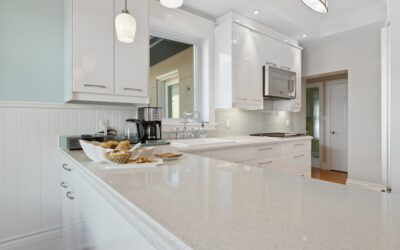
Look closely at a River White slab and you will spot something almost no other white granite has: tiny burgundy garnet crystals scattered across the surface like drops of wine on snow. Those flecks are the fingerprint of river white granite countertops, and they are the reason designers reach for this stone when a kitchen needs warmth without giving up a light, airy palette. Quarried in southern India, River White delivers soft gray veining that actually looks like moving water, a price point most remodel budgets can absorb, and a consistency between slabs that makes it one of the safer natural stones to order sight unseen.
Part of our Countertops guide — explore the full guide →
- What River White Actually Looks Like
- Origin and Slab Consistency
- Installed Cost: What to Budget
- Cabinet and Color Pairings That Work
- Finish Options: Polished, Honed, or Leathered
- Edge Profiles and Where to Spend
- Sealing and Everyday Care
- How It Stacks Up Against Other White Granites
- Is River White Right for Your Kitchen?
What River White Actually Looks Like
The background sits between true white and pale silver-gray, cooler than cream-toned granites like Colonial White but softer than the stark whites you get from quartz. Across that ground run diffuse gray veins with a horizontal, current-like flow, which is where the name comes from. The veining is low-contrast and blurry at the edges rather than sharp and linear, so the stone reads as gentle movement instead of bold marble-style drama.
Then there are the garnets. Most slabs carry small deep-red to burgundy flecks, usually 1/8 inch or smaller, sprinkled at random across the face. On some slabs they are sparse and easy to miss from six feet away; on others they show up every few inches. If the red dots matter to you, one way or the other, ask your fabricator to photograph the specific slabs on hold before templating. A few bundles run nearly garnet-free, and heavy-fleck bundles do exist, but the majority land in a pleasant middle ground.
Origin and Slab Consistency
River White comes out of quarries in the Tamil Nadu region of southern India, the same granite belt that produces a large share of the affordable white and gray stones sold in the US. Indian quarries in this belt cut at high volume, which does two useful things for buyers. First, supply is steady, so most stone yards keep multiple bundles in stock and replacement slabs are easy to source if a fabricator breaks one. Second, slab-to-slab variation is modest. Where a Brazilian stone like Alaska White can swing wildly from one slab to the next, two River White slabs from the same bundle usually look like siblings. For an L-shaped kitchen needing two or three slabs, that consistency means your seams and your island will read as one continuous material.
Standard slabs run roughly 112 to 120 inches long by 68 to 75 inches tall, in 3 cm (1 1/4 inch) thickness for most kitchen work. Some yards also carry 2 cm material, which is common for bathroom vanities or laminated waterfall edges. A typical 3 cm slab yields about 50 to 55 usable square feet after trimming, so an average 45 to 55 sq ft kitchen usually needs two slabs once you account for sink cutouts and vein flow.
Installed Cost: What to Budget
River White sits in the entry-to-mid tier of granite pricing. Expect $40 to $60 per square foot installed in most US markets, covering the slab, fabrication, a standard eased or quarter-round edge, and installation. Raw slab cost is typically $8 to $15 per square foot at wholesale, which tells you most of what you pay goes to fabrication labor rather than the stone itself. A 50 sq ft kitchen lands around $2,000 to $3,000 all-in, plus extras.
Those extras are where quotes drift apart. An undermount sink cutout with polished reveal runs $150 to $300. Upgraded edges like ogee or waterfall add $10 to $40 per linear foot. Removing and hauling off old laminate tops adds $150 to $400. Because River White is widely stocked, you can and should get three quotes; on a commodity-tier stone, fabricator pricing varies more than slab pricing does.
Cabinet and Color Pairings That Work
The cool gray undertone is your anchor. White shaker cabinets are the classic partner, and the pairing works because River White carries enough gray movement to keep an all-white kitchen from going flat. Gray cabinets, from light dove to mid-tone slate, echo the veining and produce a calm monochrome scheme. Where the stone gets interesting is the garnets: pull those burgundy flecks into the room with cranberry bar stools, a wine-red kitchen rug, oil-rubbed bronze hardware, or a deep red front door visible from the kitchen, and the whole space suddenly looks intentional.
- Safe bets: white shaker, dove gray, greige, light natural oak
- Bolder plays: navy island with brass pulls, black-framed windows, burgundy accents
- Avoid: heavy cream or yellow-beige cabinetry, which fights the cool gray ground and makes the white look dingy by comparison
For backsplashes, a simple white subway tile or a soft gray glass mosaic lets the counter carry the movement. Skip busy multicolor mosaics; the garnets already provide the accent color.
Finish Options: Polished, Honed, or Leathered
Nearly all River White inventory arrives polished, and polish suits it. The gloss deepens the gray veining and makes the garnet flecks sparkle under pendant lights. Honed River White is available by special order or can be refinished by your fabricator for roughly $10 to $20 per square foot extra; the matte surface mutes the veining into a soft watercolor effect that works in farmhouse and Scandinavian-leaning kitchens. Be aware that honing opens the surface slightly, so a honed slab needs sealing more often and shows fingerprints and oil marks more readily. Leathering is less common on this stone because the fine grain does not develop the dramatic texture that leathering gives to darker granites, but a few fabricators offer it and the result is a subtle low-sheen pebbling that hides water spots well around sinks.
Edge Profiles and Where to Spend
On a stone this visually soft, restrained edges look best. An eased edge or a 1/4-inch bevel keeps the counter modern and costs nothing extra at most shops. Half bullnose is a smart pick for households with kids, since it removes the sharp top corner at hip height. Ornate ogee and cove edges tend to fight the casual character of the stone; they read best on formal, traditional granites with heavier pattern. If you want one splurge, put it into a mitered waterfall on the island end panel instead of a fancy edge profile; River White’s horizontal flow looks genuinely striking turning a 90-degree corner down to the floor.
Sealing and Everyday Care
River White is a true granite with medium porosity, denser than marble but more absorbent than dark granites like Absolute Black. Fabricators seal it at install, and you should plan to reseal roughly once a year. The test is simple: pool a tablespoon of water on the counter for 15 minutes, and if the stone darkens underneath, it is time. A quality impregnating sealer such as a solvent or water-based fluoropolymer product costs $20 to $40 a bottle and takes 20 minutes to apply. Wipe on, let it dwell 10 minutes, buff off the excess, done.
Day to day, warm water and a drop of dish soap handle almost everything. Skip vinegar, lemon-based cleaners, and anything abrasive; acids will not etch granite the way they etch marble, but they degrade the sealer over time. Cooking oil is the main stain risk on a light stone like this, so wipe spills near the range promptly. Set hot pans on trivets out of habit; granite tolerates heat well, but thermal shock can crack stone near a cold seam or cutout.
How It Stacks Up Against Other White Granites
Among the popular Indian whites, River White is the one with directional movement. Colonial White is speckled and uniform with almost no veining, while Kashmir White has a similar flowing character but tends toward a creamier base and higher porosity. Against Brazilian Alaska White, River White is far tamer: less contrast, smaller crystals, and much better slab consistency, usually at $5 to $10 less per square foot installed. Choose River White when you want visible movement that stays quiet, and when you want confidence that the slab installed in your kitchen will match the sample you approved at the yard.
Is River White Right for Your Kitchen?
Pick this stone if you want a light, cool-toned counter with real natural-stone character at a mid-range price, and especially if the idea of tiny garnet accents appeals to you rather than annoys you. Budget $40 to $60 per square foot installed, insist on viewing or receiving photos of your actual slabs, keep the edge profile simple, and reseal annually. Do that, and river white granite countertops will still look current twenty years from now, long after trendier surfaces have dated the kitchens around them.