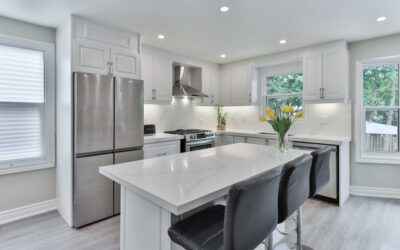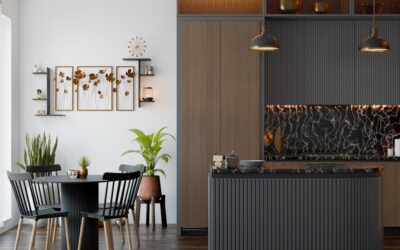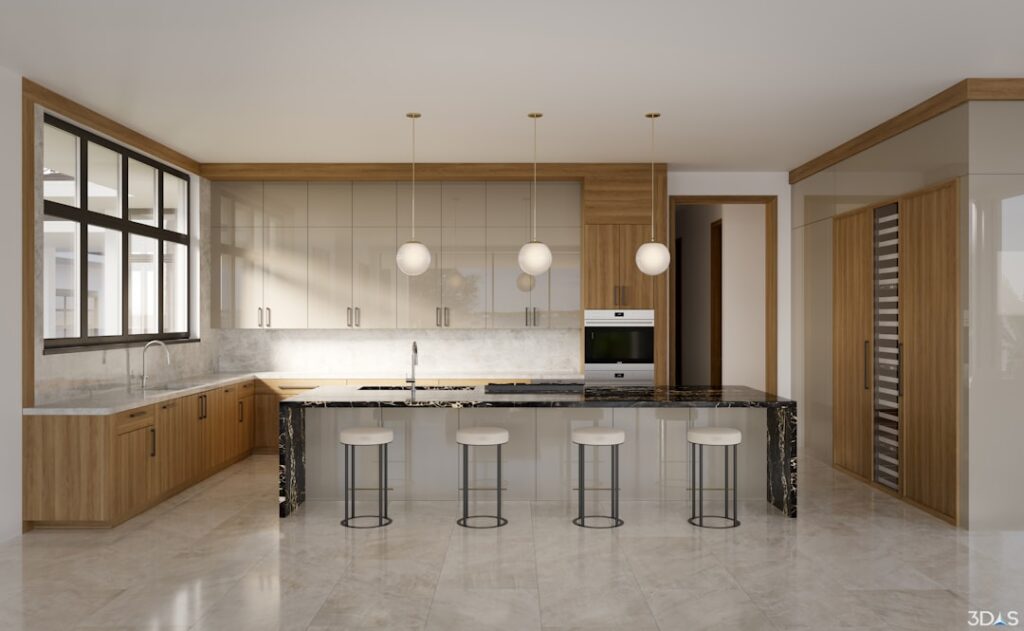
Sharp corners on a kitchen island have a way of finding hips, toddlers’ foreheads, and the flow of a crowded party. A rounded kitchen island softens all of that, improving traffic flow while adding a sculptural focal point that a plain rectangle can’t match. Whether you’re drawn to a fully round island, a gentle curved end, or a rounded seating overhang, the shape solves practical problems and elevates the look of the room. This guide covers the shape options, seating, sizing, materials, and the real costs behind that graceful curve.
Part of our Kitchen Remodeling guide — explore the full guide →
- Types of Rounded Islands
- Why Choose a Curve? The Practical Benefits
- Seating Around a Curve
- Sizing and Clearance
- Countertop Materials for Curved Islands
- What It Costs
- Design Tips to Get It Right
- Is a Rounded Island Right for You?
- Adding a Sink or Cooktop to a Curved Island
- Lighting and Proportion Above the Curve
- Frequently Asked Questions
Types of Rounded Islands
“Rounded” covers a range of designs, each with different benefits.
Fully Round or Oval Islands
A true circular or oval island makes a bold statement and works beautifully in open-concept kitchens where the island is viewed from all sides. It encourages conversation, since seating wraps around, and eliminates every corner. The trade-off is usable counter space; curves reduce flat working surface compared to a rectangle of the same footprint.
Curved-End Islands
The most popular compromise is a rectangular island with one or both ends rounded off. You keep a generous straight work surface for prep while softening the corners and creating a natural, comfortable spot for stools at the curved end. This is the versatile middle ground for most kitchens.
Curved Seating Overhangs
Here the base cabinetry stays rectangular, but the countertop curves outward on the seating side to form a rounded eating bar. It’s an easier build than a fully curved cabinet and delivers the friendly, huddle-around feel without sacrificing cabinet storage.
Why Choose a Curve? The Practical Benefits
Beyond looks, rounded islands earn their keep:
- Better traffic flow: no corners to catch clothing or bruise hips in a busy kitchen
- Child safety: soft edges are gentler when little ones are running through
- Sociable seating: curves let people face one another rather than sitting in a row
- Visual softness: a curve balances the hard lines of cabinetry and appliances
In tight kitchens especially, shaving a corner off the island can open up a pinch point and make the whole room walk better.
Seating Around a Curve
Rounded ends are ideal for stools. To seat people comfortably, plan on 24 inches of linear counter width per person, and provide a 12-inch overhang for knee room at counter height (36 inches) or 15 inches at bar height (42 inches). A curved end naturally seats two to three people who can see and talk to each other, a warmer arrangement than a straight bench.
Support the overhang properly. Curved stone overhangs beyond 10 to 12 inches usually need steel brackets or corbels hidden beneath, because unsupported stone can crack under weight.
Sizing and Clearance
The curve doesn’t change the golden rule of island clearance: leave at least 36 inches, ideally 42 to 48 inches, of walkway on all sides between the island and surrounding cabinets or walls. In kitchens with heavy traffic or multiple cooks, err toward 48 inches so appliance doors and the dishwasher can open without a collision.
A rounded island should be a minimum of about 4 feet in its longest dimension to be useful, though most functional islands run 6 to 8 feet long. If your kitchen can’t spare 42 inches of clearance around a full island, a curved peninsula attached to one run of cabinets may serve better.
Countertop Materials for Curved Islands
Not every material curves equally well. Your choice affects both looks and cost.
- Quartz: fabricators can cut smooth curves, and its consistent pattern hides seams well; the top pick for durability
- Granite and natural stone: curves beautifully but large radii may require seaming, and the slab yield drops
- Butcher block: wood can be shaped into curves and sanded smooth, giving warmth at a lower cost
- Concrete: poured in a custom form, concrete is ideal for organic, freeform curves
Expect curved fabrication to add to the price. Cutting and polishing a radius takes more labor than a straight edge, and curves increase material waste from the slab.
What It Costs
A rounded island generally costs more than a rectangular one of the same size, mainly in countertop fabrication and custom cabinetry. Curved cabinet bases are not stock items; they require custom or semi-custom construction, adding several hundred to a couple thousand dollars. Countertop curves add roughly 10% to 25% to fabrication versus straight edges. All told, a custom rounded island commonly runs $3,000 to $8,000-plus installed, depending on size, materials, and whether it includes a sink or cooktop.
Design Tips to Get It Right
Balance the curve with the rest of the kitchen. If your cabinetry is very linear and modern, a single curved end reads as an intentional, elegant contrast. Keep the pendant lighting above in proportion; two or three pendants follow a long curved island better than one. Consider the flooring pattern as well, as curves interact with tile grout lines and plank direction in ways a rectangle doesn’t.
Finally, mock it up. Tape the island’s footprint, including the curve, on your floor and live with it for a few days. Walk the clearances, pull a chair up to the seating end, and make sure the curve actually improves flow rather than just looking good on paper.
Is a Rounded Island Right for You?
A rounded kitchen island rewards open-concept spaces, homes with young children, and anyone who entertains and wants sociable seating. It costs more and yields slightly less flat counter than a rectangle, so weigh those trade-offs against the safety, flow, and striking looks it delivers. For many homeowners, softening even one end of the island is the detail that makes the whole kitchen feel custom and inviting.
Adding a Sink or Cooktop to a Curved Island
Many homeowners want the island to do more than hold stools, and a rounded shape can accommodate a sink or cooktop with some planning. Keep the appliance or basin on the straight portion of the island rather than the curve, where flat counter is at a premium and plumbing or ductwork is easier to route. Preserve landing space on both sides of a cooktop and enough counter beside a sink for dishes. Remember that a downdraft or overhead vent adds cost and constrains where the cooktop can sit, and a sink requires the plumbing and possibly the dishwasher to be planned into the cabinet run before fabrication.
Lighting and Proportion Above the Curve
Lighting can make or break how a curved island reads. A single pendant looks lost over a long island; instead, hang two or three fixtures spaced evenly, following the island’s length. Over a fully round island, a single large statement fixture or a round chandelier centered on the island echoes the shape beautifully. Hang pendants so the bottoms sit about 30 to 36 inches above the countertop, high enough to see across the island but low enough to define the space. Scale the fixtures to the island; oversized pendants overwhelm a small curved island, while undersized ones disappear over a large one.
Frequently Asked Questions
Does a rounded island cost more than a rectangular one?
Yes. Curved countertop fabrication adds roughly 10 to 25 percent over straight edges, and curved cabinet bases require custom or semi-custom construction. Expect $3,000 to $8,000-plus installed.
How much clearance do I need around a rounded island?
Keep at least 36 inches, ideally 42 to 48 inches, of walkway on all sides so appliance and cabinet doors open freely and traffic flows.
What countertop material is best for curves?
Quartz is the top pick; its consistent pattern hides seams and it fabricates into smooth curves well. Concrete and butcher block also shape into curves nicely.
How many people can a rounded island seat?
Plan on 24 inches of counter width per person. A rounded end typically seats two to three people comfortably who can face and talk to one another, which is warmer than a straight row of stools along a rectangular island.