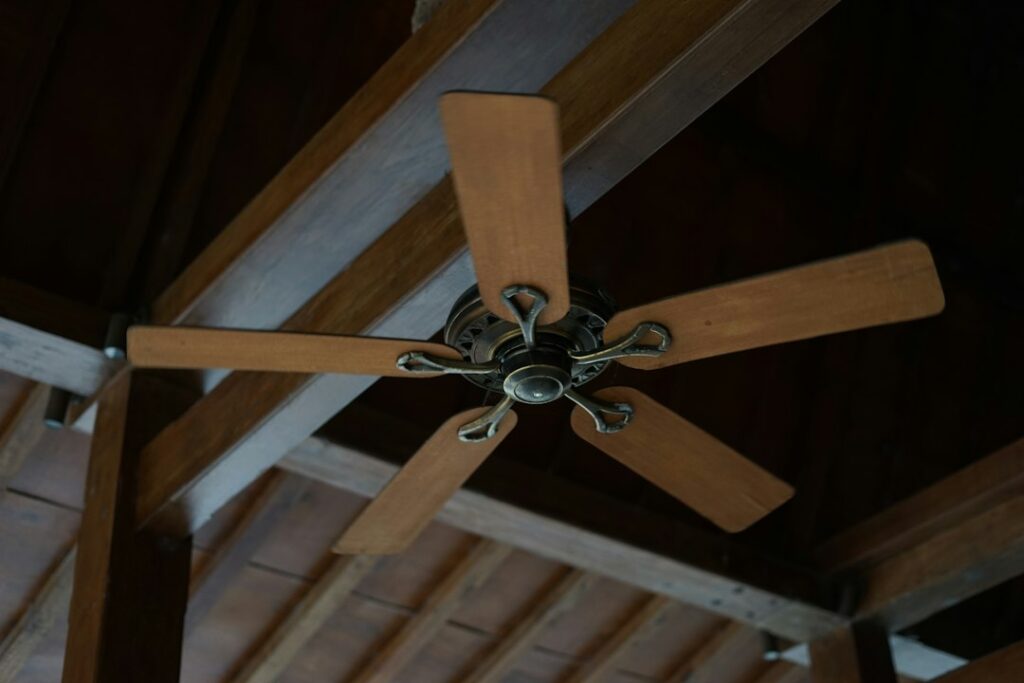
A fan is often the single largest object hanging in a room, which is why rustic ceiling fans can make or break a cabin, lodge or mountain-style interior. Pick one with hand-scraped blades and a dark iron housing and the ceiling suddenly feels like part of the timber frame. Pick a glossy builder-grade model and it looks like an afterthought, no matter how good the beams and stone are.
The rustic look rests on three building blocks: distressed or reclaimed-style wood blades, forged or hammered iron hardware, and decorative frames such as wagon wheels and open cages. Most good choices combine two of the three. Size, blade count, finish color and the light kit then decide whether the fan blends into the room or fights it.
- What Defines Rustic Ceiling Fans
- Wood Blade Styles and Finishes
- Forged Iron and Metal Details
- Wagon Wheel and Cage Designs
- Vintage Ceiling Fans and Rustic Hybrids
- Sizing and Placement for Cabin and Lodge Rooms
- Choosing a Light Kit
- Indoor, Damp and Wet Ratings
- Installation and Safety Basics
- Cost Ranges and Care
- Frequently Asked Questions
Rustic style is heavier and rougher than its cousins. Farmhouse fans lean clean and white-washed, and antique or period fans copy specific historical designs. Rustic sits closer to the hunting lodge, the ranch house and the log cabin, with knots, saw marks and blackened metal on full display.
What Defines Rustic Ceiling Fans
Most rustic ceiling fans share a short list of visual traits. Blades show visible grain, knots, wire-brushed texture or a weathered gray patina. Motor housings come in oil-rubbed bronze, matte black, aged iron or a rust-toned finish rather than polished nickel or chrome. Hardware looks heavier than it needs to be: thick blade arms, exposed rivets, strap-style brackets and chunky downrods.
Shape matters as much as finish. Straight, wide paddle blades read more rustic than slim, swept blades. Square or drum-shaped housings fit lodge rooms better than sleek domes. Light fixtures tend toward seeded glass, amber glass, Edison-style bulbs or mason-jar style shades rather than frosted white bowls.
Texture carries the look. A fan with honest-looking wood and dark metal can work in a log cabin, a converted barn, a craftsman bungalow with a stone fireplace or even a suburban family room that leans toward warm, worn finishes.
Wood Blade Styles and Finishes
Blades provide most of the rustic character, so it pays to look closely at what they are made from and how they are finished.
Solid wood versus wood-look blades
Solid wood blades look the most authentic and age nicely, but they are heavier and can warp in damp spaces. Most fans use plywood or MDF blades wrapped with a printed or textured wood veneer. A good veneer with real brushed texture is hard to tell from solid wood at ceiling height. Molded resin or ABS blades molded to look like weathered barn wood are the practical choice for covered porches and other damp locations.
Common rustic finishes
- Distressed walnut or dark oak: pairs with log walls and dark beams.
- Weathered gray or driftwood: suits modern cabins, gray stone and lighter pine paneling.
- Reclaimed barn wood look: mixed tones and saw marks for a ranch or barn conversion.
- Hand-scraped pecan or hickory: warm, light-brown tones for knotty pine rooms.
- Carved or branch-style blades: sculpted to look like leaves, paddles or tree limbs for themed lodge rooms.
Match blade tone to something already in the room, such as ceiling boards, floors, cabinets or the mantel, rather than introducing a fourth wood color. When the ceiling is dark tongue-and-groove, a lighter weathered blade keeps the fan visible; on white drywall, darker blades give the fan presence.
Forged Iron and Metal Details
Metal work is where rustic fans separate from generic wood-blade models. Look for housings with a hammered, pitted or brushed texture rather than a smooth powder coat. Oil-rubbed bronze with copper highlights, textured black, aged pewter and rust brown are the common choices.
Exposed hardware adds to the look. Some fans use strap-iron blade arms with visible bolt heads, scroll work or rope-twist details. Others wrap the housing in metal bands like a whiskey barrel. Industrial-rustic fans may use pipe-style downrods and cage-wrapped motors.
Keep metals consistent. If the room has black iron door hardware, a black iron chandelier and black window hardware, an oil-rubbed bronze fan can look slightly off. Matte black is the safest crossover finish because it works with dark and light wood alike.
Wagon Wheel and Cage Designs
A wagon wheel ceiling fan surrounds or caps the motor with a spoked wooden or metal ring that looks like an old wagon wheel. Some designs place the wheel above the blades as a decorative canopy; others hang it below as a light fixture with candle-style bulbs around the rim. Either way, the wheel brings a ranch and western feel that pairs well with leather furniture, saddle-blanket textiles and stone.
Cage fans enclose the blades inside a round metal frame, often in black or bronze. They lean industrial-rustic and work well in barn-style kitchens, lofts and shop-style garages. The cage protects blades from bumps, which is handy in rooms with lower ceilings or lots of activity, though it does reduce airflow somewhat compared with an open fan of the same diameter.
Both styles are statement pieces. Use one per room and keep other fixtures simpler, or the ceiling starts to look like a prop shop. Wagon wheel models can be heavy, so confirm the fixture weight and use a fan-rated box.
Vintage Ceiling Fans and Rustic Hybrids
Many shoppers looking for rustic style also browse vintage ceiling fans. The two overlap but are not identical. Vintage-inspired fans copy early twentieth-century designs, such as cast housings, schoolhouse glass and slim paddle blades, often in brass or bronze. Rustic fans emphasize rough wood and darker iron.
Hybrids blend the two well. A cast-iron-look motor with weathered wood paddles and a single Edison bulb can suit an old farmhouse, a mountain cabin or a craftsman home. If you want genuine antique fans, buy from a restorer who rewires them and confirms the motor and mounting hardware are safe; old fans can have brittle wiring and worn bearings.
Sizing and Placement for Cabin and Lodge Rooms
Rustic rooms are often larger and taller than average, with vaulted or beamed ceilings. Size the fan to the floor area:
- Up to 75 sq ft (bath, small loft): 29 to 36 inch blade span.
- 76 to 175 sq ft (bedroom, office): 42 to 48 inches.
- 176 to 350 sq ft (living room, kitchen): 52 to 56 inches.
- 350 sq ft and up (great room, open lodge space): 60 to 72 inches, or two fans.
Blades should hang about 8 to 9 feet above the floor and at least 10 to 12 inches below the ceiling. On a vaulted ceiling, use a sloped-ceiling adapter and a longer downrod so the blades clear the slope. In a room with exposed beams, center the fan between beams instead of mounting it on one, unless a beam is the only solid support and an approved bracket is used.
Blade count is mostly visual. Three paddles look lighter and more open; five or more wide blades look heavier and suit the lodge feel. Airflow depends more on motor quality, blade pitch and size than on count.
Choosing a Light Kit
A rustic ceiling fan with light can replace a separate fixture, which helps in bedrooms and smaller cabins. Common choices include:
- Seeded or amber glass bowls for a warm glow.
- Exposed Edison-style LED bulbs on a short cluster.
- Mason-jar or lantern-style shades.
- Candle-style bulbs on a wagon wheel ring.
- Integrated LED panels hidden under a wood-trimmed housing.
Pick warm color temperatures, around 2700K, to match wood tones. Dimmable LEDs let one fixture handle both reading light and evening ambiance. Avoid bright 5000K daylight bulbs, which make wood look gray and flat.
Indoor, Damp and Wet Ratings
Cabins come with porches, screened rooms and outdoor kitchens. Indoor-rated fans belong only in dry, enclosed spaces. Damp-rated fans handle covered porches and bathrooms with humidity. Wet-rated fans can take direct rain and are the only choice for open pergolas and uncovered exposure.
For porches, choose resin blades with a wood-grain finish and sealed housings. Real wood blades outdoors tend to warp, crack or grow mildew within a few seasons.
Installation and Safety Basics
Rustic fans tend to be heavy, so mounting matters. Every ceiling fan needs an electrical box rated and labeled for fan support, fastened to framing or a fan brace bar. Standard light boxes are not designed for the motion and weight of a fan.
If you replace an existing fixture, turn off the breaker and confirm power is off with a non-contact voltage tester before touching any wires. Follow the manufacturer’s wiring diagram, tighten blade screws evenly and use the included balancing kit if the fan wobbles. Use a sturdy ladder at the correct height and keep three points of contact. Adding a new switch, a new circuit or a box where none exists is work for a licensed electrician, and vaulted ceilings over about 12 feet often call for a pro with scaffolding.
Cost Ranges and Care
General price tiers look like this: basic wood-look fans with simple bronze housings run at the budget end, mid-range fans with better veneers, DC motors and light kits cost a few hundred dollars, and statement wagon wheel, solid wood or large-span lodge fans can run well past that. Professional installation on an existing fan-rated box is usually a modest flat fee; new wiring or high ceilings cost more.
Care is simple. Dust blades every few weeks with a microfiber cloth or a pillowcase slipped over each blade. Avoid soaking wood blades; a barely damp cloth is enough. Check blade screws and mounting bolts once a year, and reverse the fan direction seasonally: counterclockwise in summer for a cooling breeze, clockwise on low in winter to push warm air down from tall cabin ceilings.
Frequently Asked Questions
What makes a ceiling fan look rustic?
Textured or distressed wood blades, dark hammered or forged metal, heavy hardware and warm glass or Edison-style lighting. Wagon wheel and cage designs push the look further toward ranch or industrial styles.
Are wagon wheel ceiling fans heavy?
They are often heavier than standard fans because of the decorative ring. Check the listed fixture weight and mount it to a fan-rated box secured to framing or a brace bar.
Can rustic ceiling fans go on a covered porch?
Yes, if the fan is damp-rated or wet-rated. Choose resin blades with a wood-grain finish, since real wood blades tend to warp outdoors.
What size rustic fan suits a great room?
For rooms over about 350 sq ft, look at 60 to 72 inch blade spans or use two fans spaced evenly across the space.
Should the fan finish match the other metals in the room?
It looks best when it does. Matte black is the easiest finish to coordinate with both dark and light woods and most iron hardware.