A poorly chosen sauna floor warps within two seasons, traps bacteria in the grout lines, and turns into a slip hazard the moment you step in wet. Smart sauna flooring solves three problems at once: it shrugs off 180°F cabin temperatures, drains sweat and rinse water away from your feet, and stays cool enough to stand on without burning your soles. The market has narrowed to a handful of proven solutions, and the right pick depends on whether your sauna is a backyard barrel unit, a basement build, or a high-traffic gym installation.
Why Subfloor Material Choice Matters
Saunas run hot and humid, cycling between 160-200°F with ambient humidity swinging from 10% to 40% in traditional dry saunas and far higher in steam rooms. That punishes most residential flooring. Solid hardwood cups, laminate delaminates at the seams, and standard vinyl off-gasses plasticizers you do not want to breathe while sweating.
The slab or subfloor under your sauna typically stays one of three surfaces: sealed concrete, tile, or a waterproof membrane over plywood. The top layer, the part your feet touch, is where the real decision lives. That top layer is almost always removable so you can pull it out to rinse and dry the room between uses.
Cedar Duckboards: The Traditional Choice
Western red cedar is the default for a reason. It resists rot, handles repeated wet-dry cycles, and carries a pleasant aroma that amplifies when the wood warms up. Cedar duckboards are wooden grates, typically 3/4 inch slats spaced 1/2 inch apart, mounted on small feet that lift the deck roughly an inch off the floor.
The air gap is the entire point. Water runs through the slats, sits on the waterproofed subfloor below, and evaporates or drains away. Your feet stay out of the puddle. Expect to pay $8-$14 per square foot for pre-built cedar duckboard sections, or $4-$6 per board foot if you mill your own.
- Rot-resistant without chemical treatment
- Naturally cool underfoot even at high cabin temps
- Modular sections lift out for cleaning
- Develops a silver-grey patina over 2-3 years
Hemlock and Basswood Alternatives
Hemlock is the runner-up and the budget pick. It lacks cedar’s oils, so it does not scent the room, but that is actually preferred in commercial or shared saunas where users may find cedar overpowering. Hemlock costs roughly 25% less and handles heat well when properly kiln-dried to below 10% moisture content.
Basswood shows up in premium Scandinavian builds. It is light in color, very low in resin, and known for staying cool. Aspen falls in the same family. Neither is as rot-resistant as cedar, so both demand a bone-dry subfloor and a diligent post-use wipe-down.
Tile, Stone, and Concrete Floors
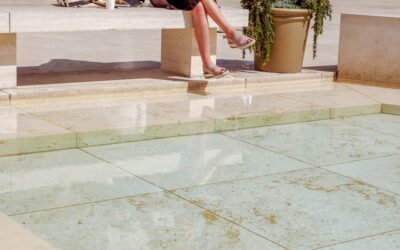
Many commercial saunas and most steam rooms skip wood entirely and run porcelain tile or sealed concrete straight through the cabin, pitched toward a floor drain. The look is modern and the hygiene is unbeatable. The downside is heat transfer. Dark tiles can hit 130°F by the end of a 45-minute session, hot enough to feel uncomfortable on bare feet.
Fix this two ways: choose light-colored porcelain or travertine to reflect radiant heat, or overlay the tile with a removable cedar or teak grate. Rubber mats are a bad idea here — most household rubber compounds warn against continuous exposure above 160°F, and cheap mats leach odor as they heat.
Non-Slip Surfaces and Drainage
Wet cedar is surprisingly grippy, but only when the slats are unfinished or lightly oiled. A glossy polyurethane topcoat turns a duckboard into a skating rink. For tile installations, specify a coefficient of friction (COF) of 0.60 or higher wet — most porcelain suppliers publish this spec.
Every sauna benefits from a slope of at least 1/4 inch per foot toward a drain. In a dry sauna this handles rinse water and mop-out. In a steam room it handles constant runoff. If the builder skipped the slope, you are looking at puddle-prone flooring for the life of the unit, and no surface material will fix that.
Food-Grade Sealers and Finishes
Most sauna wood is left unfinished. The heat dries it between sessions and the oils in cedar and hemlock self-protect. If you want extra protection against staining from sweat, use only food-grade mineral oil or a dedicated sauna paraffin oil. Products like Tylö Sauna Wood Treatment or Auroom Wax are formulated to stay stable above 180°F without off-gassing.
Never use polyurethane, standard deck stain, or tung oil inside a sauna cabin. These finishes trap moisture under the film, blister in the heat, and introduce fumes you will inhale for every future session. The smell alone tells you the finish is breaking down.
Installation Tips From the Field
Build duckboards in sections no larger than 3 by 3 feet so a single person can lift one out. Use stainless steel or hot-dipped galvanized fasteners — standard steel rusts within a year in this environment. Leave a 1/2 inch gap between the duckboard edge and the wall for air circulation.
If you are retrofitting over existing tile, verify the tile is structurally sound and the grout is sealed. A quick water test tells you: pour a cup on the floor and see if any weeps through a crack or seam. Any leak into the subframing will rot the cabin from below, and you will not see it until it is too late.
Common Mistakes to Avoid
Homeowners repeatedly trip over the same issues. Carpet tiles and foam mats show up in DIY builds and fail fast. Pressure-treated lumber under the duckboards releases chemicals when heated — never use PT wood inside a sauna. And skipping the air gap under the duckboard defeats the whole design; the floor stays wet, the wood rots, and you will be rebuilding in three years.
Final Recommendation
For a home sauna, a cedar duckboard over waterproofed concrete or tile is the sweet spot — roughly $400-$700 in materials for a 6 by 8 foot cabin, removable for cleaning, lasts 10-15 years before the boards silver beyond appeal. For commercial or gym saunas, go porcelain tile with a pitched drain and add removable teak grates in walkways. Either way, budget for the subfloor waterproofing first. The surface you step on is the easy part. What is underneath decides whether the room survives.
Prefer to explore on your own?
See how new flooring looks in your actual room in seconds — free, no signup.
Try the free Floor Studio →