Adding a sauna to the basement turned from luxury splurge to mid-market upgrade somewhere around 2022, and the appraisal data now shows roughly 60 to 75 percent cost recovery on a well-built installation. A sauna for basement use needs four things most homeowners underestimate at planning — a dedicated 240-volt circuit (or 120-volt for an infrared model), proper ventilation, a moisture-tolerant ceiling assembly, and the ten to twenty inches of headroom most basements barely have. Get the prep right and the sauna lasts thirty years with only stone and bench maintenance.
Traditional vs Infrared Saunas
Traditional Finnish saunas heat the air to 160 to 200 degrees Fahrenheit using a resistive heater wrapped in volcanic stones. Throw water on the stones and you get löyly — the steam burst that pushes apparent temperature above 220 degrees and triggers the deep sweat response Finns have built their wellness culture around for 2,000 years.
Infrared saunas warm the body directly with carbon or ceramic emitters at 110 to 140 degrees Fahrenheit. The user feels heat without the heavy ambient air temperature. Infrared units run on standard 120-volt 20-amp circuits and skip the venting requirements. Traditional units demand 240-volt 30-amp service for any heater above 6 kW.
Sizing for the Basement Footprint
Two-person infrared cabins from Sun Home, Clearlight, or Dynamic Saunas measure roughly 50 by 42 by 75 inches tall. They fit under the standard 7-foot finished basement ceiling with three inches to spare. Four-person traditional cabins measure 80 by 60 by 84 inches tall and need a 7-foot 6-inch ceiling height.
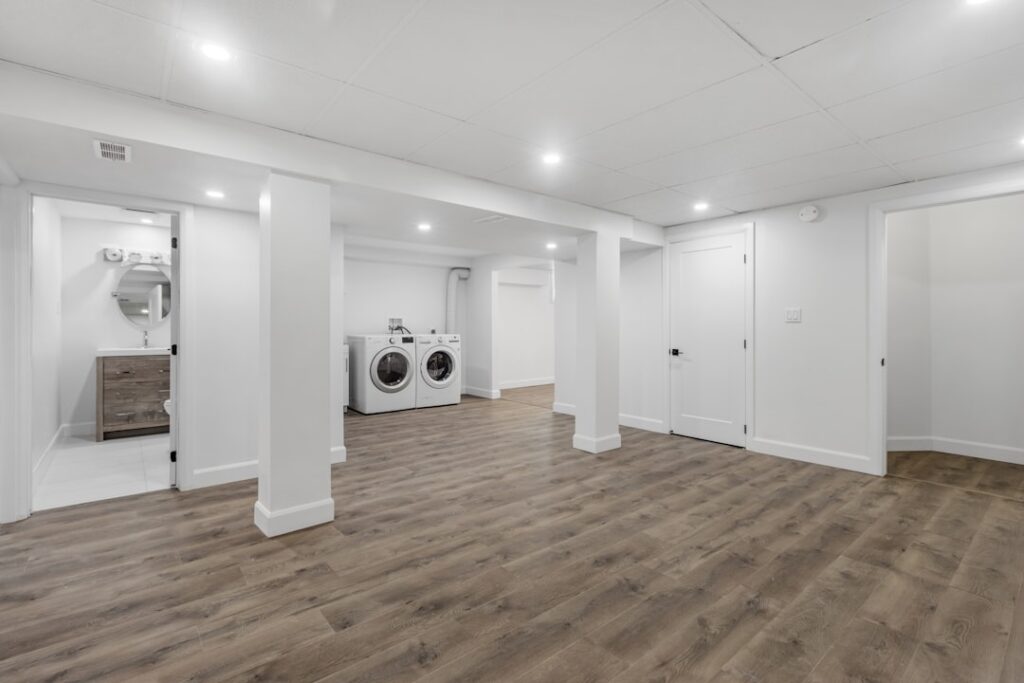
Allow at least 36 inches of clearance in front of the sauna door for egress and at least 12 inches behind the cabin for ventilation airflow. The combined footprint with clearances eats roughly 35 square feet for a two-person and 60 square feet for a four-person installation. Plan the basement layout with the sauna placed near the existing plumbing wall — a cold plunge or rinse shower nearby completes the protocol.
Electrical Requirements
Traditional saunas need 240-volt service sized to the heater. A 6 kW heater draws 25 amps and needs a 30-amp double-pole breaker with 10 AWG wire. An 8 kW heater jumps to 33 amps and requires a 40-amp breaker with 8 AWG wire. NEC Article 422 governs sauna heater wiring and requires GFCI protection on all circuits within 6 feet of the cabin door.
Infrared saunas typically pull 15 to 18 amps on a standard 120-volt 20-amp circuit. Most homes have at least one open 20-amp slot in the basement panel. Run 12 AWG wire to a GFCI receptacle within 6 feet of the cabin and the install meets code. A licensed electrician charges $280 to $580 for either circuit.
Ventilation and Air Exchange
Traditional saunas need both an inlet vent and an outlet vent — the inlet positioned near the floor below the heater, and the outlet positioned high on the opposite wall. The two vents together exchange the cabin air roughly six times per hour and prevent the carbon dioxide buildup that triggers headaches after 20 minutes of use.
The basement room housing the sauna also needs make-up air. A 6-inch diameter passive vent to outside through a rim joist provides the airflow the sauna draws when in operation. Skip this and the sauna pulls combustion air from the furnace, water heater, or other appliances — a backdraft hazard that can introduce flue gases into the house.
Wood Species and Bench Construction
Western red cedar dominates American sauna construction because the wood handles temperature swings without warping, resists rot, and stays comfortable to touch even at 180 degrees. Expect $4 to $7 per board foot for clear vertical-grain cedar from Sutter Lumber or Mendocino Forest Products. A typical four-person sauna consumes roughly 180 board feet of cedar.
Nordic spruce from Finnleo runs slightly cooler to the touch and delivers the most authentic Finnish look. Eucalyptus and basswood are budget alternatives that hold up acceptably but lack the aromatic terpenes that define the cedar experience. Skip pressure-treated lumber entirely — the chemical preservatives off-gas dangerously at sauna temperatures.
Vapor Barrier and Insulation
The sauna wall assembly stacks foil-faced vapor barrier directly against the studs (foil side facing the sauna interior), then mineral wool batts at R-13 to R-19, then 1×4 nailers, then cedar tongue-and-groove paneling. The foil reflects radiant heat back into the cabin and serves as the vapor barrier. Use aluminum HVAC tape at every seam — not standard duct tape, which fails at sauna temperatures.
The ceiling needs heavier insulation — R-30 minimum — and the same foil-faced assembly. Most heat loss in a sauna escapes through the ceiling. Skimp on the ceiling and the heater runs 30 to 40 percent longer per session to maintain temperature.
Brand Recommendations and Pricing
Sun Home Saunas, Dynamic Saunas, and Clearlight dominate the infrared market with 2-person cabins at $1,800 to $3,800 and 4-person at $3,400 to $5,800. The cabins ship pre-built and assemble in a single afternoon — no electrical service upgrade needed beyond a dedicated 20-amp circuit.
Finnleo, Almost Heaven, and Saunacore lead the traditional market. Finnleo Family at $5,800 to $8,400 for a 4-person traditional cabin with a 6 kW heater is the residential standard. Custom-built rooms framed in place run $7,200 to $14,000 in materials and labor for a 4 by 6 foot footprint, plus another $2,400 to $4,800 for the heater and stones.
The Cool-Down and Cold Plunge
The protocol calls for 15 to 20 minutes in the sauna followed by a cold plunge or cold shower at 50 to 60 degrees Fahrenheit. In a basement install, a 50-gallon cold plunge tank from Renu Therapy, Plunge, or Ice Barrel sits next to the sauna at $1,800 to $4,900 for the tank, chiller, and filtration. A simpler cold rinse shower with a thermostatic valve set to 60 degrees runs $600 to $1,400 in plumbing parts and labor.
Plan a non-slip flooring near both the sauna and cold plunge. Tile with a coefficient of friction above 0.6 wet, or marine-grade SPC luxury vinyl plank, holds up to the constant water exposure better than standard luxury vinyl tile.