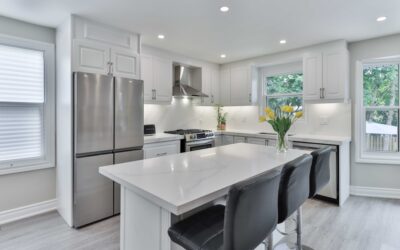
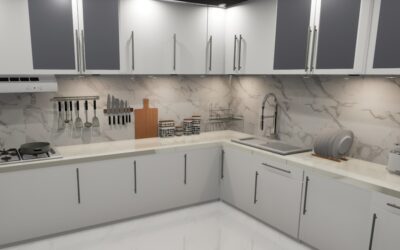
Coastal style took a sharp turn around 2019 when designers moved away from the literal anchor-and-starfish look toward something quieter and more grounded. Seaside coastal kitchen design today leans on weathered woods, soft whites with green or blue undertones, raw textures like jute and rattan, and brass hardware aged to look like driftwood-recovered hardware. The goal is a kitchen that feels lived-in by the third generation of a family who has summered at the same beach house since the 1960s, even if your house is brand new. Done well, it ages beautifully and resells exceptionally well in coastal markets where buyers expect a specific aesthetic.
Part of our Kitchen Remodeling guide — explore the full guide →
Color Palette That Holds Up
The biggest mistake homeowners make is choosing colors based on Pinterest photos taken at golden hour in Nantucket. Real coastal light is harsh, especially in afternoon sun on south-facing kitchens. Whites with too much blue read sterile by 2 PM, while warm whites with yellow undertones look dingy in the same conditions. The colors that consistently work are Benjamin Moore White Dove OC-17 for upper cabinets, Sherwin-Williams Sea Salt SW 6204 for lower cabinets or islands, and Farrow & Ball Pavilion Gray No. 242 for trim and architectural details.
For an accent wall or kitchen island, consider Benjamin Moore Boothbay Gray HC-165, a soft blue-green that shifts with the light from steely morning blue to warm green-gray at sunset. Avoid pure navy in coastal kitchens; it reads nautical-themed rather than coastal-organic. If you want depth, use Farrow & Ball Inchyra Blue No. 289, which has enough green to feel rooted in the landscape rather than imported from a yacht club.
Cabinetry That Survives Salt Air
Salt air destroys cabinets faster than any other environmental factor in residential construction. Within five miles of the ocean, expect particle board cabinets to fail at the joints within seven to ten years as moisture migrates through the laminate. Spend the money on solid wood or marine-grade plywood construction. The cost difference is substantial: KraftMaid stock cabinets in painted maple run about $185 to $260 per linear foot, while semi-custom solid wood from a regional shop typically costs $320 to $480 per linear foot.
Door styles that work include simple shaker, beadboard inset, and flat-panel slab. The shaker is the most versatile and resells across multiple style preferences. Beadboard reads as more explicitly coastal and dates faster, so use it on islands or open shelving rather than the entire kitchen. Skip raised-panel doors with heavy ornamentation; they feel too formal for the coastal aesthetic and collect salt dust in the profile recesses.
Countertops Worth Specifying
Quartz beats natural stone for coastal kitchens because salt and acidic citrus do not etch the surface. The Cambria Brittanicca Warm pattern at $85 to $110 per square foot installed reads as carrara marble without the maintenance headaches. For a more rustic feel, look at Caesarstone Rugged Concrete 4033 at $65 to $85 per square foot, which mimics weathered limestone without the porosity issues.
- Avoid: Polished marble or limestone, soapstone in heavy-use kitchens, dark granite that reads too formal
- Choose: Honed quartz, butcher block on islands, soapstone on bar tops if you want one natural material
- Budget pick: Formica Calacatta Marble laminate at $9 to $14 per square foot installed for rental properties
- Splurge pick: Honed Calacatta Gold marble at $145 to $195 per square foot if you accept the etching patina
Floors That Hide Sand
Sand tracked in from the beach is the constant enemy of coastal kitchen floors. Polished hardwood shows every footprint and scratches visibly within two seasons of heavy summer use. Wide-plank engineered oak with a wire-brushed, matte-oil finish performs better because the textured surface disguises sand particles and minor scratches between annual oilings. Stuga Studio Birka at $14.99 per square foot or Mirage Imagine Hickory White Mist at $11.49 per square foot are both proven performers in beach houses.
For full-time residences or rental properties, consider porcelain tile that mimics weathered wood. Daltile Emerson Wood EM06 at $6.49 per square foot handles salt and sand abuse for decades without visible wear. The 8-by-48-inch planks read as actual wood from across the room but cannot warp, stain, or scratch. Pair with a 3/8-inch unsanded grout in Mapei Bone or Avalanche to maintain the soft tonal palette.
Hardware and Lighting Details
Hardware in a coastal kitchen needs to look slightly aged from day one. Polished chrome and brushed nickel both feel wrong; they read as suburban-developer-default. Instead, specify unlacquered brass that will patina naturally over five to seven years, satin brass that arrives looking patinated, or oil-rubbed bronze for darker palettes. Rejuvenation Mission Bin Pulls at $34 each and Schoolhouse Heritage Knobs at $28 each both hit the right note without feeling thematic.
Lighting matters as much as hardware. Skip the pendant lights styled to look like ship lanterns or rope-wrapped industrial fixtures; both feel forced. Better choices include Visual Comfort Linear Sconces in burnished brass at $445 each over the island, Cedar & Moss Alto Pendants in white with brass hardware at $295 each over a dining peninsula, and Hudson Valley Wickham wall sconces at $329 each beside the range for warm task lighting. For under-cabinet, use Kichler 4UCSK linear LEDs at $89 per 22-inch unit on a dimmer switch, set to 2700K color temperature for warm evening light.
Open Shelving and Display Considerations
Open shelving photographs beautifully in coastal kitchens but creates real maintenance work in a salt-air environment. Glass, pottery, and brass tarnish or develop films within weeks if not used regularly. If you commit to open shelving, limit it to one wall section of three to five linear feet rather than replacing all upper cabinets. Use solid white oak shelves at 1.5 inches thick rather than thinner industrial-style metal brackets, which rust quickly within 10 miles of the ocean even with powder-coat finishes.
Display only items you use weekly: everyday plates, mixing bowls, glasses for water and wine. Skip the decorative ceramics and curated cookbooks that look great in photographs but accumulate dust and salt residue. The Vermont Country Store sells solid pine peg rails at $39 to $69 per 36-inch unit, which work better than open shelves for mugs and frequently-used tools because items hang rather than collecting dust horizontally.
Range Hood and Backsplash Choices
The range hood is the focal point in most coastal kitchens. A custom plaster hood with simple curved profile, built on a stainless steel insert from Vent-A-Hood or Best, costs $2,400 to $4,800 finished but anchors the room as a thoughtful architectural element. Alternatives include reclaimed wood hood surrounds at $1,800 to $3,200 or simple stainless steel chimney hoods at $890 to $1,400 if budget is the priority.
For backsplash, hand-made or hand-glazed ceramic tile carries the look better than perfectly uniform machine-made tile. Look at Tabarka Studio Moroccan zellige at $28 to $45 per square foot, Cle Tile Field Tile in Mushroom at $25 per square foot, or Fireclay Tile 3-by-12 subway in Sea Glass at $32 per square foot. Run the backsplash full-height behind the range and to the underside of upper cabinets elsewhere. Skip the 4-inch backsplash strip that was standard in the 2000s; it reads as builder-grade and dates the kitchen immediately.