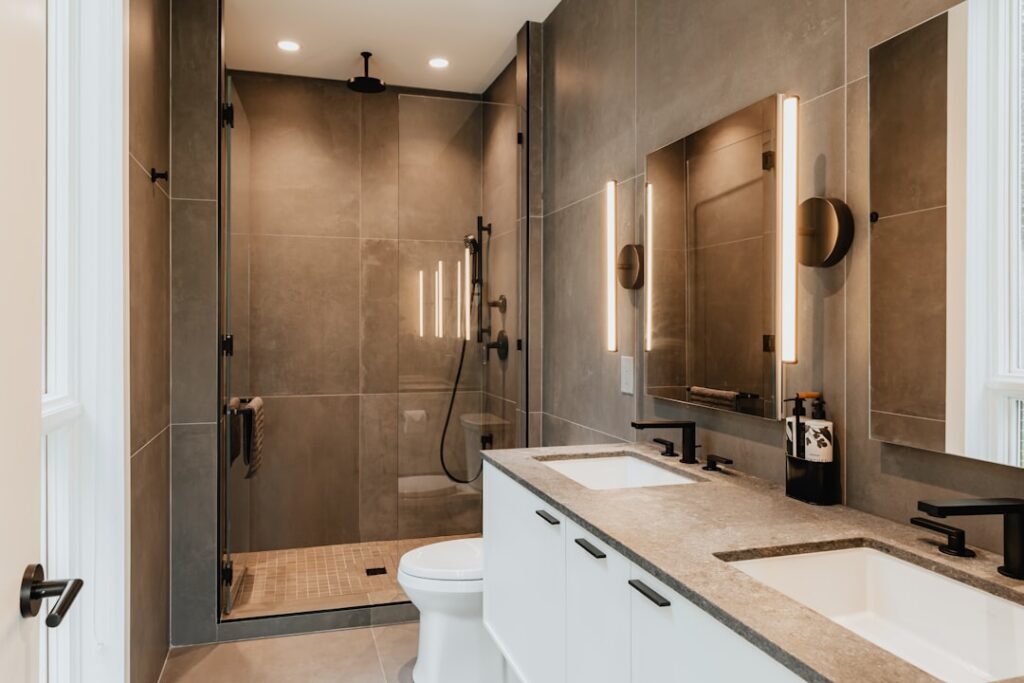
When a frameless glass panel swings open smoothly and closes with a satisfying click, you rarely think about the hardware doing the work. But the moment water starts leaking onto the bathroom floor or the door begins to sag, shower door hinges become the most important component in the whole enclosure. These small pieces of solid brass or stainless steel carry the entire weight of a heavy glass panel, keep the seal tight, and determine whether your door feels luxurious or loose and rattly for the next fifteen years.
This guide walks through how these hinges function, the different styles available, what they cost, and how to adjust or replace them without cracking a $600 slab of tempered glass.
- How Shower Door Hinges Actually Work
- The Main Types of Shower Door Hinges
- Materials and Finishes That Last
- Weight Limits and Glass Thickness
- Adjusting a Sagging or Leaking Door
- Replacement Costs and What to Budget
- DIY Replacement: Do It Without Breaking the Glass
- Wall-Mount vs. Glass-to-Glass Hinge Layouts
- Signs Your Hinges Need Replacing
- Common Mistakes to Avoid
How Shower Door Hinges Actually Work
A frameless shower door hinge sandwiches a piece of 3/8-inch or 1/2-inch tempered glass between two metal plates, clamped tight against a rubber gasket so metal never touches glass directly. One leaf of the hinge mounts to the fixed panel or the wall stud, and the other clamps the moving door. Inside the barrel is a spring-loaded cam mechanism that provides the self-closing action and holds the door at 0, 90, and sometimes 180 degrees.
Because the glass has no frame around it, the hinges are structural. A standard 30-inch by 72-inch tempered glass door weighs roughly 65 to 90 pounds, and typically two or three hinges share that load. That is why cheap hinges fail: the springs weaken, the door drops a few millimeters, and suddenly it drags on the curb or won’t latch.
The Main Types of Shower Door Hinges
Not every enclosure uses the same hardware. The style you need depends on how the glass meets the wall and the neighboring panels.
- Wall-mount hinges: Attach directly to a tiled wall with anchors driven into studs or backer board. The most common configuration in walk-in showers.
- Glass-to-glass hinges: Connect a swinging door to a fixed glass side panel with no wall involved. Both leaves clamp glass.
- Pivot hinges: Use a top-and-bottom pin system rather than side barrels, letting the door rotate on a vertical axis. Common on older 1980s and 1990s enclosures.
- Continuous (piano) hinges: A single full-height hinge running the entire edge of the door, spreading the load and reducing sag. Popular on heavy 1/2-inch glass.
- Framed door hinges: Simpler, screw-in hinges used with aluminum-framed builder-grade doors, far cheaper and easier to swap.
Materials and Finishes That Last
Solid brass is the gold standard for the internal mechanism because it resists corrosion in a constantly wet environment. Avoid zinc alloy or die-cast pot metal hinges, which pit and seize within a few years. Over the brass, manufacturers apply finishes to match your other bathroom fixtures.
Popular finishes include polished chrome, brushed nickel, matte black, oil-rubbed bronze, and increasingly champagne bronze and brushed gold. Matte black looks stunning but shows hard-water spots faster, so plan on wiping it down. Whatever you choose, buy the hinges, handle, and towel bar in one finish family from the same maker to avoid subtle color mismatches.
Weight Limits and Glass Thickness
This is where DIYers get into trouble. Every hinge is rated for a maximum glass weight and thickness. A hinge built for 3/8-inch glass will not properly clamp 1/2-inch glass, and overloading a two-hinge setup with an oversized door leads to sag and stress cracks radiating from the clamp points.
As a rule of thumb, doors up to about 24 inches wide can run on two hinges; wider or taller doors need three. Reputable brands such as CRL (C.R. Laurence), Frameless Hardware Company, and Dorma publish load charts. A single high-quality hinge often supports 90 to 130 pounds, but distributing weight across three is always safer than maxing out two.
Adjusting a Sagging or Leaking Door
Before you assume a hinge is dead, try adjusting it. Many self-closing hinges have a set screw that changes the spring tension and the closing speed. Others allow small lateral adjustment so you can re-square a door that no longer meets the strike jamb evenly.
- Check that the door is level with a torpedo level; a drop on the latch side usually means the top hinge screws have loosened.
- Snug the mounting screws, but never overtighten against glass—you can crack it.
- Replace the clear rubber gaskets and the vinyl sweep at the bottom if water is escaping; worn seals, not the hinge, cause most leaks.
- Adjust the internal cam tension so the door closes firmly without slamming.
Replacement Costs and What to Budget
Individual frameless hinges run roughly $30 to $90 each for quality brass units, with designer finishes at the top of that range. A full hardware kit—two or three hinges plus a handle—typically costs $120 to $350. Framed builder-grade hinges are far cheaper, often $10 to $25 apiece.
If you hire a glass or shower company, labor to swap hinges usually adds $150 to $400 depending on whether the glass must be removed and re-set. The whole point of replacing hardware rather than the glass is savings: a new custom glass panel alone can run $500 to $1,200 installed, so keeping the existing glass and refreshing the hinges is the economical fix.
DIY Replacement: Do It Without Breaking the Glass
Swapping hinges yourself is realistic if you work slowly and have a helper. The glass is heavy and the enclosure is unforgiving of a dropped panel.
- Get a second person to hold the door before you loosen anything.
- Support the door on a folded towel resting on the shower curb.
- Remove the door hinge leaves first, then lift the glass out and lay it flat on a blanket.
- Transfer the new hinges one at a time, matching the exact bore locations—frameless glass has factory-drilled holes you cannot relocate.
- Use only the supplied gaskets; missing gaskets are the number-one cause of cracked glass during reinstallation.
- Rehang, then adjust for square and test the swing before caulking anything.
If your glass has no pre-drilled holes and relies entirely on clamp-style hinges, replacement is even easier because you only reposition the clamps along the edge.
Wall-Mount vs. Glass-to-Glass Hinge Layouts
How your enclosure is built dictates which hinge configuration you need, and mixing them up leads to expensive re-orders. In a standard alcove shower, one fixed panel or the tiled wall anchors the door, so a wall-mount hinge is correct—but the wall must have solid blocking or studs behind the tile, not just backer board, to hold the screws under years of load. Installers often add wood blocking during the framing stage specifically where hinges will land, and skipping this is why some doors slowly pull loose.
In a neo-angle or frameless corner enclosure, the door frequently hangs from a fixed glass return panel rather than a wall. Here you need a glass-to-glass hinge, which clamps both leaves onto glass. These require careful alignment because any twist between the two panels transfers directly into the door swing. When ordering, confirm the hinge’s “handing”—left or right—and whether it’s designed for a 90-degree, 135-degree, or 180-degree relationship between panels, since the internal stops differ.
Signs Your Hinges Need Replacing
Hardware rarely fails overnight; it warns you first. Learning to read these signals lets you fix a $60 problem before it becomes a shattered-glass emergency.
- The door no longer self-closes or drifts open—usually a weakened internal spring.
- Visible corrosion, pitting, or green residue around the barrel, indicating cheap pot-metal hinges breaking down.
- A grinding or squeaking swing that lubrication won’t quiet, meaning the internal cam is worn.
- The door drags on the curb or won’t line up with the strike—the hinges have sagged.
- Rust-colored streaks bleeding onto the glass or tile from the mounting screws.
Catching any of these early and swapping the hinges preserves the expensive glass, which is always the costliest part of the enclosure to replace.
Common Mistakes to Avoid
The biggest error is buying mismatched hinges that aren’t rated for your glass thickness. The second is overtightening screws directly against glass, which creates a stress point that can shatter days or weeks later. Third, homeowners often blame the hinge for leaks when the real culprit is a $12 gasket or door sweep. Finally, never mix pivot hardware with side-barrel hardware on the same door—the geometry won’t align, and the door will bind.
Give your hinges a light silicone lubricant once a year, wipe away hard-water buildup with a vinegar solution, and check the mounting screws each spring. Treated well, a quality set of shower door hinges will outlast the tile around them, keeping your glass door swinging true and your bathroom floor dry for well over a decade.