Half the foundation plantings in America are fighting their own house — yews swallowing windows, junipers blocking the walk, and a homeowner with hedge trimmers losing the war two Saturdays a month. Choosing shrubs for the front of house comes down to one discipline: match the plant’s mature size to the spot, and the design mostly takes care of itself. The right lineup layers three heights — low edging under windows, mid-size anchors between them, and one or two taller corner plants — with enough evergreen structure to look intentional in January. Here are the proven picks by height, with zones and spacing so you can plant once and prune rarely.
- The Three-Height Framework
- Low Shrubs Under 3 Feet: The Front Row
- Mid-Size Anchors, 3 to 5 Feet
- Corner and Feature Plants, 5 to 8 Feet
- Evergreen vs. Flowering: Get the Ratio Right
- Practical Planting and Budget Notes
- The Takeaway
- Mistakes That Ruin Foundation Plantings
- A Sample 40-Foot Facade Plan
- Quick Answers for First-Time Planters
- Low Maintenance Bushes for Sun, Shade and Tight Spots
The Three-Height Framework
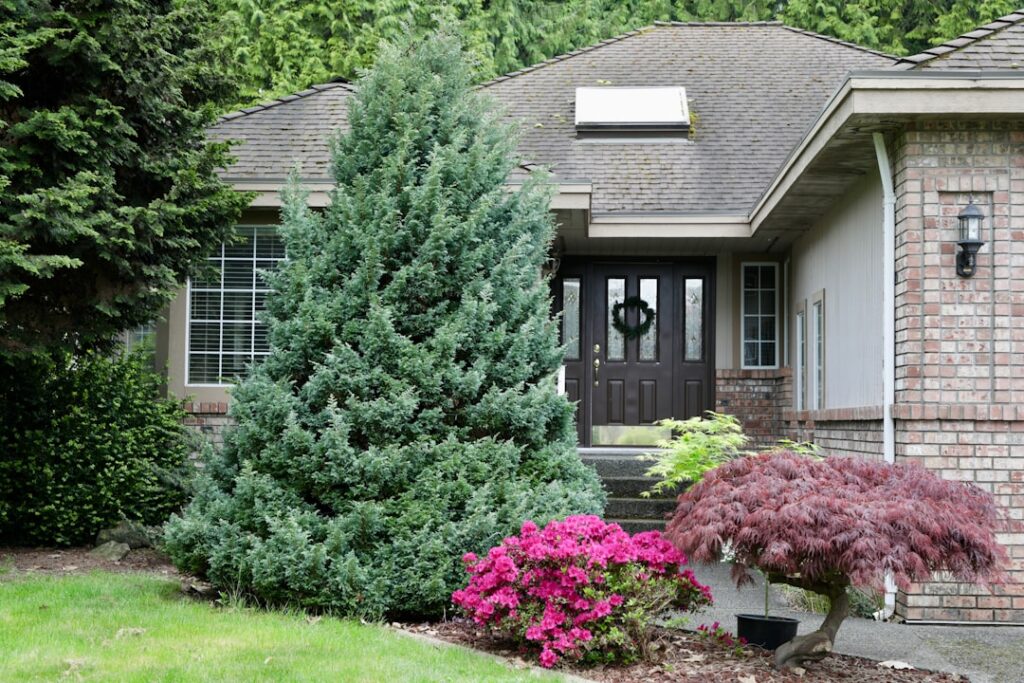
Look at any professionally designed foundation bed and you’ll see the same skeleton. Front row: plants maturing 1-3 feet, set 2-3 feet off the bed edge. Middle row: 3-5 foot shrubs anchoring the space between and below windows — the workhorse layer. Corners and blank walls: 5-8 foot plants (or small trees) that visually “tie the house down” without hitting the eaves. Two universal rules: keep everything at least 2-3 feet off the foundation itself for air circulation and maintenance access, and check the mature width on the tag — a shrub labeled 4 feet wide goes 4 feet from its neighbor’s center, not wherever looks full the day you plant. A bed that looks sparse for two years beats a hedge you butcher for twenty.
Low Shrubs Under 3 Feet: The Front Row
- Boxwood ‘Green Velvet’ or ‘Baby Gem’ (zones 5-9): The classic evergreen edger, 2-3 feet, takes shearing or looks fine untouched. Where boxwood blight is active, substitute inkberry holly.
- Inkberry holly ‘Shamrock’ or Gem Box (zones 4-9): Native boxwood lookalike, 2-3 feet, tolerates wet spells boxwood won’t.
- Dwarf Japanese holly ‘Soft Touch’ (zones 5-8): Fine-textured 2-foot mound for part shade.
- Spirea Double Play Candy Corn or ‘Goldflame’ (zones 3-8): 2-3 feet of copper-gold foliage and pink summer bloom; nearly unkillable in sun.
- Dwarf fothergilla (zones 4-8): Native, honey-scented spring bottlebrushes and orange fall color at 2-3 feet.
- ‘Blue Star’ juniper (zones 4-8): Steel-blue 1-3 foot mound for hot, dry, reflected-heat strips by walks and driveways.
Mid-Size Anchors, 3 to 5 Feet
This layer carries the facade. Under windows, pick plants that top out just below sill height — typically 3 feet — so you never prune for daylight.
- Bloomstruck or Let’s Dance reblooming hydrangeas (zones 4/5-9): 3-4 feet, months of summer color on the shadier east and north faces.
- Dwarf panicle hydrangeas — Little Lime, Bobo (zones 3-8): Sun-tolerant, foolproof, 3-5 feet of white-to-pink cones from July to frost.
- Encore azaleas (zones 6/7-10) or native Rhododendron hybrids (zones 4-8): Evergreen spring show for acid soils and filtered light.
- Dwarf Korean lilac ‘Palibin’ (zones 3-7): Tidy 4-5 foot dome, fragrant May bloom, no powdery mildew drama.
- Ninebark Little Devil or Tiny Wine (zones 3-7): Native, burgundy foliage at 3-4 feet — a color anchor against light siding.
- Abelia Kaleidoscope (zones 6-9): Semi-evergreen, glowing variegation, 2-3 feet, months of small white flowers pollinators love.
- Distylium Vintage Jade (zones 7-9): The South’s new evergreen workhorse — heat, drought, wet clay, shade tolerance in one 3-4 foot plant.
Corner and Feature Plants, 5 to 8 Feet
Corners want height that softens the vertical edge of the house without becoming a ladder-and-loppers project. Strong picks: ‘Sky Pencil’ Japanese holly for a narrow exclamation point in tight spots (zones 5-8); Hydrangea paniculata ‘Limelight’ trained as a standard for a flowering feature (zones 3-8); dwarf conifers like ‘Gracilis’ hinoki cypress that stay 5-8 feet for decades (zones 4-8); viburnums such as ‘Spring Bouquet’ or native arrowwood for flowers, berries, and birds (zones by species, broadly 2-9); and in the South, camellias for winter bloom in bright shade (zones 7-9). Resist the big-box temptation to plant full-size arborvitae ‘Green Giant’ or Leyland cypress at a house corner — those are 40-foot trees wearing a 4-foot pot.
Evergreen vs. Flowering: Get the Ratio Right
A foundation bed that’s all hydrangeas is a row of sticks from November through April. Designers aim for roughly half to two-thirds evergreen structure — boxwood, holly, distylium, conifers — with flowering shrubs woven between for seasonal payoff. Then layer bloom times: fothergilla and azalea in spring, hydrangea and abelia through summer, camellia or witch hazel shoulder seasons where climate allows. Repeat plants in odd-numbered groups (threes and fives) rather than collecting one of everything; repetition is what reads as “designed” from the street. Foliage color does year-round work flowers can’t — a burgundy ninebark or gold spirea against white siding carries the bed even out of bloom.
Practical Planting and Budget Notes
Test your conditions before buying: hours of direct sun per section (east and north faces are shadier and cooler than the reflected furnace of a south-facing brick wall), soil drainage, and your USDA zone. Plant in spring or early fall, in holes twice the rootball’s width and no deeper, with crowns slightly high and 2-3 inches of mulch kept off the stems. Water deeply once or twice weekly through the first season. Cost-wise, 3-gallon shrubs run $25-60 each and establish faster than the $80-150 7-gallon impulse buys; a typical 40-foot facade takes 12-18 plants, so figure $400-900 in plants DIY, or $2,000-4,500 for a professionally designed and installed bed. One splurge worth making: buy the front-row evergreens in matched sizes from the same grower lot, because a formal low hedge with one off-color plant will bother you every single day you pull into the driveway.
The Takeaway
Great shrubs for the front of house aren’t rare or expensive — they’re correctly sized. Keep the front row under the windows, anchor the middles at 3-5 feet, mark the corners with something that stops short of the gutters, and hold your evergreen ratio above half. Do that with plants suited to your zone and sun, and the facade upgrades itself every year while the pruning shears mostly stay in the garage.
Mistakes That Ruin Foundation Plantings
Five errors account for nearly every overgrown front bed in America. First, buying for day-one fullness — the number-one cause of the seven-foot yew wall eating a picture window; space for year five, and fill gaps with perennials or annuals meanwhile. Second, ignoring the downspout and roofline: plants under a valley drip line or a snow-shedding metal roof get crushed and drowned, so route water away and keep crowns out of the splash zone. Third, planting the same moisture-loving shrub across a bed that ranges from soggy corner to bone-dry eave shadow — walk the bed after a storm and match plants to the actual microsites. Fourth, shearing everything into meatballs; most flowering shrubs bloom on wood that shearing removes, and selective hand-pruning right after bloom keeps both shape and flowers. Fifth, forgetting the view from inside: stand at your own front windows before finalizing placement, because a perfectly sized shrub outside can still be a wall of leaves from the sofa.
A Sample 40-Foot Facade Plan
To make the framework concrete, here’s a proven east-facing layout for a 40-foot ranch front with a centered door and two windows. Corners: one ‘Gracilis’ hinoki cypress left, one ‘Sky Pencil’ holly pair right of the garage line. Under each window: three Little Lime hydrangeas on 42-inch centers, topping out at sill height. Between and flanking the door: five ‘Green Velvet’ boxwoods as a low rhythm line, with a single Kaleidoscope abelia each side for foliage color. Front edge: seven dwarf fothergilla alternated with catmint or coral bells for the perennial layer. Total: about 20 plants, roughly $650 in 3-gallon stock, and nothing in the plan ever needs more than one light annual pruning to stay in bounds.
Quick Answers for First-Time Planters
When can I plant? Container shrubs go in any time the ground works, but early fall is the professional favorite — warm soil, cool air, and a full root season before summer stress.
How long until the bed looks finished? Rule of thumb for shrubs: sleep, creep, leap. Year one they establish, year two they grow modestly, year three they hit stride. Mulch and edging make even a young bed read as intentional.
Do I need landscape fabric? Skip it. Fabric strangles shrubs as they mature, and weeds root in the mulch above it anyway. Two to three inches of mulch, refreshed lightly each spring, controls weeds and feeds the soil as it breaks down.
What about foundation drainage and termites? Keep irrigation drip lines a couple of feet off the foundation, never bury siding edges with mulch, and maintain that 2-3 foot air gap — your inspector, your siding, and your future self all benefit.
Low Maintenance Bushes for Sun, Shade and Tight Spots
Low maintenance bushes share three traits: they stay close to their mature size without shearing, they shrug off common pests in your region, and they need little extra water once established. Most bed chores come from plants that outgrow their space, so start with light and size.
Picks for Full Sun
Beds on south and west faces take reflected heat from siding and pavement, so choose plants that like it hot and lean:
-
Dwarf conifers such as compact mugo pine and dwarf spruce forms hold a tidy shape for years and never need flowers deadheaded.
-
Native sumac in its low, spreading forms covers slopes and banks with glossy leaves and strong fall color.
-
Potentilla blooms most of the summer on a 2 to 3 foot mound and tolerates poor, dry soil.
-
Dwarf crape myrtle in warm zones gives summer flowers without the annual topping that ruins full size trees.
Picks for Shade and Part Shade
North and east sides, or beds under mature trees, call for plants that stay dense without much direct sun. Japanese plum yew handles deep shade and deer pressure better than most evergreens. Leucothoe and dwarf mountain laurel fit acid soils with filtered light. Sweetspire (a native) suckers slowly into a loose mass, tolerates damp spots and turns red in autumn. Compact cherry laurel forms work in milder climates where a glossy, broad leaf look is the goal.
Slow Growers That Skip the Pruning Shears
Growth rate matters as much as final height. A slow grower that adds 2 to 4 inches a year gives you a decade or more before it ever touches a window sill, while a fast grower can double in two seasons. Before buying, look for these signals on the tag or in the nursery description:
-
Mature size listed as a range that fits the spot with a foot to spare on every side.
-
Words like dwarf, compact or slow growing, backed by an actual size in feet rather than only a marketing name.
-
A natural mounded, globe or low spreading habit, which looks finished without shaping.
-
Disease resistance noted for your area, especially for boxwood blight, juniper rust or powdery mildew.
Expect slow growers to cost a bit more per plant at the same pot size, since nurseries hold them longer. A one gallon shrub often runs in the low tens of dollars, with larger container sizes costing several times more.
Planting Habits That Keep Work Low
Even the easiest shrub turns into a chore if it is planted poorly. Group plants by water needs so one bed does not need two watering schedules. Set each root ball slightly above grade, backfill with native soil, and spread 2 to 3 inches of shredded mulch, kept a few inches away from stems and from the house siding. A simple drip line on a timer covers the first two summers, after which most established bushes need water only during long dry spells.
Before digging any new bed, call 811 a few business days ahead so utility lines are marked, since gas, power and communication lines often run right along the front of a house. Keep plantings clear of meters, vents and the outdoor condenser unit so service access stays open.