The standard 6-foot sliding glass door is in millions of American homes for one reason: it is cheap and it does not swing. But sticky rollers, a narrow opening that only uses half the frame, and a look that dates the house push many owners to look elsewhere. The good news is that sliding patio door alternatives now range from classic hinged French doors to walls of glass that fold completely out of the way. Each option changes how much floor space you need, how much opening you get, and how much you will spend, so it pays to compare them side by side before you order.
Part of our Decks & Outdoor guide — explore the full guide →
- Why Homeowners Look for Sliding Patio Door Alternatives
- Option 1: Hinged French Doors
- Option 2: Hinged Patio Doors With One Active Panel
- Option 3: Bifold and Folding Glass Walls
- Option 4: Multi-Slide and Pocket Door Systems
- Option 5: Pivot Doors
- Option 6: Upgraded Sliding Doors
- Option 7: Doors Paired With Sidelights or Transoms
- Comparison at a Glance
- Planning Your Replacement: Clearance, Structure, and Flooring
- Frequently Asked Questions
- Choosing What Fits Your Home
Why Homeowners Look for Sliding Patio Door Alternatives
Most complaints about sliders fall into a handful of categories. The track collects grit and wears out rollers, so the panel gets harder to push each year. Only half the width opens, which means a 72-inch door gives you roughly a 33-inch passage. Older units often have single-point latches that feel flimsy, and aluminum frames without thermal breaks sweat in winter. Style is the other driver; a builder-grade slider can look out of place in a craftsman or farmhouse renovation.
That said, sliders still have real strengths. They need zero swing clearance, they seal reasonably well, and quality modern units glide smoothly on stainless tracks. Before you replace, decide which problem you are actually solving: opening width, looks, security, efficiency, or space.
Option 1: Hinged French Doors
French doors are the most common replacement for sliders. Two hinged panels open from the center, so the full width becomes usable, often 64 to 68 inches of clear passage in a 72-inch unit. They suit traditional architecture and allow true full-height divided-lite looks.
- Cost: $1,500 to $5,000 for the unit, plus $600 to $1,500 installed.
- Pros: Wide opening, classic style, strong multi-point locking.
- Cons: Needs roughly 3 feet of swing clearance inside (inswing) or outside (outswing); screens are trickier.
Outswing versions free up interior floor space and resist wind-driven rain well, but you need a clear deck or patio area in front. Retractable screens mounted in the jamb solve the screen problem for about $300 to $600 per opening.
Option 2: Hinged Patio Doors With One Active Panel
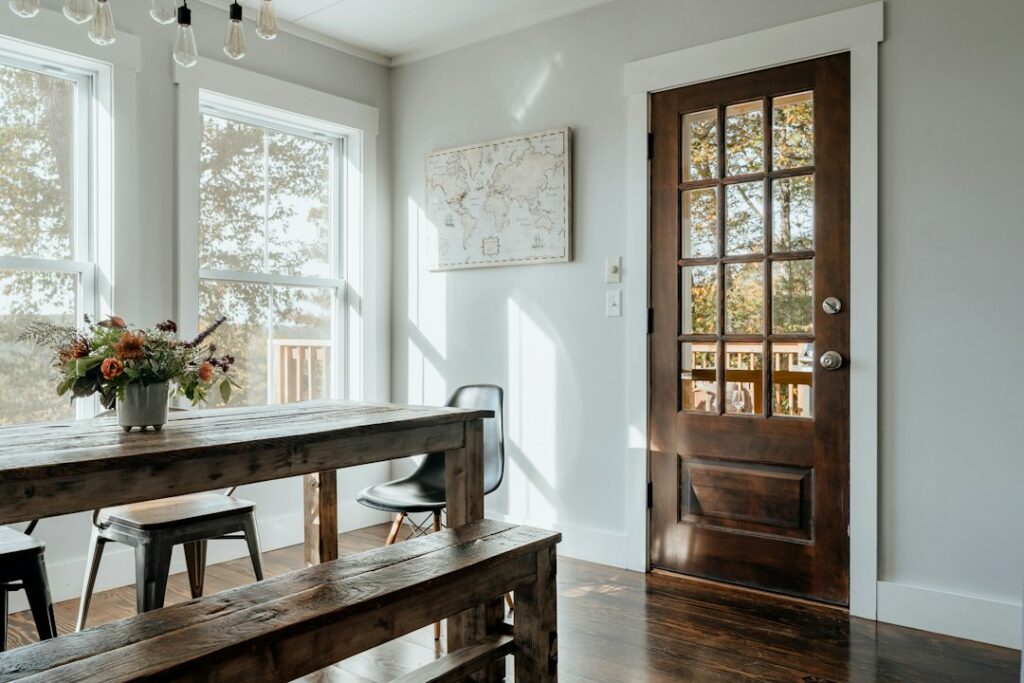
Often called garden doors or single-hinged patio doors, these look like a French door but only one panel opens while the other stays fixed. You get the appearance of a French door with a narrower swing, usually around 30 to 36 inches. They are a good fit where a sofa or dining table sits near the door and you cannot sacrifice a full double swing.
Costs run a little below a full French door, typically $1,200 to $3,500 for the unit. Because the fixed panel can be built stiffer, some models seal and insulate better than double-active doors.
Option 3: Bifold and Folding Glass Walls
Bifold doors, also called accordion or folding doors, use three to seven narrow panels that hinge together and stack to one or both sides. Nearly the entire opening clears, so a 12-foot wall becomes a 12-foot opening to the patio.
- Cost: $1,000 to $1,500 per linear foot installed for quality aluminum or clad units; a 12-foot system often totals $12,000 to $22,000.
- Pros: Dramatic indoor-outdoor connection, one panel often works as a daily-use door.
- Cons: More seals and hinges to maintain, stacked panels intrude into the room or patio, and wide openings typically require a new structural header.
Look for units with a low-profile or recessed sill if you want a flush transition. Recessed sills drain less effectively, so in rainy climates or on exposed elevations a slightly raised weather-resistant threshold is the safer choice.
Option 4: Multi-Slide and Pocket Door Systems
If the slider concept is fine but the execution is not, a multi-slide system keeps the sliding motion while fixing its limits. Three or more large panels ride on stacked tracks and either stack behind one fixed panel or disappear entirely into a wall pocket. A pocketing multi-slide can open a full wall with no visible panels at all.
These systems carry premium pricing, commonly $1,200 to $2,500 per linear foot installed, and pocketing designs require building a thicker wall cavity. They handle larger glass panels than bifolds, so views stay cleaner with fewer vertical frames. They are popular in contemporary homes and warm climates where the door stays open for months.
Option 5: Pivot Doors
A pivot door rotates on a pin set in from the edge instead of on side hinges, allowing very large, heavy panels up to 5 feet wide or more. A single oversized glass pivot panel makes a bold architectural statement and opens smoothly with surprisingly little effort.
Pricing typically runs $4,000 to $15,000 installed. Pivots need clearance on both sides of the pivot point, sealing can be less airtight than a compression-seal hinged door, and they are better as a design feature than a high-traffic kid-and-dog door.
Option 6: Upgraded Sliding Doors
Sometimes the best alternative to a bad slider is a good one. Modern premium sliders use tandem stainless rollers, fiberglass or wood-clad frames, multi-point locks, and Low-E glass with U-factors near 0.25. A new mid-grade vinyl slider costs $1,000 to $2,500 installed, while fiberglass and clad units run $2,500 to $6,000.
If your frame is sound, even a repair may be enough: replacement rollers cost $20 to $60 a pair, and cleaning and waxing the track restores smooth operation on many doors. Adding a secondary foot lock or a bar in the track improves security for a few dollars.
Option 7: Doors Paired With Sidelights or Transoms
Another route is a single wide hinged door, 36 or 42 inches, flanked by fixed sidelight panels. You keep most of the glass area of a slider and gain a solid, well-sealing entry. Adding a transom above lets in extra light without extra swing. This configuration works well in a mudroom-to-patio transition where you need durability more than a huge opening, and it typically costs $2,000 to $6,000 installed.
Comparison at a Glance
| Door style | Usable opening | Installed cost |
|---|---|---|
| Standard slider | About 50% | $1,000–$6,000 |
| French doors | About 90% | $2,100–$6,500 |
| Bifold wall | About 90–95% | $12,000–$22,000+ |
| Multi-slide (pocket) | Up to 100% | $15,000–$30,000+ |
| Pivot door | Varies | $4,000–$15,000 |
Planning Your Replacement: Clearance, Structure, and Flooring
Measure the rough opening first. Many French doors are made in the same 72×80 and 60×80 sizes as sliders, which allows a straight swap without resizing. Widening the opening for a bifold or multi-slide means cutting into an exterior wall, usually a load-bearing one. That requires a correctly sized header, temporary shoring, and in almost every jurisdiction a building permit. Have a licensed contractor or structural engineer size the header, and hire a licensed electrician if outlets or exterior lights need relocating.
Next, map swing clearance. Hinged doors need a clear arc equal to panel width on the swing side. Check furniture layouts, heating registers, and rug edges, and verify the door will clear the floor. If you are also replacing flooring, install the new floor first or plan the threshold height around it; a door set for thin vinyl plank may drag once you add thicker engineered hardwood with underlayment.
Finally, focus on water management. Any patio door needs a sloped sill pan and properly lapped flashing. Flush thresholds look great but depend on an exterior slope away from the house and ideally a trench drain in front of the door.
Frequently Asked Questions
What is the cheapest alternative to a sliding patio door?
A standard vinyl or steel French door or a single-active garden door in the same rough opening is usually the least expensive, often $2,000 to $4,000 installed.
Can I replace a sliding door with French doors without resizing the opening?
Often yes. Many French doors come in the same nominal sizes as sliders. A contractor will confirm the rough opening, sill height, and whether trim or siding needs adjustment.
Are bifold doors worth the cost?
They are worth it when you use the patio often and want the room to open fully in good weather. For a door opened only a few times a day, French doors deliver most of the benefit for far less money.
Which patio door style is most secure?
Hinged doors with three-point locking hardware and laminated glass are generally harder to force than older single-latch sliders.
Choosing What Fits Your Home
Start with how you use the space. If you want a wider daily passage and a traditional look, French or garden doors are the natural upgrade. If you entertain outdoors and want the wall to disappear, invest in a bifold or multi-slide system and budget for the structural work. If swing space is tight, a premium slider may still be the smartest choice. Whatever you pick, prioritize proper flashing, solid locks, and efficient glass, and bring in licensed pros for any wall or wiring changes.