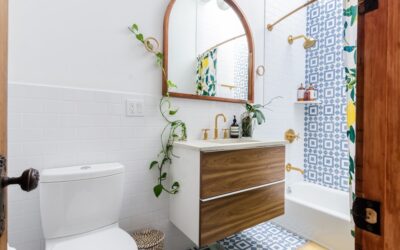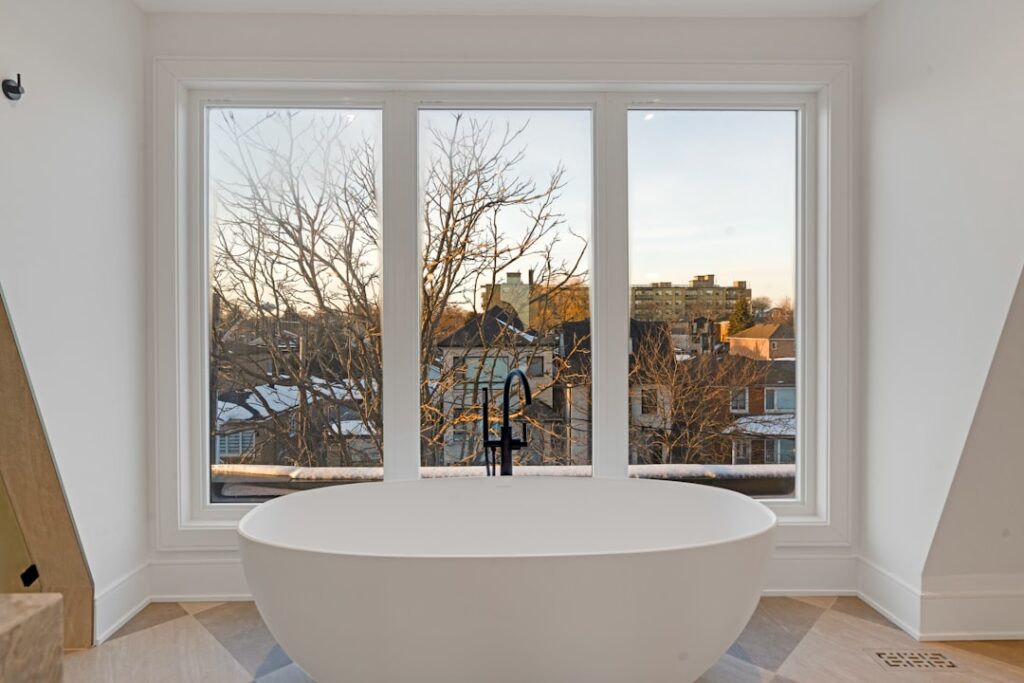
The internet keeps repeating the same advice about painting small bathrooms white, and it’s wrong half the time. Small bathroom colors only make a 40 sq ft powder room feel bigger when the value (lightness) and undertone match the room’s natural and artificial light. I’ve painted 5 by 8 baths charcoal that feel airier than the same room in flat white, simply because the contrast and sheen were dialed in correctly.
Part of our Bathroom Remodeling & Flooring guide — explore the full guide →
How Color Affects Perceived Space
Visual size depends on three factors: light reflectance value (LRV), contrast between walls and trim, and how seamlessly color flows from wall to ceiling. Paints with an LRV above 70 reflect the most light. Anything below 30 absorbs light and shrinks the apparent footprint, but a saturated dark color with no contrast can also blur the boundaries of the room and make it feel oddly limitless. The trick is committing to one strategy.
Stark contrast (white walls, black trim) carves the room into pieces and emphasizes how small it is. Tonal palettes (one color on walls, ceiling, and trim in slightly different sheens) read as a continuous envelope and trick the eye into seeing more space.
Best Light Colors for Small Bathrooms
If your bathroom has one small window or a single overhead light, lean into pales with high LRV. These four are workhorses for a reason:
- Benjamin Moore Chantilly Lace (OC-65): LRV 92.2, the cleanest white on the market. Around $74 per gallon in Aura, $58 in Regal Select.
- Sherwin-Williams Alabaster (SW 7008): LRV 82, soft warm white that pairs with brushed nickel and brass. About $58 per gallon in Emerald.
- Behr Polar Bear (75): LRV 88, neutral white with no yellow shift under LED. Around $42 per gallon in Marquee.
- Farrow & Ball Strong White (No. 2001): LRV 75, warm enough to soften a north-facing bath. About $130 per gallon.
Pair these whites with mirrors that span the full vanity width (24 inches minimum, ideally 30 to 36) to double the perceived size.
Why Dark Colors Sometimes Work Better
A windowless powder room under flattering 2700K LED can carry a saturated dark color beautifully. Hague Blue, Tricorn Black, and forest green all create what designers call a “jewel box” effect: cocoon-like, intentional, and surprisingly larger-feeling than a brittle white that exposes every flaw. The catch is you need to commit fully. Paint the ceiling, the trim, and even the door the same color in different sheens, and add brass or polished nickel hardware to bounce light.
Dark bathrooms also hide drywall imperfections, water stains around the toilet, and the inevitable scuff marks behind the door. Maintenance over 5 years is noticeably easier than chasing touch-ups on flat white.
Color Choices by Bathroom Size and Light
Here’s how I match palettes to common configurations after walking thousands of jobsites:
- Half-bath, no window, single overhead: deep saturated color (Hague Blue, Studio Green) tonal head to toe.
- Full bath, one small window, north-facing: warm off-white (Alabaster) on walls, same color one shade lighter on ceiling.
- Full bath, one window, south or west-facing: soft greige (Edgecomb Gray, Accessible Beige) that won’t feel washed out by sun.
- Master bath, two windows: any color you want; light is rarely the constraint.
Best Paint Sheen for Small Bathrooms
Bathrooms see steam, splash, and frequent cleaning. Eggshell is the absolute minimum, satin is standard, and semi-gloss is best for trim and small windowless half-baths where you want maximum light bounce. Skip flat at all costs; humidity will lift it within two years and you’ll see roller marks every time the light hits the wall.
Mildew-resistant formulas like Benjamin Moore Aura Bath & Spa, Sherwin-Williams Emerald Urethane Trim Enamel, and Behr Premium Plus Ultra Bath cost a few dollars more per gallon but add real years to a paint job exposed to a daily shower.
Trim, Ceiling, and Door Strategy
The single move that opens up a small bathroom more than color choice is painting the trim and ceiling the same color as the walls. Stop the eye from reading where the wall ends and the ceiling begins, and the brain reads the room as taller. For pure whites, use the same shade on trim in semi-gloss and on the ceiling in flat. For mid-tones and dark colors, shift the ceiling one or two shades lighter to keep it from feeling oppressive.
Doors painted the wall color disappear visually, which is exactly what you want in a 40 sq ft space where every cut-out reads as clutter. A glossy white door in a dark blue room calls attention to itself and breaks the envelope.
Lighting Pairs With Color
Bulb color temperature changes how a paint reads more than any other variable. Use 2700K bulbs for warm whites and creams; they’ll turn yellow under 4000K. Cool grays and blues hold up under 3000K to 3500K. Aim for 75 to 100 lumens per sq ft total in a bath, with the vanity light delivering at least 1,000 lumens (two 60-watt-equivalent bulbs in a sconce or vanity bar). A poorly lit bath makes any color look muddy.
Mistakes to Skip
Five repeat offenders:
- White walls with bright white trim in a dimly-lit bath; you’ve created stripes that emphasize cramped dimensions.
- Buying paint based on a 1-inch chip; bathrooms reflect color back from every surface so swatch a 12 by 12 inch sample minimum.
- Using flat or matte in a wet space; it will fail.
- Painting only the walls and leaving popcorn ceiling untouched; that ceiling kills the whole room.
- Picking a trendy color year over year; resale buyers want neutral envelopes they can imagine themselves in.
Cost to Paint a Small Bathroom
A 5 by 8 bathroom has roughly 130 sq ft of paintable wall after subtracting tile, vanity, and door. One gallon covers two coats with leftover for touch-ups. DIY cost runs $50 to $130 in paint and supplies. A painter typically charges $250 to $500 for prep, two coats on walls and ceiling, plus trim. Add $75 to $150 for caulking and minor drywall patching; small bathrooms always have more pinholes than you think.