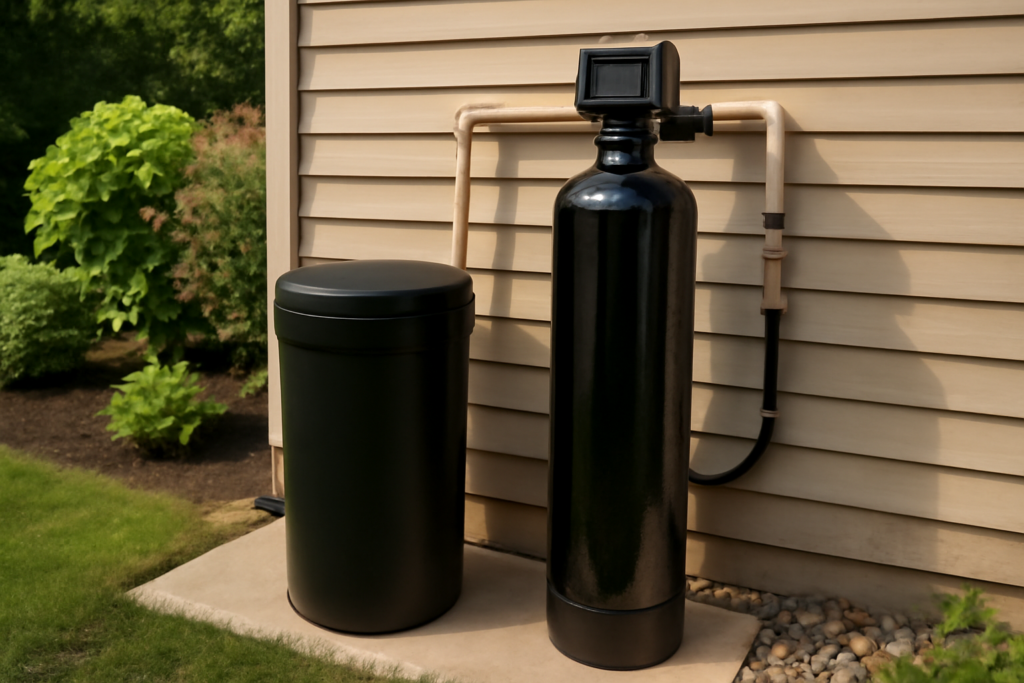
If you’ve been shopping whole-house treatment, the SpringWell water softener line probably came up, and for good reason. SpringWell sells two very different products under that umbrella, and buyers constantly mix them up. One is a true salt-based ion-exchange softener; the other is a salt-free conditioner that doesn’t actually remove hardness at all. I’ve installed both, and choosing right depends entirely on your water test and what problem you’re solving. Here’s how a SpringWell water softener actually performs, what each line costs, and which one fits your home.
Two Product Lines, Two Different Jobs
SpringWell splits its softening lineup into the SS1 salt-based softener and the FutureSoft salt-free conditioner. They solve overlapping but distinct problems:
- The SS1 uses cation-exchange resin and a salt brine tank to physically strip calcium and magnesium out of your water. Test the treated water and you’ll read near zero grains per gallon. This is real softening.
- FutureSoft uses template-assisted crystallization (TAC). It converts dissolved hardness minerals into microscopic crystals that won’t stick to pipes and heaters, so you get scale prevention without removing the minerals. Your hardness number on paper doesn’t change.
If you want that slick, soap-lathering “soft water” feel and zero scale, you need the SS1. If your only goal is stopping scale buildup with no salt, no electricity, and no wastewater, FutureSoft makes sense, especially where salt-based systems are restricted.
The SS1 Salt-Based Softener
The SS1 is SpringWell’s workhorse. It ships with a Bluetooth-enabled metered control head, so it regenerates based on actual water usage rather than a fixed timer, which trims salt consumption. SpringWell sizes it by bathroom count rather than raw grain capacity, but under the hood the tanks scale up in resin volume:
- SS1 (1 to 3 bathrooms): roughly a 32,000-grain equivalent, right for smaller households.
- SS4 (4 to 6 bathrooms): around 48,000 grains, the most common pick.
- SS+ (7-plus bathrooms): pushes past 64,000 grains for large homes.
Service flow rates run high, about 11 to 20 GPM depending on model, so you won’t see a pressure drop with two showers going. Expect a family of four to burn 40 to 50 pounds of salt a month. Use evaporated pellets, not rock salt, to keep the brine tank clean.
The FutureSoft Salt-Free Conditioner
FutureSoft is genuinely maintenance-free. There’s no brine tank, no salt to haul, no drain line, and no electricity. SpringWell rates it for a strong 12 to 20 GPM flow with virtually no pressure loss, and the certified TAC media lasts around six years before it needs replacing. It’s a great choice if:
- You’re on municipal water with moderate hardness (under about 25 gpg).
- You want scale protection but hate maintenance or can’t discharge brine.
- You don’t mind that water won’t feel “slippery” the way salt-softened water does.
The honest limitation: FutureSoft does not handle iron or very hard well water well. Above 25 gpg or with meaningful iron, TAC efficiency drops and you should go salt-based instead.
Pricing Tiers
SpringWell sells factory-direct, so pricing is fairly transparent. As a ballpark:
- SS1 salt-based softener: roughly $1,000 to $1,600 depending on size.
- FutureSoft conditioner: roughly $900 to $1,500 by household size.
- Softener + whole-house filter combos: $2,000 to $2,800 when you bundle carbon filtration for chlorine and taste.
Add professional installation, typically $300 to $700, unless you’re comfortable doing the plumbing yourself. Factor in ongoing salt for the SS1 at roughly $10 to $15 a month.
Warranty and Support
This is where SpringWell earns points. Both lines carry a lifetime warranty on the tanks and valve bodies, which is unusually strong for the category. They also back purchases with a 6-month money-back guarantee, so you can install, live with it, and still return it if the water doesn’t perform. Read the fine print: the lifetime coverage is for the original owner and assumes proper installation and, on the SS1, reasonable feed-water conditions.
Installation Notes From the Field
Both systems mount on the main line after the pressure tank (on wells) and before the water heater. A few things I always do:
- Install the included bypass valve so the house stays on water during service.
- On the SS1, run the drain line to a standpipe or floor drain with an air gap, and put a 120V outlet within reach of the head.
- Keep outdoor hose bibs on untreated water so you’re not wasting softening on the lawn.
- Size your connections to the main, usually 3/4-inch or 1-inch. SpringWell ships fittings for both.
Plan on a half-day for the plumbing. The Bluetooth app on the SS1 makes setting hardness and regeneration cycles genuinely easy, no cryptic button sequences on the valve head.
How SpringWell Compares to Rival Brands
SpringWell isn’t the only name in factory-direct water treatment, and it’s fair to see where it lands. Against competitors like Fleck-based builds, Aquasana, and SoftPro, a few things stand out:
- The lifetime warranty and 6-month trial are more generous than most. Many brands cap valve coverage at 5 to 10 years.
- The Bluetooth head is genuinely easier to program than the button-sequence Fleck valves that dominate the mid-market.
- Factory-direct pricing undercuts dealer-installed systems, but you give up the local dealer relationship for warranty service.
Where a Fleck-based system still wins is serviceability. Fleck parts are everywhere and any well tech can rebuild one. SpringWell’s proprietary head is reliable but ties you to their support line for parts. Neither is wrong; it’s a trade-off between ease-of-use and universal repairability.
Combining SS1 With Whole-House Filtration
Most homes that need softening also want cleaner-tasting water, and this is where SpringWell’s ecosystem shines. Their CF1 whole-house carbon filter pairs ahead of the SS1 to strip chlorine, chloramine, and taste-and-odor compounds before water hits the resin. That ordering matters: chlorine oxidizes softener resin over time, so filtering it out first extends resin life. A typical premium setup runs the sequence as sediment pre-filter, then CF1 carbon, then SS1 softener, then to the house. On well water, you’d insert an air-injection iron filter between the sediment stage and the carbon. Budget $2,000 to $2,800 for a softener-plus-filter combo, and expect the carbon media to last four to six years or around a million gallons.
Which One Should You Buy?
Run a water test first, always. Then decide:
- Hard well water, iron present, or you want that soft-water feel: get the SS1 salt-based softener, and add an iron filter upstream if your test shows more than 1 ppm iron.
- City water, moderate hardness, low-maintenance priority, salt restrictions: FutureSoft is the smarter buy.
- Chlorine taste and odor on top of hardness: bundle a whole-house carbon filter with either unit.
One more practical note: think about maintenance appetite honestly. If hauling 40-pound salt bags down basement stairs every few weeks sounds miserable, and your water is only moderately hard, FutureSoft removes that chore entirely for six years at a stretch. If you crave that unmistakable soft-water feel and you’re already treating well water, the salt routine is a fair trade. There’s no universally right answer, only the one that fits your water chemistry and your tolerance for upkeep. Whichever you pick, register the warranty at purchase, keep your original order confirmation, and photograph the installed system so any future warranty claim goes smoothly. Keep the bypass accessible too, because you’ll use it for every filter change and service visit over the system’s life, and a softener buried behind boxes in a corner is a softener that gets neglected.
A SpringWell water softener is solid equipment either way, but the two lines aren’t interchangeable. Match the technology to your actual water chemistry, size it to your bathroom count with a little headroom, and you’ll get a system that quietly does its job for well over a decade. The lifetime warranty and six-month return window mean the downside risk is about as low as it gets in this category.