
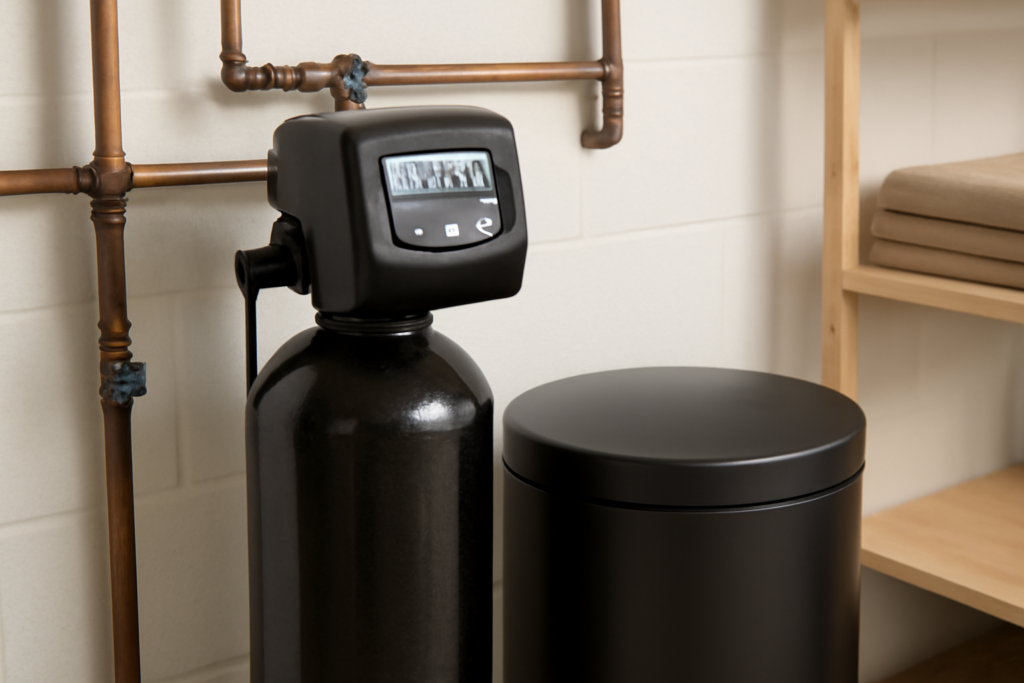
A Clack water softener isn’t a single product so much as a workhorse control valve, the Clack WS1, that sits on top of a resin tank and runs the whole softening process. Plumbers and water-treatment pros favor it because it’s rebuildable, easy to program, and built to outlast the cheaper proprietary valves on big-box systems. This guide explains how it works, how to size one by grains, setup and programming, maintenance, and what it costs.
If you have hard water, scale on your faucets, spots on your dishes, dingy laundry, and soap that won’t lather, a properly sized Clack-based softener is one of the most reliable ways to fix it for good.
What Makes a Clack Softener Different
Most home softeners are a resin tank, a brine tank, and a control valve. The control valve is the brain, and this is where Clack stands out. The WS1 is a modular, serviceable valve: its internal parts, the piston, seals and spacers, and the drive assembly, can be swapped in minutes with basic tools, so a valve that would be landfill on a sealed system becomes a five-minute rebuild. That serviceability is why independent installers build so many systems around it.
Note that Clack sells the valve to system builders, not typically as a retail box. So you’ll buy a “Clack water softener” as a complete system, resin tank, brine tank and a WS1 valve, assembled by a dealer or online supplier, rather than a single branded appliance. When shopping, confirm the valve is a genuine WS1 and note who supports it.
How Softening Works
Hard water carries dissolved calcium and magnesium. Inside the resin tank, thousands of tiny beads hold sodium ions. As hard water passes through, the beads grab the calcium and magnesium and release sodium in exchange, so soft water leaves the tank. Eventually the beads fill up with hardness minerals and must be recharged.
That’s what regeneration does. On a schedule or, better, based on actual water use, the WS1 valve draws brine (salt water) from the brine tank through the resin, stripping off the calcium and magnesium and flushing them to the drain, which reloads the beads with sodium. A metered Clack valve regenerates only when you’ve used the resin’s capacity, which saves salt and water versus a timer.
Sizing by Grains of Hardness
Sizing is the step people get wrong, and it decides whether the softener works well or wastes salt. You size by grain capacity, calculated from your water hardness and daily water use.
- Find your hardness in grains per gallon (gpg). Test your water or ask your utility; multiply a milligrams-per-liter figure by 0.0584 to get gpg. Many homes run 10 to 25 gpg.
- Estimate daily use. A common rule is 75 gallons per person per day, so a family of four uses about 300 gallons.
- Multiply hardness by daily gallons for grains removed per day. Four people at 15 gpg and 300 gallons is 4,500 grains a day.
- Match to a tank. To regenerate about weekly, you want roughly 7 days of capacity, about 31,500 grains here, so a 32,000-grain (1 cubic foot) system fits. Bigger homes or harder water step up to 48,000 or 64,000 grains.
Size for regeneration every 5 to 10 days. Too small and it regenerates constantly and wastes salt; too large and the resin sits stagnant between cycles. Add about 5 gpg of compensation if your water also has dissolved iron, which the softener helps handle up to a point.
Installation Overview
A Clack softener installs on the main water line where it enters the house, after the meter and before the water heater, so both hot and cold are softened. The basic steps:
- Shut off the main water supply and drain the line.
- Plumb the softener inlet and outlet into the main with a bypass valve, so you can isolate the unit for service.
- Run the valve’s drain line to a floor drain, standpipe, or utility sink with an air gap.
- Connect the brine tank overflow and brine line to the valve.
- Add resin (if not pre-loaded), fill the brine tank with salt, and set the valve.
This is a DIY-friendly job for anyone comfortable with basic plumbing and PEX or copper connections. If your plumbing is soldered copper and you’d rather not sweat joints, a plumber will install a supplied system for $300 to $700 in labor.
Programming the WS1 Valve
The WS1’s clear display walks you through a short setup. The key settings:
- Hardness: Enter your tested gpg so the valve knows how much capacity each gallon uses.
- Regeneration time: Set it for the small hours, commonly 2 a.m., when no one is drawing water.
- Capacity and reserve: A metered WS1 calculates when to regenerate from your hardness and usage, holding a reserve so you never run out of soft water before a cycle.
- Salt setting: Lower salt dosages save money but reduce capacity per regeneration; the valve balances this based on your inputs.
Once set, a metered Clack runs itself, regenerating only when you’ve actually used the resin.
Maintenance and Cost
Upkeep is light. Keep the brine tank at least a third full of salt, and use clean pellet or solar salt rather than rock salt to avoid mush and bridging. Once or twice a year, check for a salt bridge (a hard crust that keeps salt from reaching the water) and break it up. Every few years, add a resin-cleaning product if you have iron, and periodically inspect the valve’s injector and screen. When the valve seals eventually wear, a Clack rebuild kit runs $30 to $60 and takes minutes, one of the big advantages of the platform.
A complete Clack water softener system typically costs $700 to $1,500 depending on grain capacity and resin quality, plus $5 to $10 a month in salt for a family of four. Against the cost of scaled pipes, ruined water heaters, and shortened appliance life from hard water, that’s a strong return, and the rebuildable WS1 valve means the system can serve you for well over a decade with only pennies in wear parts.
Common WS1 Problems and Fixes
The rebuildable design means most issues are quick fixes rather than replacements.
- Hard water returning: Usually a salt bridge in the brine tank or a low salt level, not a valve fault. Check and break up any crust, and confirm the tank has salt above the water line.
- Softener won’t draw brine: A clogged injector or a plugged brine-line screen. Clean the injector and screen, cheap Clack parts, before suspecting anything bigger.
- Constant water running to drain: Often a worn piston or seals-and-spacers, exactly the parts a rebuild kit replaces in minutes.
- Motor not advancing: The drive assembly; the WS1’s modular drive swaps out without special tools.
Because Clack publishes exploded diagrams and sells every internal part, a homeowner with basic tools can service the valve instead of paying to replace a sealed unit, which is the whole reason pros build systems around it.
Resin Quality Matters
The valve gets the attention, but the resin does the actual softening, and its grade affects lifespan. Standard 8-percent cross-linked resin is the economical choice and works fine on clean municipal water. If your water carries chlorine or any iron, step up to 10-percent cross-linked resin, which resists the oxidative breakdown that shortens resin life, worth the small premium. Good resin lasts 10 to 15 years; harsh water or heavy chlorine shortens that. When you buy a system, ask which resin it ships with, because a bargain price sometimes means low-grade resin you’ll be replacing sooner.
Is a Clack System Right for You?
A Clack water softener makes sense if you want a system that a local dealer or you can service for decades rather than throw away when the valve wears. Buy a complete system sized to your hardness and household, insist on a genuine WS1 valve and decent resin, set it to regenerate on metered demand, and keep clean pellet salt in the brine tank. The upfront cost of $700 to $1,500 lands in the same range as a big-box unit, but the rebuildable valve and quality components mean you’re buying a system that keeps paying off long after a sealed-valve softener would be headed to the curb.


