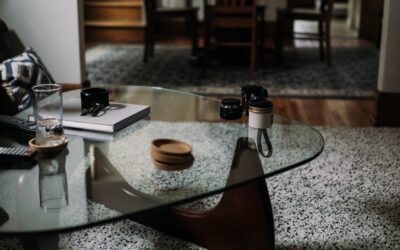
Most decorators will tell you to match a round table with a round rug, but that pairing leaves awkward triangle slivers of bare floor at every chair leg. A square rug under round table actually works better in 90 percent of dining rooms because the geometric contrast feels intentional, the corners hold chair legs flat as they slide out, and you stop the rug at logical edges of the room rather than mid-floor. The trick is sizing it correctly, since a square that is six inches too small visually shrinks the table and a square that is two feet too large overwhelms the space.
The Sizing Rule That Actually Works
Measure the diameter of your round table, then add 48 to 60 inches to find the minimum square rug side length. A 48-inch round table needs at least a 96-inch (8-foot) square rug to give chairs room to slide back without catching the back legs on the rug edge. A 60-inch round table calls for a 108-inch (9-foot) square minimum.
The math comes from chair clearance, not aesthetics. A standard dining chair needs 18 to 24 inches of pull-out space to seat comfortably. If the back legs roll off the rug edge during pull-out, you get the wobble-and-snag effect that ruins both the rug fringe and your patience. Always size for the worst-case scenario, which is an adult pushing back to stand up.
Best Rug Shapes by Room Type
Dining rooms are the most common application, and the square almost always reads more sophisticated than the round there. Breakfast nooks and small kitchens can use square rugs as small as 5 by 5 feet if the table is 36 inches in diameter or less. Entryway round tables (often 30 to 36 inches) look striking over a 5 by 5 foot rug or even a 4 by 4 foot rug for tighter foyers.
- 30-inch round table: 5 by 5 foot square rug minimum
- 36-inch round table: 6 by 6 foot square rug minimum
- 42-inch round table: 7 by 7 foot square rug minimum
- 48-inch round table: 8 by 8 foot square rug minimum
- 54-inch round table: 8 by 8 foot square (acceptable) or 9 by 9 foot (ideal)
- 60-inch round table: 9 by 9 foot square rug minimum
Material Choices That Hide Spills and Crumbs
A dining room rug lives a hard life. Wine, gravy, coffee, and bread crumbs all end up on the floor at some point. Indoor-outdoor polypropylene rugs from brands like Ruggable or Loloi clean with a hose or a damp cloth and come in patterns that hide stains between deep cleanings. Expect to pay 200 to 600 dollars for an 8 by 8 foot indoor-outdoor square.
Wool offers the upgrade path. A flat-weave wool rug from Annie Selke or Dash and Albert resists matting and crushes much less than nylon under chair legs. Budget 700 to 1,800 dollars for the same 8 by 8 size in wool. Avoid silk, viscose, and bamboo silk in any dining application, since these fibers stain permanently from water alone and absolutely cannot handle a single dropped glass of red wine.
Pattern, Color, and Visual Weight
Solid rugs make the round table the visual star but show every crumb. Geometric patterns and tribal-style rugs hide soil best and let the round table read as a sculpture floating on a grid. Medallion-style rugs with a center motif fight the table for attention, so save those for living rooms where there is no large round object competing for the eye.
Color choice depends on the floor underneath. Dark wood floors (walnut, espresso oak) work with cream, dusty blue, or rust rugs that brighten the room. Light floors (white oak, maple) handle saturated colors like deep navy, forest green, or burgundy. Gray LVP and tile floors look best with warm-toned rugs to counter the cool flat surface.
Rug Pad Matters More Than You Think
A square rug under a round table will get scooted, dragged, and trampled by chair legs every day. Without a rug pad, the rug walks across the floor over months and ends up out of center by a foot. Worse, the chair legs catch the edges and start tearing the binding.
Get a 1/4-inch felt-and-rubber pad cut to one inch smaller than the rug on all sides. Mohawk Home Premium Felt Rug Pad and RugPadUSA both make excellent pads in the 80 to 150 dollar range for an 8 by 8 size. The felt cushions the rug and protects the finish on hardwood underneath. The rubber backing grips without leaving sticky residue, which cheaper waffle-pattern pads always do.
Common Mistakes to Avoid
The biggest sizing mistake is buying a rug that fits only the table itself, with chair legs landing on bare floor. Aside from the wobble issue, it makes the room feel claustrophobic because the eye reads the bare floor as the actual usable space. Always size for chair pull-out, not table edge.
The second mistake is layering a small square rug over wall-to-wall carpet. Carpet on carpet creates compression bumps that no rug pad will fix, plus the layering rarely looks intentional. If you have wall-to-wall carpet, skip the area rug entirely and let the round table sit directly on the carpet. A square rug under round table pairing only works on hard surface floors.
Where to Buy and What to Spend
Budget under 400 dollars goes to Ruggable, Wayfair, or Target for a washable square. Mid-range (400 to 1,200 dollars) gets you a wool flat-weave from Rugs USA, Boutique Rugs, or Annie Selke. High-end (1,200 dollars and up) takes you into hand-knotted territory from Pottery Barn, Crate and Barrel, or boutique dealers like Revival Rugs.
Always order one size larger than you think you need. A rug that turns out slightly too big can be tucked under furniture on adjacent walls. A rug that turns out too small has no fix except returning it. Most online retailers offer free returns on rugs in original packaging within 30 days, which makes the try-before-you-commit approach low risk if you save the box.