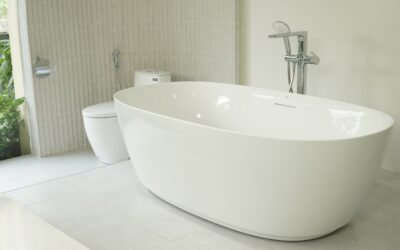
A tub that looks fine in the showroom can feel wrong the moment you climb in for the first soak at home. The standard bathtub height for American alcove tubs sits between 14 and 17 inches from finished floor to top of rim, which corresponds to an interior bathing depth of about 12 to 15 inches. Modern soaking tubs and freestanding designs push this higher to 19 to 24 inches, while walk-in tubs and accessibility-focused designs stay between 17 and 19 inches with a door for easier entry. Height affects everything from how deeply you can soak to whether elderly family members can safely use the tub.
Part of our Bathroom Remodeling & Flooring guide — explore the full guide →
Why Height Specifications Vary So Much
Three different measurements get called “tub height” depending on context. Overall height refers to the distance from floor to top of the highest rim point. Water depth refers to how deep the water can be before overflowing, measured from drain to overflow outlet. Bathing depth refers to the usable depth from the seat or floor of the tub to the overflow point. A tub with 17 inches of overall height might only have 12 inches of water depth and 10 inches of comfortable bathing depth if the floor profile and overflow placement are not optimized.
Manufacturers measure inconsistently. Always check the spec sheet for water depth specifically rather than relying on the overall height number. Kohler, American Standard, Toto, and Bain Ultra all publish detailed dimension drawings showing each measurement separately, while budget brands often list only overall height and leave actual bathing depth unclear.
Alcove Tub Heights by Type
Different alcove tub styles target different height ranges. Basic builder-grade alcove tubs typically measure 14 to 15 inches overall with about 11 to 13 inches of water depth. These are the tubs you find in starter homes and rental properties where cost matters more than soaking experience. Mid-range alcove tubs increase the height to 16 to 18 inches overall, providing 13 to 15 inches of water depth and noticeably more comfortable bathing. Deep-soaking alcove tubs push the height to 19 to 22 inches overall with 16 to 19 inches of water depth.
- Builder-grade alcove (14-15 in): Sterling Performa, Kohler Villager basic – $350-650
- Mid-range alcove (16-18 in): American Standard Cambridge, Kohler Mariposa – $625-1,200
- Deep-soaking alcove (19-22 in): Kohler Underscore, Toto Aimes – $1,400-2,400
- Premium alcove (22+ in): Kohler Tea-for-Two alcove, BainUltra Charism – $2,800-5,500
Going taller than 18 inches in an alcove tub creates step-over challenges for shorter users and presents access issues for elderly or mobility-impaired bathers. The trade-off between deep soaking comfort and easy entry is real, and choosing the right height depends entirely on who will use the tub regularly.
Freestanding Tub Heights
Freestanding tubs run noticeably taller than alcove styles because the design philosophy prioritizes soaking depth over universal accessibility. Most freestanding tubs measure 22 to 26 inches overall height with internal bathing depths of 16 to 21 inches. The taller silhouette also provides better visual proportion in the open floor space where freestanding tubs typically install. A 14-inch tall freestanding tub looks visually weak and almost squatty in an open bathroom, while a 24-inch tall version reads as a substantial architectural feature.
Popular freestanding options include the Signature Hardware Lyon 67-inch acrylic at $1,599 with 23-inch height, the Native Trails NativeStone Avalon at $4,895 with 22-inch height, and the Victoria + Albert Barcelona at $7,200 with 25-inch height. For ultra-deep soaking, the Kaldewei Centro Duo Oval at $8,400 reaches 26 inches overall with 19 inches of water depth. Skip ultra-cheap freestanding tubs under $700 because the wall thickness is too thin to retain heat, and water cools 30 to 50 percent faster than in quality acrylic or stone composite construction.
ADA and Accessibility Requirements
The Americans with Disabilities Act sets specific requirements for accessible bathtubs in commercial and multifamily residential contexts, and these specs provide useful guidance for residential aging-in-place planning. ADA-compliant tubs have rim heights of 17 to 19 inches from the floor with a reinforced seat at the head end measuring 15 inches deep and 17 to 19 inches above the tub floor. The grab bars must be 33 to 36 inches above the floor and capable of supporting 250 pounds of static load.
Walk-in tubs designed for residential accessibility typically measure 17 to 21 inches in step-in height at the door threshold, which is significantly lower than the rim height of standard alcove tubs. The door swing requires either inward or outward clearance depending on the model, and the internal seat sits 17 to 19 inches above the tub floor. Quality residential walk-in tubs include the Kohler Walk-In Bath at $9,800 to $12,500 installed, Safe Step at $4,500 to $7,500, and Premier Care at $6,200 to $9,800. The price differences reflect heating, jet quality, door seal durability, and warranty coverage rather than height differences.
How Ceiling Height Affects Tub Height Choice
Ceiling height matters more than people realize when selecting tub height. In bathrooms with 8-foot ceilings, freestanding tubs above 24 inches overall start to look heavy and overwhelming, especially in smaller rooms. The recommended rule is that overall tub height should not exceed 25 percent of ceiling height for balanced proportions. An 8-foot ceiling tolerates tubs up to 24 inches; a 9-foot ceiling supports tubs up to 27 inches; a 10-foot or higher ceiling can accommodate the tallest 30-inch sculptural designs without looking out of scale.
For lower 7-foot 6-inch ceilings common in basement bathrooms and older homes, stay below 22 inches overall tub height. Going taller in low-ceiling spaces creates a cramped feeling that no amount of paint or lighting can correct. If you want deep soaking in a low-ceiling bathroom, choose a tub with a recessed floor design where the bathing area sits 2 to 4 inches below finished floor level, accessed by step-down rather than step-over.
Step-In Height Versus Bathing Depth
The single most important measurement for comfort is the relationship between step-in height and bathing depth. The ideal ratio for most adults is roughly 1:1 to 1.2:1, meaning that the step-over height should be approximately equal to or slightly less than the actual water depth you can enjoy. A tub with 17 inches step-in height should provide 15 to 17 inches of water depth for comfortable proportional design.
- For elderly users or those with mobility concerns, prioritize step-in height below 17 inches even if water depth must be sacrificed.
- For deep-soak enthusiasts in healthy condition, accept step-in heights of 22 to 26 inches in exchange for genuine 18 to 22-inch water depths.
- For families with young children, choose mid-range 16 to 18-inch tubs that are safe for kids while still adequate for adult bathing.
- For rental properties, builder-grade 14 to 15-inch tubs maximize universal accessibility and minimize cost.
- For aging-in-place planning, install grab bars during initial construction even if you do not need them yet; retrofitting grab bars in tile is expensive and visible.
Custom Heights and Pedestal Variations
Some installations use a pedestal or platform to raise tub height beyond standard specifications. This works well visually for deep soaking tubs in larger bathrooms but creates structural and accessibility considerations. Pedestals 4 to 6 inches tall require either solid masonry construction or properly braced framing capable of supporting the tub weight plus water. A 60-inch freestanding tub on a 6-inch pedestal can weigh 1,400 to 1,800 pounds full of water and a 200-pound bather, requiring proper floor reinforcement.
Step access becomes mandatory for any tub installation above 24 inches overall height including pedestal. Plan for at least one step measuring 10 to 11 inches deep with a 6 to 8-inch rise, ideally with non-slip surface. Some designers integrate the step into a deck surround that extends out from the tub side, creating a seating ledge that doubles as access. Budget $400 to $1,200 for stone or tile step construction depending on materials and finish complexity.