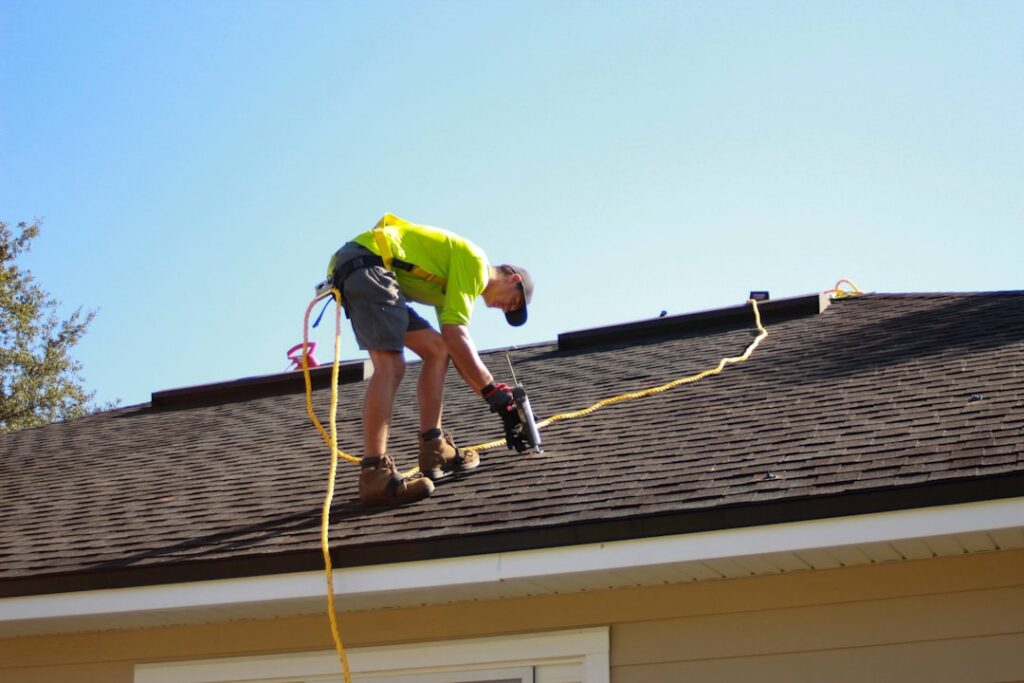
I have worked enough post-storm neighborhoods to know exactly how the first 48 hours go: adrenaline, a blue tarp shortage at every hardware store in the county, and a parade of out-of-state trucks knocking on doors. Storm damage roof repair is really three jobs in sequence: stop the water now, document everything for insurance, then get the permanent repair done by someone who will still answer the phone next year. Homeowners who handle those three in order come out fine; homeowners who skip the documentation or sign the first clipboard shoved at them fund the horror stories. Here is the full playbook, with real costs for every damage type.
Part of our Roofing guide — explore the full guide →
First 24 Hours: Safety, Then Stop the Water
- Stay off the roof. Wet shingles, hidden punctures, and compromised decking put homeowners in emergency rooms after every major storm. Assess from the ground with binoculars and from inside the attic with a flashlight.
- Check for the disqualifiers: downed lines touching the house, a tree resting on the structure, or sagging ceilings holding water. Those are calls to the utility, an emergency tree service ($500-$2,500 for crane removal off a roof), and a poked drain hole in the ceiling bulge with a bucket underneath, respectively.
- Control interior water: buckets, plastic sheeting over furniture, and move electronics. In the attic, a piece of plywood and a bucket under the drip protects the ceiling below.
- Emergency tarping: a proper tarp job runs the tarp from over the ridge down past the damage, secured with 1×3 furring strips screwed through the tarp into the roof, never just bricks and hope. If you are not comfortable up there, roofing companies and disaster services charge $200 to $1,000 for emergency tarping, and here is the key point: your insurance policy almost certainly covers reasonable emergency mitigation, and actually requires you to prevent further damage. Keep every receipt.
Document Before You Touch Anything
This is the step that pays. Before cleanup and before any contractor climbs up, photograph and video everything: wide shots of each roof slope from the ground, close-ups of visible damage, every interior stain and drip, downed limbs, dented gutters and AC fins (hail corroborators), and the date-stamped weather itself, a screenshot of the local storm report. Hail damage especially lives or dies on evidence, because it can look minor from the ground, bruised shingle mats and knocked-off granules, while functionally ending the roof’s life. Save damaged material: keep a few of the blown-off shingles in the garage. Your claim is a story told in photographs, and you cannot re-take them after the repair.
Reading the Damage: What Each Storm Type Does
- Wind (58+ mph): creased, lifted, or missing shingles, usually along ridges, edges, and the windward slopes. A crease is a broken shingle even if it lies back down; it will fail soon.
- Hail: 1-inch and larger hail bruises asphalt shingles, circular dark spots where granules are gone and the mat is soft, dents metal vents, and cracks tile and skylights. Damage is often invisible from the ground, which is why post-hail inspections matter even when the roof “looks fine.”
- Falling debris: punctures and cracked decking around the impact, plus damage that radiates further than the visible hole.
- Water infiltration after any of the above: stains spreading days later, a musty attic, wet insulation. Water travels along rafters and shows up ceilings away from the actual breach, which is why chasing a leak by the stain misleads everyone but the person who goes into the attic during rain.
Storm Damage Roof Repair Costs
| Repair | Typical Cost |
|---|---|
| Emergency tarp installation | $200-$1,000 |
| Replace missing/damaged shingles (small area) | $150-$600 |
| Larger section repair with decking | $500-$1,800 |
| Flashing, vent, or pipe boot repair | $150-$500 |
| Puncture repair incl. structural decking | $400-$2,000 |
| Full asphalt roof replacement | $8,000-$20,000 (typical US home; regional and size variance is wide) |
| Interior ceiling/insulation repair after leak | $300-$1,500 |
The repair-versus-replace call usually turns on roof age and damage spread. Scattered wind damage on a 5-year-old roof is a repair. Widespread hail bruising on a 12-year-old architectural shingle roof is a replacement, and insurers know it, which is why hail events total more roofs than any other peril. Note that repairs on older roofs come with a matching problem: discontinued shingle colors mean visible patches, and some states have matching statutes that can push an insurer toward larger scope. Worth asking about, politely and in writing.
The Insurance Claim, Played Correctly
Call your carrier promptly, most policies require timely notice, and understand your two numbers before the adjuster visits: your deductible (wind/hail deductibles are often 1 to 2 percent of dwelling coverage, which on a $400,000 house is $4,000 to $8,000, not the $1,000 you might assume) and whether your policy pays replacement cost or actual cash value, the latter depreciating an old roof’s payout hard. Get your own roofing contractor’s written scope and estimate before or alongside the adjuster’s inspection, and it is completely normal for your roofer to meet the adjuster on site; a good one advocates for legitimate scope items like code-required upgrades, ice-and-water barrier, and full-slope replacement where repairs cannot match. If the numbers land far apart, you can request a re-inspection, invoke appraisal under most policies, or hire a licensed public adjuster (typically 5 to 15 percent of the settlement) for large disputed claims. One caution: for damage below or near your deductible, think twice before filing at all, since a claim on the record can affect premiums for years. Pay the $600 repair out of pocket; file for the $15,000 roof.
Storm Chasers: How to Not Get Burned
After every major storm, door-knockers appear offering free inspections and deductible “waivers.” Some are legitimate; the predictable scams are worth naming. Never sign anything on the doorstep, especially an assignment of benefits or a “contingency agreement” that locks you to that company if insurance pays. Deductible waiving is insurance fraud in most states, and the company volunteering to commit fraud for you will cut the same corners on your roof. Verify a physical local address, state license where required, liability and workers’ comp certificates, and manufacturer credentials, and pay by check or card on a written contract with a deposit no larger than 10 to 30 percent, never cash up front. The local roofer who was busy before the storm will be reachable after it; that is the whole vetting philosophy in one sentence.
DIY Repairs: Where the Line Sits
A confident homeowner on a walkable single-story roof in dry weather can replace a handful of blown-off shingles: slide a flat bar under the shingle above, pop the nails, slip in the new shingle, nail in the sealant line, and dab roofing cement over exposed nail heads and under the tab. Materials run $30 to $60. Beyond that, steep slopes, wet decking, structural punctures, anything two stories up, the fall risk is not worth the labor savings, and roofers price small repairs reasonably precisely because they would rather you not try. Whatever you patch yourself, photograph it for the claim file first.
After the Repair: Verify and File
Two closing habits protect the money you just spent. First, verify the work: walk the property and photograph the completed repair from the same angles as your damage photos, confirm debris and nails are magnet-swept from the lawn and driveway, and get the warranty terms, workmanship and materials separately, in writing before final payment. Second, keep a storm file: photos, the adjuster’s report, invoices, and the contractor’s contact, all in one folder. The next hailstorm will ask for the same paperwork, and roofs repaired after a documented event settle future claims faster and cleaner than roofs with a mystery history.
Final advice from a lot of storm seasons: mitigate immediately and keep receipts, document like a lawyer, file only claims that clear your deductible with room to spare, and hire boring local competence over urgent strangers. Then, when the new roof or repair goes on, spend the small extras that make the next storm a non-event: ring-shank nails or the high-wind nailing pattern, ice-and-water membrane at eaves and valleys, and impact-rated shingles if you live in hail country, which also earn insurance discounts in many states. The best storm damage roof repair is the one the next storm cannot undo.