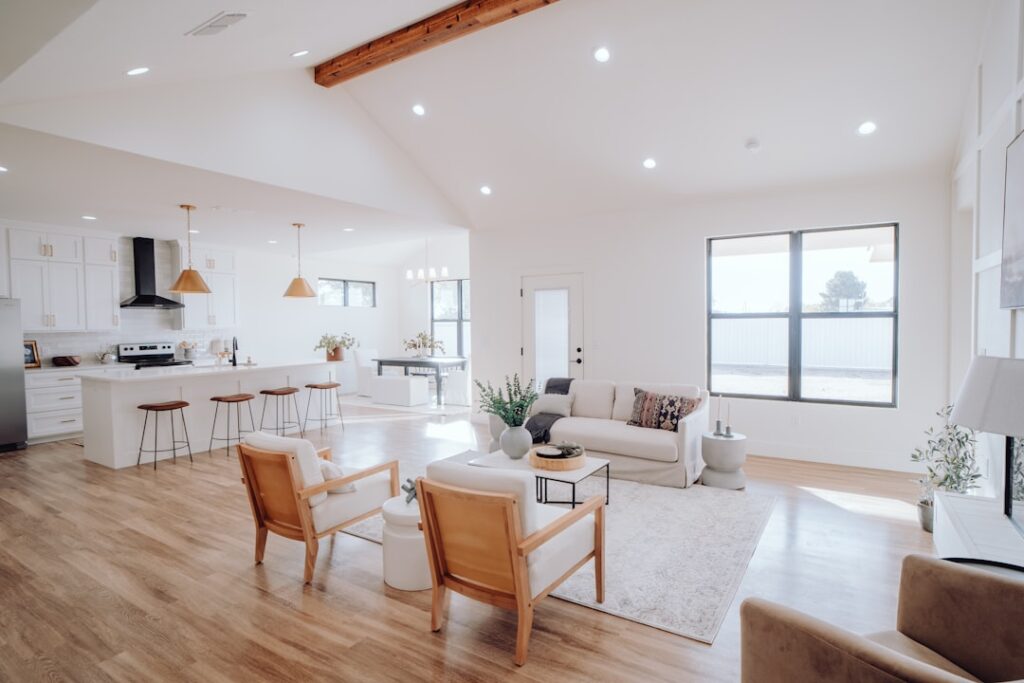
Designers stopped calling beige “beige” about a decade ago because the word killed sales — now everything warm and neutral gets labeled tan, sand, oat, wheat, or biscuit. The category quietly became the best-selling color family across every flooring material. Tan flooring hides dust better than gray, makes north-facing rooms feel sunnier, and pairs with almost any wall color from greige to navy. The trap is undertone: pull the wrong sample and your floor reads pink or yellow under LED lighting.
What Counts as Tan
True tan sits in the warm-neutral range between cool greige and saturated honey. The Pantone reference is somewhere around 7501C to 7506C — light brown with a yellow base, no green, no gray, no red. In flooring catalogs, look for product names with “natural oak,” “wheat,” “saddle,” “almond,” or “sand dune.” Stay away from anything labeled “blonde” (too pale), “amber” (too orange), or “mocha” (too brown).
Tan Hardwood Options
White oak is the workhorse. Natural-finish white oak from Mohawk’s TecWood line, Bruce’s Frontier collection, or Shaw’s Empire series lands squarely in tan territory and stays there as the floor ages. Red oak skews pinker over time as UV light oxidizes the tannins, which is why most designers steer clients away from it for tan looks.
- Site-finished 3/4 inch solid white oak: $8.50 to $12.00 per square foot installed
- Prefinished engineered white oak (5/8 inch with 4 mm wear layer): $7.00 to $10.50 per square foot installed
- Wide-plank European oak (7 to 9 inch boards): $11.00 to $18.00 per square foot installed
Hickory delivers a similar tan range with more grain drama and a Janka hardness rating of 1,820 — about 30 percent harder than white oak’s 1,360. If you have large dogs or rambunctious kids, hickory absorbs scratches better.
LVP and SPC in Tan Tones
Vinyl plank is where the tan trend exploded. Print technology now captures the natural-oak look so convincingly that a 7-inch wide SPC plank from COREtec’s Pro Plus line is hard to distinguish from real wood under everyday lighting. Notable tan LVP options include:
- COREtec Pro Plus “Pittsburgh Oak” or “Hudson Oak” — 22 mil wear layer, $4.29 per sq ft
- Mohawk SolidTech “Tanner Hill” — 20 mil wear layer, $3.89 per sq ft
- Karndean Korlok “Texas White Ash” — glue-down LVT with 30 mil wear layer, $5.49 per sq ft
- Shaw Floorte “Paragon Plus” in Cottage Oak — 20 mil, $3.69 per sq ft
For households with kids and pets, a 20 to 22 mil wear layer is the practical minimum. Lower-mil tan LVP shows scratches against the warm color faster than dark planks do.
Tan Laminate
Laminate still beats LVP on edge crispness and texture realism, especially at the AC5 commercial-rated tier. Pergo TimberCraft +WetProtect in “Heathered Oak” runs about $3.49 per square foot and matches a true tan undertone with embossed-in-register grain. Mohawk RevWood Plus “Glazed Oak” is another reliable pick at $3.29. Both are AC4 or AC5 rated for high-traffic residential use.
The downside is impact sound. Even with a quality 3 mm foam underlayment, laminate clicks underfoot more than SPC. If you live in a townhouse with HOA noise rules, request the IIC and STC ratings before ordering.
Tile That Reads Tan
Porcelain tile with a wood-look print covers the tan family well, but the joint lines remain visible and the underfoot feel is colder. For bathrooms and entries, large-format 9 x 48 inch planks from Daltile’s RevoTile or MSI’s Cyrus series provide a wood appearance with full waterproof construction. Pricing runs $3.50 to $6.00 per square foot for material, plus $5 to $8 per square foot for installation.
If you want a more traditional tan, look at travertine or beige limestone. Honed travertine in 12 x 24 inch format brings genuine warmth and stone variation that no print can match — expect $7 to $11 per square foot installed, plus annual sealing.
How to Avoid the Pink and Yellow Trap
Tan samples lie under store fluorescent lighting. Take three steps before you commit:
- Order full-size samples (not 3 inch chips) and lay them on your actual floor for at least 48 hours.
- View samples under three light conditions — morning daylight, midday daylight, and your evening artificial lighting. LEDs at 3000K push warm undertones; 4000K pulls them cool.
- Place samples next to your existing trim and cabinets. A tan that looked perfect in isolation can clash with a cream cabinet or yellowed maple trim.
If the sample reads pink against your wall, it has too much red oxide in the print or stain. If it reads yellow-green, it leans toward olive. Either is hard to live with for ten years.
Wall Colors That Work With Tan Floors
Tan is the most forgiving floor color in the catalog, but the strongest pairings come from carefully chosen wall paint. Sherwin-Williams Accessible Beige, Benjamin Moore Edgecomb Gray, and Behr Swiss Coffee all hold their own next to a warm oak floor. For contrast, navy walls (Hale Navy or Naval) create a coastal look that has stayed on trend for nearly a decade.
Done right, tan flooring is the closest thing to a flooring color that never goes out of style. Pick the right undertone, match the wear layer to your traffic, and you have a floor that will still look intentional fifteen years from now.
Resale Value and Long-Term Style
Real estate agents repeatedly cite warm neutral floors as a resale advantage over both bright white and cool gray. Tan reads as classic without committing to a specific design era — it pairs equally well with farmhouse, transitional, modern, and traditional interiors. Gray flooring, which dominated the 2015 to 2020 era, has visibly fallen out of favor, while tan and natural-oak looks have only strengthened. For homeowners planning to sell within five years, choosing tan over a trending color often returns the cost difference twice over at closing.
Within the tan family, the safest bet for long-term appeal is a medium-warm oak tone with subtle grain character. Avoid heavy rustic distressing, hand-scraped texture, and oversized bevels — all dated faster than smooth-faced, modern wide-plank looks. A 7-inch white-oak SPC or engineered plank in a natural finish will read as current in 2035 with the same confidence it does today.
Prefer to explore on your own?
See how new flooring looks in your actual room in seconds — free, no signup.
Try the free Floor Studio →