
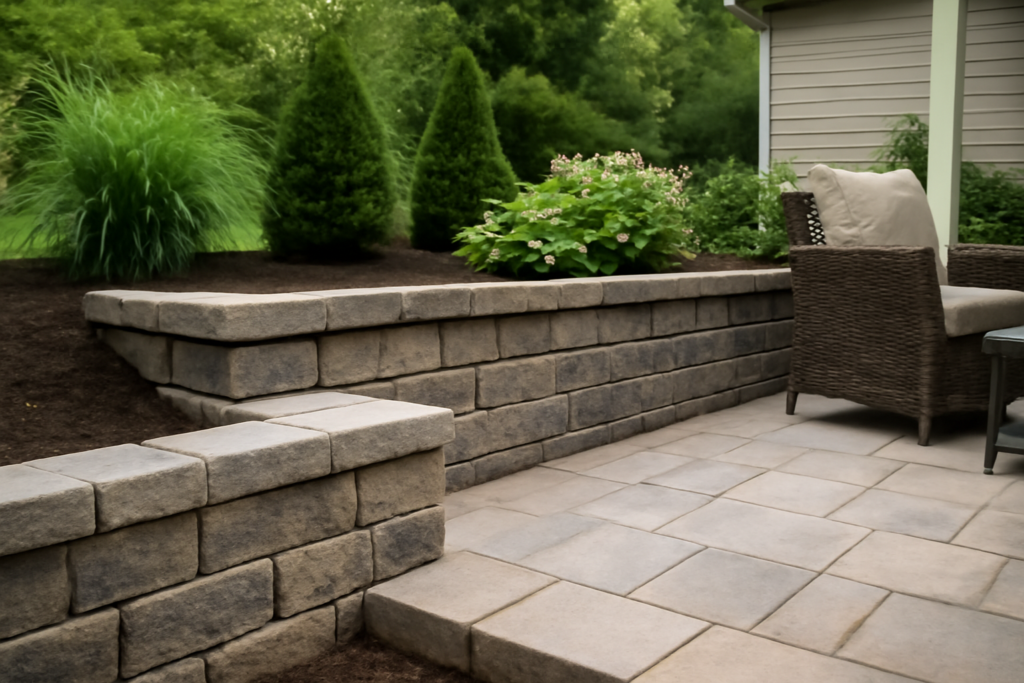
Retaining walls fail more often from cheap block and skipped drainage than from bad luck, which is why the premium segmental systems keep gaining ground in residential landscaping. A techo bloc retaining wall sits at the top of that market: dense, wet-cast and high-strength dry-cast concrete units from the Quebec-based manufacturer, engineered as complete wall systems with matching caps, corners, and steps. The look is closer to quarried stone than to the pebbly gray block of a big-box garden wall, and the price reflects it — expect $40-$90 per face foot installed. Here is how the product lines break down and what a properly built wall involves.
Who Techo-Bloc Is and Why Installers Specify It
Techo-Bloc has manufactured concrete pavers and wall systems since 1989, distributing across the eastern US and Canada through landscape supply yards rather than big-box retail. Two things distinguish the product physically. First, casting quality: many of its wall units are wet-cast or high-density dry-cast at compressive strengths typically exceeding 8,000 psi, well above the ASTM minimums that commodity block meets, which translates to crisper texture, better freeze-thaw resistance, and color that runs through the unit rather than sitting on the face. Second, system completeness — every line ships with matching caps, 90-degree corners, step units, and often coordinating pavers, so a wall, stair, and patio read as one design.
Color blending is the visible signature. Multi-tone units like Sandlewood, Champlain Grey, and Onyx Black shift shade across a pallet the way natural stone does, avoiding the repetitive stamped look that gives away budget block from across the yard.
The Main Wall Systems
Mini-Creta
The residential workhorse: a tumbled, weathered-face modular block in 3- and 6-inch heights designed for garden walls, planters, and terraces up to about 3-4 feet with appropriate setback. Material runs roughly $12-$20 per square foot of wall face. Its rounded profile suits traditional and cottage landscapes.
Graphix
A smooth, contemporary face in large-format units for the modern-architecture market. Crisp shadow lines, tight joints, and colors like Onyx Black and Greyed Nickel. Material pricing lands around $15-$25 per face foot. Graphix walls photograph like poured architectural concrete at a fraction of the formwork cost.
Semma
A chiseled, quarried-stone appearance in mixed unit sizes, aimed at estate and natural landscapes. Among the most expensive lines at $18-$30 per face foot in material, and among the most convincing stone impressions in the segmental industry.
Structural and Large-Scale Systems
For taller engineered walls, Techo-Bloc’s heavier structural units and geogrid-compatible systems handle serious grade changes; several unit types are designed for reinforced walls well beyond the 4-foot residential threshold when built to an engineer’s design. Freestanding double-sided systems like Aveny and matching cap programs handle seat walls, outdoor kitchens, and pillars.
What a Techo-Bloc Wall Costs Installed
Budget by the square foot of visible wall face. Materials — block, caps, geotextile, crushed stone base, drain pipe, and adhesive — typically total $20-$35 per face foot for the popular lines. Professional installation adds $20-$55 per face foot depending on access, terrain, and region, putting most finished walls at $40-$90 per square foot of face. A 40-foot-long, 3-foot-tall garden wall (120 face feet) therefore lands around $5,000-$10,500 installed; a 100-foot engineered wall at 6 feet with geogrid can run $30,000-$60,000 once design fees and excavation are counted.
Cost drivers worth anticipating: machine access (a yard reachable only through a 36-inch gate means hand-carrying tons of material), disposal of excavated soil, drainage complexity, curves and steps (both add cutting labor), and engineering — walls over 4 feet, or shorter walls carrying a driveway, slope, or structure surcharge, need a stamped design at $1,500-$5,000. Techo-Bloc sits 30-60 percent above commodity block in material cost, but installation labor is nearly identical, so the premium on the finished wall is usually only 10-25 percent.
How a Proper Wall Goes Together
The block is only as good as the base and drainage behind it, and this is where failed walls almost always went wrong. A correct residential build follows a consistent sequence. Excavate a trench below frost-relevant depth for the wall type — typically burying at least one course, or 10 percent of wall height — and wide enough for 12 inches of drainage aggregate behind the units. Compact 6-9 inches of 3/4-inch crushed stone base in lifts with a plate compactor, then screed it dead level; the first course is set by hand, checked unit by unit, because every error in course one amplifies upward.
Subsequent courses stack in running bond with the system’s setback (most Techo-Bloc walls batter back automatically via lips or pins), backfilled as you go with clean crushed stone, not soil, directly behind the block. A 4-inch perforated drain pipe at the base of that stone column, daylighted or run to a drain, is non-negotiable — hydrostatic pressure from waterlogged backfill is what bulges and topples walls. Separate stone from native soil with geotextile fabric, glue caps with concrete adhesive, and slope the finished grade to shed surface water away from the wall face. Taller engineered walls add geogrid layers extending back into compacted fill at intervals the design specifies.
DIY or Hire It Out?
A 2- to 3-foot garden wall on flat, accessible ground is honest DIY territory for a fit homeowner: the skills are excavation, compaction, and patience with a level, and Techo-Bloc’s installation guides cover each system’s specifics. Respect the tonnage, though — a modest 120-face-foot wall involves moving 8-12 tons of block and stone, which is a rented skid steer or a very long week with a wheelbarrow. Renting a plate compactor ($90-$130 per day) is mandatory, not optional.
Hire a certified contractor for anything over 4 feet, anything holding back a driveway or slope above it, tiered walls whose combined height acts as one wall, or wet sites. Techo-Bloc’s website lists trained installer-partners, and using one typically strengthens warranty conversations. Get itemized bids showing base depth, drainage stone, pipe, and geogrid — a low bid that is vague on what is behind the wall is the expensive bid in ten years.
Design Choices That Change the Finished Look
Small design decisions separate a wall that looks engineered from one that looks landscaped. Curves soften long runs and are easy with smaller units like Mini-Creta, while Graphix’s large faces want straight lines and crisp 90-degree corners. Integrating steps from the matching step program — rather than improvising treads from cap units — keeps riser heights code-consistent at 7 inches and visually ties the wall to the patio. Low-voltage hardscape lights recessed under cap overhangs cost $30-$60 per fixture and transform a retaining wall into the yard’s best evening feature for a modest add during construction (retrofitting wire later means lifting glued caps). And where a grade change exceeds comfortable single-wall height, two terraced 3-foot walls with a planted bed between them often cost less than one engineered 6-footer and look considerably better — just space the tiers far enough apart that the upper wall does not surcharge the lower one, a rule of thumb of twice the lower wall’s height.
Warranty, Longevity, and Maintenance
Techo-Bloc backs its products with a transferable lifetime warranty on structural integrity of the units for residential use — covering the block itself against cracking and disintegration, not installation errors, which is another argument for building the invisible parts correctly. Properly built, a segmental wall of this quality is a 50-year-plus structure; freeze-thaw performance is a particular strength given the company’s Canadian test market.
Maintenance is minimal. Rinse the face annually, pull weeds from joints before they root, and keep an eye on drainage outlets so the base pipe stays clear. Efflorescence — a white mineral haze common on all new concrete products — washes off with efflorescence cleaner and stops recurring within the first couple of seasons. Watch the wall itself for early warnings: new bulges, opening joints, or leaning indicate water or surcharge problems that are cheap to fix at first appearance and expensive after a winter of ice pressure. A wall that gets those basics — good base, clean stone, working pipe — will outlast the landscaping around it, which is exactly what you are paying the Techo-Bloc premium for.


