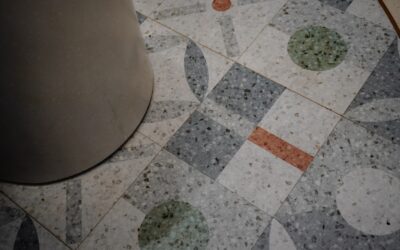
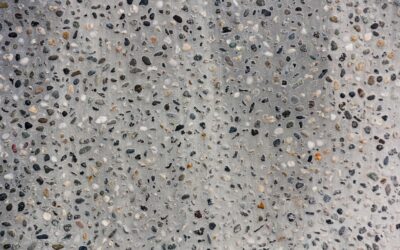
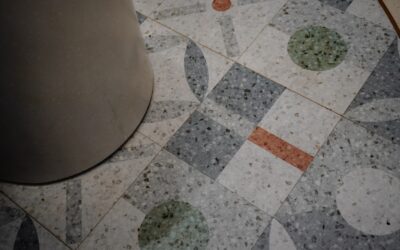
The terrazzo revival of the past five years caught the flooring industry off guard. Real poured terrazzo runs $30 to $50 per square foot installed, takes weeks to cure, and requires specialty crews most cities are short on. The workaround that has taken over residential and light-commercial projects: terrazzo LVT flooring, a luxury vinyl tile printed and embossed to mimic the chip-and-binder look at one-fifth the cost. Whether the look holds up over a decade of foot traffic depends almost entirely on which product you buy.
What Terrazzo LVT Actually Is
Terrazzo LVT is a multi-layer vinyl tile, typically 2 to 5mm thick, with a high-resolution print film showing terrazzo aggregate and a clear PVC wear layer ranging from 12 to 28 mil. The best products use registered embossing — the texture lines up with the print image, so individual chips read three-dimensional rather than flat. Tile sizes range from 12 by 24 inches up to 24 by 48 inches, and the larger formats deliver a more authentic poured look.
Pros of Going With Terrazzo LVT
- Cost runs $3 to $9 per square foot versus $30 to $50 for genuine terrazzo
- Installation in days rather than weeks, with click-lock or glue-down options
- Waterproof core handles bathrooms, kitchens, and basements without sealing
- Comfort underfoot is warmer and softer than poured stone
- Replaceable plank-by-plank if a section gets damaged
- Available in dozens of chip color and binder combinations
Cons That Pictures Hide
Print resolution is the make-or-break detail. Cheap import LVT under $3 per square foot uses a low-DPI print that pixelates obviously when you stand and look down at the floor — the chips look like pasted-on shapes rather than embedded aggregate. Real terrazzo has random chip distribution; budget LVT often uses an obvious 4 by 8 tile repeat that becomes visible across larger floors.
The other limitation is depth. Genuine terrazzo can be polished to a mirror sheen that catches light in a way print film cannot replicate. In strong directional light, even premium terrazzo LVT reads slightly flatter than the real thing. For most everyday lighting, the difference is invisible.
Top Brands Worth Considering
Five products dominate the residential and light-commercial market right now:
- Karndean Korlok Terrazzo collection — $7.50 to $9 per sq ft, 28 mil wear layer, glue-down
- Forbo Allura Materials terrazzo prints — $6 to $8 per sq ft, commercial-grade
- Mannington Adura Max Terrazzo — $4.50 to $6 per sq ft, click-lock LVT
- Mohawk SolidTech Terrazzo — $3.50 to $5 per sq ft, value-tier rigid core
- Shaw Floorte Terrazzo — $4 to $6 per sq ft, mid-range balance of look and cost
Karndean is the best in-class for residential applications where the floor is a design feature. Forbo wins for commercial spaces where wear matters more than aesthetics. Mannington and Shaw cover the sweet spot for most homeowners.
Where Terrazzo LVT Works Best
Powder rooms and small bathrooms are the easiest wins — terrazzo LVT brings a high-design look without the moisture sensitivity or installation complexity of real terrazzo. Kitchens and laundry rooms are next, especially with the larger 24 by 48 inch formats that read closer to a poured surface.
Open-concept living and dining spaces work as long as you commit to the larger format and avoid obvious tile-to-tile repeats. Entryways, mudrooms, and basement family rooms round out the natural fit list.
Where to Skip It
Commercial lobbies with 1,000+ daily foot traffic events should use real terrazzo or porcelain tile printed with terrazzo patterns. The wear layer on LVT, even at 28 mil, will telegraph paths within five to seven years in those conditions. Outdoor or three-season rooms also fall outside the warranty for most LVT — UV exposure fades the print film and the click joints can flex with extreme temperature swings.
Installation Tips From the Field
- Acclimate cartons in the install room for 48 hours at 65 to 85°F
- Mix planks or tiles from at least four cartons during install to randomize the pattern
- Verify subfloor flatness to within 3/16 inch over 10 feet — terrazzo prints reveal subfloor waves more than wood-look LVT
- For glue-down, use the manufacturer’s recommended pressure-sensitive adhesive and roll with a 100 lb roller in both directions
- For click-lock rigid core, leave 1/4 inch expansion at all walls and around fixed obstacles
- Mock up a 4 by 4 foot section and step back 10 feet before committing — the pattern reads very differently from a sample chip
Caring for Terrazzo LVT
Daily care is straightforward. Sweep or vacuum without a beater bar, then damp-mop weekly with a pH-neutral cleaner like Bona Pro or the manufacturer’s branded cleaner. Avoid steam mops and oil-based polishes — both can soften or dull the wear layer over time. Felt pads on furniture, no-mark wheels on rolling chairs, and a generous entry mat handle 90 percent of the long-term abrasion risk.
Cost Comparison: Real Versus Print
For a 200-square-foot bathroom in 2026:
- Poured cementitious terrazzo: $6,000 to $10,000 installed
- Epoxy terrazzo: $8,000 to $12,000 installed
- Premium terrazzo LVT (Karndean): $1,800 to $2,200 installed
- Mid-range terrazzo LVT: $1,200 to $1,500 installed
- Budget terrazzo LVT: $700 to $1,000 installed
The savings compound when you scale up. A 1,200-square-foot main floor saves $30,000 or more by going LVT instead of poured terrazzo.
The Honest Verdict
For homeowners who love the terrazzo look but live on a real budget, terrazzo LVT flooring is one of the most successful pattern adaptations in the LVT category. Pick a 24-inch or larger tile, spend the extra $1 to $2 per square foot on a 20+ mil wear layer, and pay attention to print quality at the showroom. Done right, the floor reads as authentic terrazzo from standing height and saves $20 to $40 per square foot over the genuine article.
Prefer to explore on your own?
See how new flooring looks in your actual room in seconds — free, no signup.
Try the free Floor Studio →