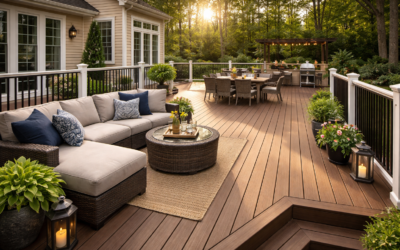
Trex Transcend railing is the company’s premium composite railing line, and its main selling point is flexibility: you can mix composite rails with composite or aluminum balusters, add glass panels or turn the top rail into a flat cocktail rail. That flexibility also makes ordering confusing, because a finished run is built from several separately sold parts rather than one box.
The short version: Transcend comes in three main colors (Classic White, Charcoal Black and Vintage Lantern), installs over a sleeved 4×4 post, and is sold as rail and baluster kits in 6 and 8 foot lengths at 36 or 42 inch heights. Post sleeves, caps, skirts and lights are bought separately.
- Trex Transcend Railing Components and Colors
- How a Transcend Section Goes Together
- Infill Styles: Choosing the Look
- Pros and Cons of Transcend
- Planning and Tools
- Installation Overview
- Choosing Colors That Work With Your Deck
- Troubleshooting Common Issues
- Typical Price Range
- When to Call a Pro
- Frequently Asked Questions
Trex Transcend Railing Components and Colors
| Component | Options | Key dimensions |
|---|---|---|
| Crown top rail | Classic White, Charcoal Black, Vintage Lantern | 6 ft rail is 67.5 in; 8 ft rail is 91.5 in |
| Universal top/bottom rail | Same three colors | Same lengths; can carry a deck board as a cocktail rail |
| Square composite balusters | Kit colors | 1.418 in square; 16 per pack |
| Round aluminum balusters | Aluminum kits; confirm color per kit | 0.75 in diameter; 20 per pack |
| 4 in post sleeve | Composite in multiple colors, or aluminum | 4.45 x 4.45 in; 40 or 108 in long; fits a 4×4 post |
| 6 in post sleeve, cap and skirt | Classic White only | 5.5 x 5.5 in sleeve; 39 or 108 in long |
| Glass panel kit | Mounting hardware only (glass not included) | For 6 ft rail sections |
| Post cap lights | Optional upgrade | Sold separately; follow the lighting guide |
Classic White is the color behind the common search for white Trex railing. It is the only color offered in the 6 inch post sleeve, flat cap and skirt, and the only color for the 6 ft composite stair kit. If you want black or Vintage Lantern posts, plan on the 4 inch sleeve.
How a Transcend Section Goes Together
Each rail and baluster kit includes a crown top rail, a universal bottom rail, balusters, baluster spacers, an adjustable foot block and mounting hardware. A finished section looks like this from the ground up:
- A pressure-treated 4×4 post, structurally attached to the deck framing.
- A post sleeve slid over the post, with a skirt at the base and a cap on top.
- A bottom rail held off the deck by the adjustable foot block (which keeps the rail from sagging mid-span).
- Balusters seated in spacers that set consistent gaps.
- The crown top rail capping the balusters and fastened to the post sleeves with brackets.
The 6 ft kit spans a 67.5 inch rail and the 8 ft kit spans 91.5 inches; those lengths are the rail itself, so post spacing has to suit them. Aluminum baluster kits come in horizontal and stair versions in all three colors. Composite kits come in all three colors for 8 ft horizontal and stair runs, while the 6 ft composite stair kit is white only.
Infill Styles: Choosing the Look
Square composite balusters
The traditional look. The 1.418 inch square balusters match the rail color for a solid, painted-wood appearance. They come cut to length for 36 inch rail heights (30.375 inches long) and 42 inch heights (36.375 inches long).
Round aluminum balusters
Thin 0.75 inch round metal balusters are the most popular mix-and-match option. A white top rail with black round balusters, or Vintage Lantern rails with black balusters, gives a lighter, more open look than composite. Lengths are 30.25 inches for 36 inch rail and 36.25 inches for 42 inch rail.
Colonial balusters
The accessory infill kit also lists colonial-style balusters for a more traditional turned look. Availability varies by color and region, so check before you design around them.
Glass panels
A glass mounting kit lets you swap balusters for glass in 6 ft sections. The glass itself is not included and must be sourced separately, usually cut and tempered by a local glass shop. This is the choice for lake and mountain views.
Cocktail rail
Using the universal rail on top, you can fasten a deck board flat across it to create a wide drink ledge. It is a nice touch along a view side or around a bar area.
Pros and Cons of Transcend
| Pros | Cons |
|---|---|
| Mix composite and aluminum balusters and colors | Premium price compared with basic composite or aluminum railing |
| Three rail colors that coordinate with composite decking | Limited color choice for 6 in post hardware (white only) |
| Glass and cocktail rail options from the same line | Many separate parts to order: sleeves, caps, skirts, brackets |
| No painting or staining; wipe-clean surface | Glass for the glass kit is a separate purchase |
| Limited residential warranty | Spans and post spacing are fixed by kit lengths |
Planning and Tools
Before ordering, sketch the deck with every post location, measure each run between posts and count stair sections separately. Then list kits, sleeves, caps, skirts and any stair or angle brackets. Most homeowners also plan a few extra balusters for breakage.
- Post level (for plumbing posts and sleeves in two directions at once)
- Miter saw with a fine-tooth blade for composite rails
- Drill/driver, bits and the hardware supplied in the bracket packs
- Tape measure, speed square and a pencil or marker
- Clamps and a helper for holding long top rails
- Safety glasses and hearing protection
Installation Overview
- Confirm post strength. Railing loads depend on how posts attach to the framing. Use the blocking and through-bolting the manufacturer’s installation guide and your local code call for.
- Plumb the posts. Use a post level on two faces. A sleeve cannot correct a leaning post.
- Install sleeves and skirts. Slide the skirt on, then the sleeve, and trim the sleeve to height if needed.
- Measure and cut rails. Measure between sleeves at the top and bottom, since posts are rarely perfectly parallel. Cut rails and balusters per the guide.
- Set brackets. Attach rail brackets to sleeves at consistent heights using a spacer block.
- Assemble the infill. Place the bottom rail with its foot block, set spacers and balusters, then lower the top rail over them.
- Fasten and cap. Secure rails to brackets, add post caps and wire any post cap lights.
Stairs use stair-specific kits and brackets. Rake angles make measuring trickier, so dry-fit before cutting.
Choosing Colors That Work With Your Deck
Rail color is usually chosen against the decking and the house trim. Classic White rails read crisp and traditional, especially on homes with white window trim, and white top rails with black round balusters are a common way to keep the view open while still tying into dark accents. Charcoal Black gives a modern outline and tends to disappear visually against dark siding or a wooded backdrop. Vintage Lantern is a warm brown that pairs with brown and reddish composite decking for a more natural, wood-like look.
Keep in mind that dark rails absorb more sun and feel warmer to the touch on hot afternoons, while white shows dirt and pollen sooner. Order a sample of the rail color, hold it against your decking in daylight, and check it against the house trim before you buy a full set of kits. Mixing colors is allowed by design, but limiting a deck to two railing colors usually looks more intentional than three.
Troubleshooting Common Issues
Rail sags in the middle
The adjustable foot block is missing or not adjusted. Set it so the bottom rail is supported at midspan.
Balusters rattle or look uneven
Spacers were skipped or cut wrong. Reinstall with the supplied spacers and check that both rails are parallel.
Sleeves look crooked
The post underneath is out of plumb. Shim inside the sleeve only if the guide allows; otherwise correct the post.
Gaps where rails meet sleeves
Composite moves slightly with temperature. Cut to the guide’s specified fit rather than jamming rails tight on a hot day.
Typical Price Range
The manufacturer places Transcend in the upper price tier of its composite railing, below the glass, mesh and rod rail versions of its Signature aluminum railing. Material costs per linear foot are typically well above basic composite or vinyl railing and comparable to other premium composite systems, and glass sections add more. Professionally installed composite railing commonly lands in a broad range per linear foot depending on stairs, post count and infill. Get itemized quotes that separate kits, posts, sleeves, lighting and labor.
When to Call a Pro
Bring in a deck contractor when posts need new blocking or replacement, when the deck is high off the ground, or when your area requires a permit and inspection for guard rails. Code generally requires guards on decks above a certain height and sets minimum heights and maximum baluster spacing; your local building department sets the exact rules. Glass sections and long stair runs are also good jobs to hand off.
Frequently Asked Questions
What colors does Trex Transcend railing come in?
The current line lists Classic White, Charcoal Black and Vintage Lantern for rails and kits. The 6 inch post sleeve, flat cap and skirt are listed in Classic White only.
Can I mix white rails with black balusters?
Yes. Transcend is designed so you can mix and match composite rails with composite or aluminum balusters, and white rails with black round balusters is a popular combination.
What rail heights are available?
Kits and balusters are sized for 36 inch and 42 inch rail heights. Check your local code to see which height your deck needs.
Do Transcend kits include posts?
No. Kits include the top rail, bottom rail, balusters, spacers, foot block and hardware. Post sleeves, caps and skirts are sold separately and slide over a pressure-treated 4×4 post.
Does Transcend come with glass?
A glass mounting kit is offered for 6 ft sections, but the glass panels themselves are not included and must be purchased separately.