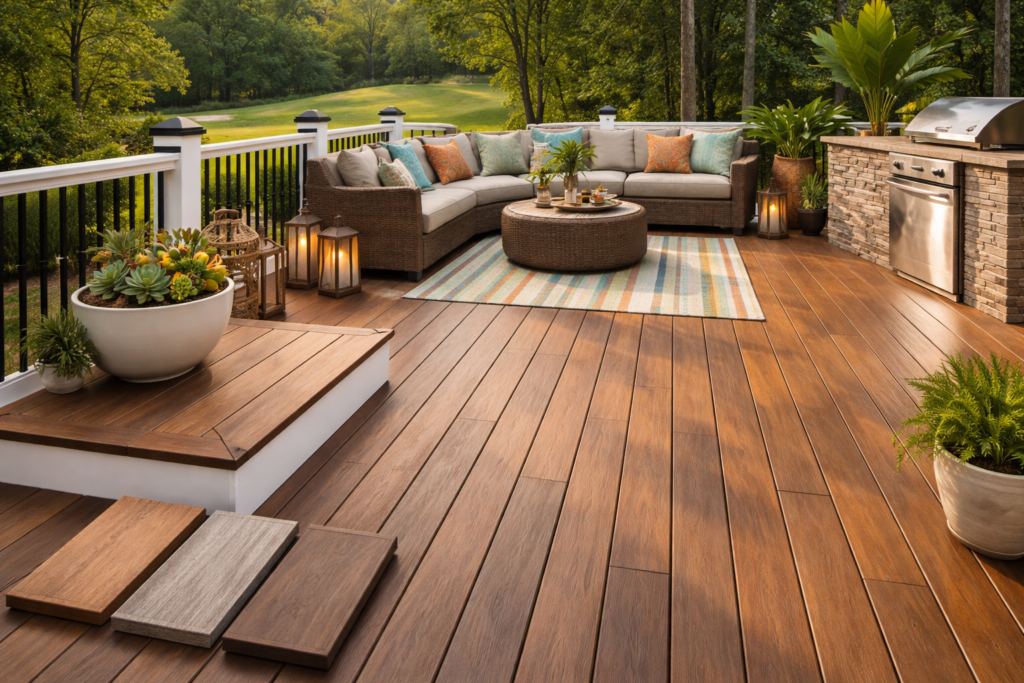
Most people pick a deck color from a 3-inch chip, then get surprised when 400 square feet of it shows up in full sun. Trex Tiki Torch is one of the colors where that surprise is usually a pleasant one. Trex describes it as an easygoing light brown with hints of nutmeg and ginger, designed to mimic tropical teak, and it sits in the premium Transcend line alongside Havana Gold, Island Mist, Lava Rock and Spiced Rum.
In plain terms, Tiki Torch reads as a warm, honey-to-caramel brown with darker streaks running through it. It is lighter than a classic walnut deck and noticeably warmer than gray composite. That middle position makes it one of the easier Transcend colors to pair with siding, trim and furniture, and it hides everyday dirt better than very light or very dark boards.
- Trex Tiki Torch at a Glance
- Undertones: What Color Is Tiki Torch Really?
- Tiki Torch vs Spiced Rum and Other Transcend Colors
- Heat and Scratch Visibility
- Best Pairings: Siding, Trim and Railing
- Is Trex Tiki Torch Right for Your Deck? A Quick Decision Guide
- Cleaning and Care
- Troubleshooting Common Complaints
- General Cost Ranges
- When to Call a Pro
- Frequently Asked Questions
The sections that follow cover the specs Trex publishes, how the undertones behave in different light, what shows on the surface over time, and the house and railing colors that tend to work with it.
Trex Tiki Torch at a Glance
Before you order samples, it helps to know what the color actually is on paper. These figures come from the manufacturer’s Transcend product pages; board dimensions are the same across every Transcend color.
| Spec | Value | What it means |
|---|---|---|
| Product line | Trex Transcend (premium capped composite) | Top tier of the brand’s decking lineup |
| Color family | Brown, multi-tonal (variegated) | Streaks of lighter and darker brown, not a flat solid |
| Maker’s description | Light brown, nutmeg and ginger notes, teak look | Warm undertone, never gray or green |
| 1-inch board (grooved or square edge) | 0.94 in x 5.5 in actual | Grooved: 12, 16, 20 ft; square edge: 16, 20 ft |
| 2×6 square edge board | 1.3 in x 5.5 in actual | Thicker option in 12, 16, 20 ft lengths |
| Fascia | 1×8 and 1×12, 12 ft | Matching color to wrap rim joists |
| Warranty | 50-year limited residential and fade and stain | Covers fading and staining, not abuse or misuse |
| Recycled content | About 95% recycled or reclaimed material | Reclaimed sawdust and plastic film core |
Tiki Torch has been part of the Transcend palette for years, and the manufacturer’s site still lists it as a current color with full board, fascia and sample options. Product lines do change, so confirm availability and the current spec sheet with your dealer before you lock in a design.
Undertones: What Color Is Tiki Torch Really?
The base of the board is a light-to-medium brown, and the undertone is firmly warm. Think toasted cinnamon and caramel rather than chocolate. Some dealers describe a hint of red or copper in the streaks, and that matches what most people notice in person: in low evening light, the board can lean slightly orange-red, while in midday sun it looks more golden.
The variegation matters as much as the base color. Each board has darker grain lines and lighter washes printed into the cap, so a finished deck looks like it was laid from many slightly different planks. That variation is why the color hides footprints and pollen better than a single-tone board.
How Light Changes It
- Full southern or western sun: reads brighter and more golden; the darker streaks soften.
- North-facing or shaded decks: looks deeper and a touch redder, closer to a medium brown.
- Under a covered porch roof: the streaks stand out more, which can look busier on a small porch floor.
- Wet boards: darken noticeably for a short time, then return to the dry shade as they dry.
Because of these shifts, place full-size samples on the actual deck frame and look at them at 9 a.m., midday and dusk before you decide. A 12-inch sample tells you far more than a printed swatch.
Tiki Torch vs Spiced Rum and Other Transcend Colors
The most common comparison is Tiki Torch vs Spiced Rum, because both are warm brown tropical-wood looks from the same line. They solve different problems.
| Color | Look | Best for |
|---|---|---|
| Tiki Torch | Light brown, teak style, warm spice notes | Sunny yards, lighter siding, a relaxed feel |
| Spiced Rum | Dark burnt-umber brown with black lowlights, ipe style | Formal or modern homes, high contrast with white trim |
| Havana Gold | Golden, lighter brown | Coastal or cottage looks |
| Island Mist | Gray | Cool-toned houses, gray or white siding |
| Lava Rock | Dark reddish brown | Brick homes, traditional styles |
Spiced Rum looks richer in photos, but it absorbs more heat and shows dust, pollen and light scratches more readily because the contrast against the dark surface is higher. Tiki Torch is the more forgiving everyday choice. If you want a two-tone design, the pair works well together: Spiced Rum as a picture-frame border and Tiki Torch in the field gives definition without making the whole deck dark.
Heat and Scratch Visibility
Every composite board gets hot in direct sun, and the manufacturer says plainly that darker colors feel hotter. Tiki Torch, as one of the lighter Transcend browns, generally runs cooler underfoot than Spiced Rum or Lava Rock. It is still not cool. On a July afternoon in a hot climate, plan on sandals, an outdoor rug in seating areas, or some shade from a pergola or umbrella.
For scratches, the capped surface is marketed as fade, stain, scratch and mold resistant, but no composite is scratch-proof. The streaky pattern on Tiki Torch is your friend here. A light scuff from dragging a chair blends into the grain rather than showing as a bright line, the way it might on a solid dark board.
What Does Show
- Dark grill grease and food spills, if left to sit for days
- Gray pollen film in spring, mostly visible in shaded corners
- Rust marks from metal furniture feet left on wet boards
- Deep gouges that cut through the protective cap (these should be avoided, not repaired)
Best Pairings: Siding, Trim and Railing
Warm decks look best next to colors that either share the warmth or provide clean contrast. Avoid cool blue-grays that fight the orange tones.
House and Siding Colors
- Warm whites and creams: the classic choice; the deck becomes the accent.
- Greige and taupe siding: a quiet, cohesive look for suburban homes.
- Sage and olive greens: pull the teak character forward and suit wooded lots.
- Deep navy or charcoal: work if the trim is white; the white trim keeps the deck from clashing.
- Red brick: fine with a soft orange-red brick; with very purple-red brick, test samples first.
Railing Colors
Classic White railing gives a traditional porch look and frames the brown boards cleanly. Charcoal Black railing reads more modern and lets the deck color stand out. A brown railing that is close to, but not identical to, the boards often looks like a mismatch, so pick contrast unless you can compare actual samples side by side.
Is Trex Tiki Torch Right for Your Deck? A Quick Decision Guide
- Choose it if you want a natural wood look, have a sunny yard, have kids or pets, or want a color that hides daily dirt.
- Consider a darker brown if your house is crisp white or modern and you want strong contrast.
- Consider a gray if your siding is cool gray, blue or black-and-white.
- Get samples if your brick or stone has strong pink or purple tones.
Search interest in trex transcend tiki torch tends to come from people redoing an older brown deck, and it is a natural upgrade for that situation: the same general color family with a more convincing wood grain and stronger surface protection.
Cleaning and Care
Capped composite needs much less work than wood, but it is not zero maintenance. Sweep regularly so grit does not get ground into the surface. Twice a year, wash with warm soapy water and a soft-bristle brush, then rinse well. For spring pollen or mildew spots in shaded areas, a composite deck cleaner made for capped boards does the job faster than dish soap. Always follow the cleaner’s label and test in an out-of-the-way spot first.
- Skip stiff wire brushes; they can scuff the cap.
- Use a pressure washer only at the settings and tip distance the manufacturer allows, and with a fan tip.
- Wipe grease and oil quickly; soapy water works best on fresh spills.
- Put felt or rubber pads under furniture feet and planters.
- Clear snow with a plastic shovel, never a metal blade.
Troubleshooting Common Complaints
“The boards look different from each other.” That is the variegation by design. Mix boards from several bundles while installing so streak patterns spread evenly rather than clustering in one area.
“It looks more orange than the sample.” Low sun and nearby red brick or cedar fencing can push the warm tones. Neutral rugs and furniture in gray, cream or black calm it down.
“White marks after cleaning.” Usually mineral residue from hard water or soap left to dry. Rinse thoroughly and dry with a soft cloth or squeegee.
“A hazy spot under the grill.” Grease absorbed into surface texture. Clean promptly with a degreasing composite cleaner, and use a grill mat going forward.
General Cost Ranges
Transcend is the premium tier, so material cost runs higher than entry-level composite. As a rough national guide, capped premium composite decking boards often run about $4 to $7 per linear foot depending on profile and length, and a professionally built premium composite deck commonly lands in the range of $40 to $70 per square foot installed once framing, railing, fasteners and labor are counted. Color does not usually change the price within the line, but special-order lengths and fascia can add lead time. Get two or three local quotes, because regional pricing varies widely.
When to Call a Pro
Hire a licensed deck contractor if you are building a new raised deck, replacing framing, attaching a ledger to the house, or building stairs. Composite boards need specific joist spacing, gapping for expansion and approved fasteners to keep the warranty valid, and most jurisdictions require a permit for new decks. A pro can also help you check whether the existing frame is sound enough to resurface.
Frequently Asked Questions
Is Trex Tiki Torch a light or dark brown?
The manufacturer calls it a light brown with nutmeg and ginger notes. In shade or low light it can read closer to medium brown with a slight red cast.
Does Tiki Torch get hot in the sun?
All composite gets hot in direct sun. As one of the lighter browns in the line, Tiki Torch generally feels cooler than the darker colors, but shoes or shade are still a good idea on hot days.
What railing color goes with Tiki Torch decking?
Classic White and Charcoal Black are the safest choices because they contrast clearly. A brown railing close to the deck color can look mismatched.
What is the difference between Tiki Torch and Spiced Rum?
Tiki Torch is a lighter, teak-style brown, while Spiced Rum is a dark ipe-style brown with black lowlights. Spiced Rum shows dust and heat more; Tiki Torch is more forgiving.
Is Tiki Torch still available?
The manufacturer’s site lists it as a current Transcend color. Confirm stock and lengths with a local dealer before you finalize plans.