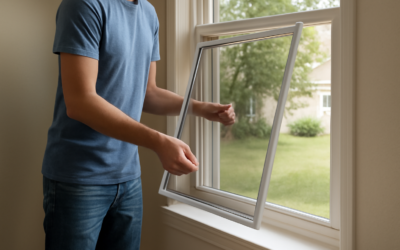
Screen mesh gets all the attention, but the frame is what actually determines whether a window screen fits, seals, and survives a decade of seasons. Understanding the types of window screen frames — the materials, the extrusion sizes, the corner systems, and the mounting hardware — turns a confusing repair-aisle visit into a ten-minute purchase, and it is the difference between a screen that snaps crisply into its track and one that bows, rattles, and falls out in July. Here is the complete field guide, from builder-grade aluminum to custom wood.
Part of our Windows & Doors guide — explore the full guide →
- Aluminum Frames: The Default for Good Reason
- Vinyl and Fiberglass-Composite Frames
- Wood Frames: Historic and Custom Work
- Steel and Specialty Security Frames
- Corner Systems: The Part Everyone Ignores
- Mounting Hardware: How Screens Stay Put
- Sizing and Rescreening Basics
- Matching Mesh to Frame
- Which Frame Type Should You Choose?
Aluminum Frames: The Default for Good Reason
Roll-formed aluminum accounts for the overwhelming majority of window screens in American homes. The frame is a hollow rectangular extrusion, mitered or square-cut at the corners, joined with plastic or metal corner inserts, with the mesh held in a groove (the spline channel) by a rubber cord called spline.
- Standard frame stock: 5/16 x 3/4 inch is the near-universal residential size; 7/16 x 3/4 and 7/16 x 1 inch appear on larger windows and some patio doors.
- Finishes: mill (raw silver), white, bronze/brown, and black, painted or anodized. Match your window’s screen channel, not your trim.
- Cost: a complete DIY frame kit for one window runs $10 to $20; frame stock in 8-foot sticks costs $4 to $8 per piece at hardware stores.
Strengths are obvious — cheap, light, straight, rustproof, and every hardware store in the country stocks parts. The weakness is denting and kinking: a bent aluminum frame rarely straightens true, and the thin roll-formed wall can crush if a spline is forced with too small a groove. The fix is equally cheap: rebuild the frame with new stock and corners for a few dollars a side.
Vinyl and Fiberglass-Composite Frames
Vinyl-framed screens ship with many vinyl replacement windows because the material matches the window’s look and never corrodes or conducts heat. Extruded PVC frames are quieter in the track than aluminum and shrug off coastal salt air that pits mill-finish aluminum. Their limits: vinyl moves with temperature — long spans bow on hot days — and it gets brittle with UV exposure over 15 to 20 years, so corners crack where aluminum would dent. Composite and fiberglass-reinforced frames on premium windows (some Andersen and Marvin lines) solve the stiffness issue at a price, and are usually proprietary: replacement means ordering from the window manufacturer with the window’s unit number, not cutting generic stock. Check the frame’s back face for a molded part number before assuming anything is standard.
Wood Frames: Historic and Custom Work
Old houses with wood windows often carry wood-framed screens — half or full-height frames in pine, fir, or mahogany, joined with mortise-and-tenon or doweled corners, with mesh stapled on and covered by a screen-bead molding. Nothing else looks right on a 1920s bungalow, and hanging hardware (clips, turn buttons, hangers at the top rail) is still sold by restoration suppliers. Expect to build or commission them: a custom wood screen runs $80 to $250 per opening from a millwork shop, or a weekend per batch if you build your own from 3/4 x 2-inch stock. Maintenance is real — paint or spar varnish every few years — but a maintained wood screen outlives everything else on this list. For storm-screen combinations, wood triple-track conversions exist but most owners pair wood screens with separate wood storms, swapped seasonally the old way.
Steel and Specialty Security Frames
Heavier extruded aluminum and roll-formed steel frames carry security screens — stainless steel mesh systems (Crimsafe-style) that resist cutting and impact. These are engineered products with tamper-resistant fasteners, screwed to the window frame rather than clipped, priced at $300 to $900 per opening installed. On the lighter end, pet-resistant screen systems often upgrade to 7/16-inch or larger frame stock so the heavier vinyl-coated polyester mesh has a frame stiff enough to tension against. If a standard frame keeps bowing under pet screen, the frame is the problem, not the spline.
Corner Systems: The Part Everyone Ignores
Frames fail at corners, and corners come in three types. Plastic inserts — square-cut frame stock joined by molded plastic corners pushed into the hollow — are the DIY standard, cheap and replaceable, sold in bags matched to frame size ($0.50 to $1 each). Metal corners, internal or external, are stiffer and survive removal-reinstallation cycles better; they are worth the upgrade on screens that come out every season. Mitered mechanically-joined corners appear on factory screens from window manufacturers, clean-looking but frequently proprietary. When rebuilding a screen, always replace the corners — they cost pennies, and reused brittle plastic corners are why rebuilt screens go parallelogram in the track.
Mounting Hardware: How Screens Stay Put
- Spring plungers: pin-style plungers on one side press into holes in the window channel. Standard on many double-hung screens.
- Flat tension springs: leaf springs along the top rail compress to pop the screen in and hold it tight. The most common system on vinyl windows.
- Turn clips and butterfly latches: small rotating clips screwed to the window stop, typical on older aluminum self-storing storm-screen combos.
- Lift tabs and pull tabs: not retention hardware, but the plastic or metal tabs you grip to remove the screen — order frames with them installed or add stick-on versions.
- Screw-mounted: fixed screens on casements and security screens fasten directly with screws through the frame.
Identify your hardware before ordering or building; a perfect frame with the wrong retention system is a screen that lives in the garage.
Sizing and Rescreening Basics
Measure the opening or the old frame, not the mesh. For channel-mounted screens, the frame should be about 1/8 to 1/4 inch smaller than the opening in each dimension, with hardware making up the tension fit. Frame stock cuts with a hacksaw or miter saw at 32 teeth per inch; plastic corners set the final dimensions, so cut stock short by twice the corner’s internal offset (the corner bag lists it). Rescreening an intact frame costs $8 to $15 in mesh and spline DIY, or $15 to $35 per screen at a hardware store’s screen shop. A full frame rebuild adds $10 to $20. When more than a third of a home’s screens need work, negotiating a batch price with a local glass-and-screen shop usually beats DIY time unless you enjoy the work — and it is honest work to enjoy.
Matching Mesh to Frame
Frame and mesh are a system, and pairing them wrong is a common source of bowed rails and saggy screens. Standard fiberglass mesh (18×16 weave) tensions lightly and works in any frame, including the thinnest 5/16-inch roll-formed stock — it is the forgiving default and the right choice for 90 percent of rescreens. Aluminum mesh holds a crisper, flatter plane and resists small impacts, but it tensions harder and shows every installation wobble; pair it with straight, stiff frames and a practiced spline hand. Pet screen — vinyl-coated polyester roughly seven times stronger than standard fiberglass — pulls hard enough to bow a 36-inch span of light frame stock, so step up to 7/16-inch heavy-wall frame or add a center crossbar (cross-braces and their clips cost a couple of dollars) on anything wider than about 30 inches. The fine-mesh options run the other direction: 20×20 no-see-um mesh for gnat country and solar screen fabrics that block 65 to 90 percent of heat gain both install like standard fiberglass but reduce airflow noticeably, worth knowing before you do the whole west wall. Spline diameter ties it together — heavier mesh in the same groove usually wants one size smaller spline to seat without crushing, and every mesh package lists the pairing. Buy the mesh and spline together, test one corner before committing, and the frame will pull the fabric drum-tight without complaint.
Which Frame Type Should You Choose?
Match the frame to the window and the climate, not to a bargain. Vinyl windows take their matching vinyl or standard aluminum screens; historic wood windows deserve wood or, at minimum, bronze-finished aluminum that disappears visually; coastal homes justify vinyl or marine-anodized aluminum; households with dogs upgrade to heavy-wall frames with pet mesh; security concerns move you into engineered steel-mesh systems. For everyone else, standard 5/16 x 3/4 aluminum with fresh plastic corners and the correct retention hardware remains the sensible default — cheap to build, cheap to fix, and invisible when it is doing its job, which is exactly what anyone should want from the types of window screen frames on their house.