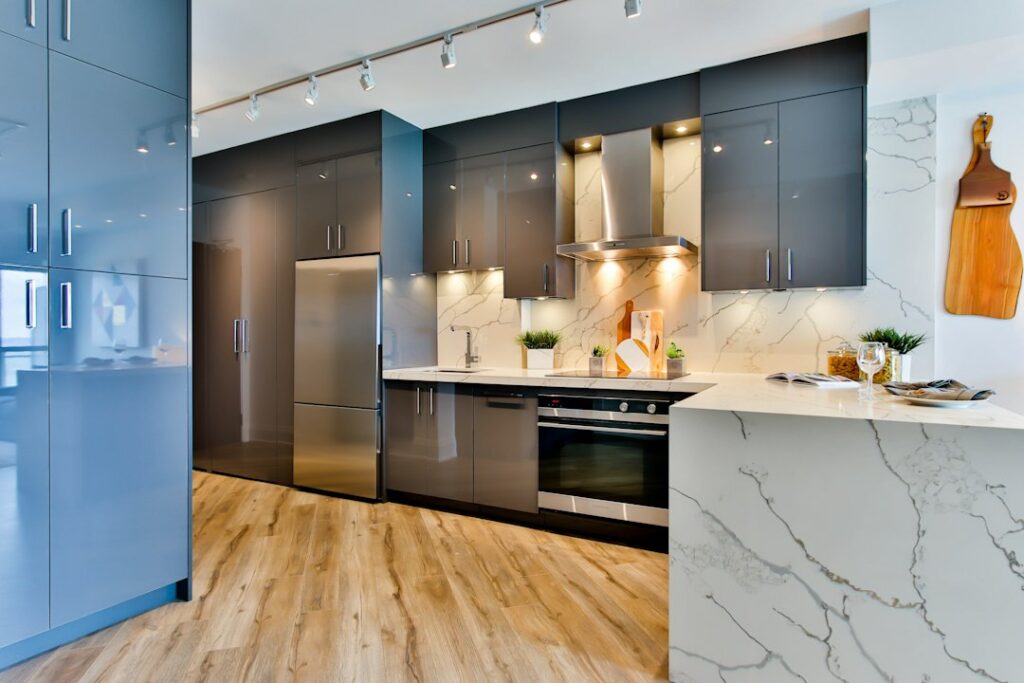
A full-height tile or slab backsplash can look stunning until a row of beige receptacles interrupts it every few feet. That is why under cabinet outlets have become a favorite in kitchen remodels: the receptacles move to the underside of the wall cabinets, where they stay within reach of the countertop but out of sight from anywhere but a crouch. The backsplash becomes one uninterrupted surface, and the countertop still has the power it needs for a toaster, mixer, or coffee maker.
Part of our Kitchen Remodeling guide — explore the full guide →
There are two main ways to do it. The first is a continuous plug strip, sometimes called plugmold, mounted along the bottom front or back edge of the cabinets. The second is an angled power strip, a slim triangular housing that tucks into the corner where the cabinet bottom meets the wall and faces its receptacles down and out toward the counter. Both are hardwired into kitchen circuits, both must provide GFCI protection, and both have to satisfy the same countertop spacing rules that apply to ordinary wall receptacles.
- How Under Cabinet Outlets Work in a Kitchen
- Code Basics: Spacing, GFCI, and Circuits
- Not the Same as an In-Cabinet Appliance Outlet
- Planning Your Layout Step by Step
- Tools and Materials
- Electrical Safety for Anyone Touching the Wiring
- When to Call a Licensed Professional
- Troubleshooting
- Cost Ranges
- Frequently Asked Questions
This guide explains how each option works, how code shapes the layout, and where the DIY line sits. Short version: planning is homeowner territory, but the wiring belongs to a licensed electrician in most kitchens.
How Under Cabinet Outlets Work in a Kitchen
Standard kitchen receptacles sit in wall boxes roughly 42 to 46 inches off the floor, which puts them squarely in the middle of the backsplash. Under cabinet electrical outlets relocate that power to the bottom of the upper cabinets, typically about 54 inches off the floor. Wiring runs through the wall behind the cabinets and enters the strip through a knockout or a box concealed by the housing.
Because the strips stay hidden from standing eye level, the backsplash can be tiled or clad as a single uninterrupted field. That matters most with large-format porcelain, quartz or stone slab backsplashes, and busy mosaics where a cut-out would break the pattern.
Angled Power Strips
An angled power strip, also sold as a task lighting angled power strip when it includes an integrated light, mounts in the joint between the cabinet underside and the wall. Its triangular profile points the receptacles at about 45 degrees toward the counter, so cords drop naturally and plugs stay easy to reach. Many models come in lengths of 2 to 4 feet with multiple receptacles, optional USB ports, and finishes in white, black, stainless, or paintable housings. Some integrate LED task lighting in the same body, combining two under-cabinet upgrades into one fixture.
Under Cabinet Strip Outlets (Plugmold)
Under cabinet strip outlets are low-profile channels with receptacles spaced every 6 to 12 inches. They mount flat to the underside of the cabinet, usually toward the front edge behind the light rail, or along the back near the wall. They offer lots of receptacles in a compact line but can be a little harder to reach when mounted at the back.
Individual Undermount Receptacles
A third approach uses individual boxes mounted into the cabinet bottom or a false bottom panel. Undermount cabinet outlets like these work, but the boxes eat into cabinet space and require careful framing. Most remodelers prefer the strip styles for a cleaner install.
Code Basics: Spacing, GFCI, and Circuits
Electrical codes vary by jurisdiction, and your local building department has the final say. That said, the core principles for countertop receptacles are widely adopted across the United States:
- Spacing: Receptacles serving the countertop are generally placed so that no point along the wall line of the counter is more than 24 inches from a receptacle. In practice, that means a receptacle at least every 4 feet, plus one for any counter section 12 inches or wider. An under cabinet receptacle strip must meet the same coverage, so a single short strip on a long run of cabinets is rarely enough.
- GFCI protection: All kitchen countertop receptacles need ground-fault circuit interrupter protection. That can come from a GFCI receptacle at the start of the run, a GFCI breaker in the panel, or strips with built-in GFCI. The protection has to be accessible for testing and resetting.
- Small-appliance circuits: Countertop receptacles are typically fed by at least two dedicated 20-amp small-appliance circuits. Relocating receptacles to under cabinet strips does not reduce that requirement.
- Height limits: Many jurisdictions limit how high over the countertop a receptacle can be and still count toward countertop coverage. Standard upper cabinets usually fall within that range, but tall gaps or very high cabinets may not. Confirm with your inspector before committing.
- Listed equipment: Use strips listed for the application and install them per the manufacturer’s instructions. Some local inspectors have specific preferences about under cabinet receptacle placement, so ask early.
Islands and peninsulas follow their own rules and cannot use under cabinet strips at all, since there is no upper cabinet overhead. Plan those with pop-up or side-mounted receptacles instead.
Not the Same as an In-Cabinet Appliance Outlet
People sometimes confuse under counter outlets or under cabinet outlets kitchen layouts with receptacles placed inside a cabinet. An in-cabinet outlet powers a specific appliance, such as a microwave over the range, a garbage disposal under the sink, or a dishwasher. Those are dedicated appliance receptacles with their own rules. Under cabinet strips are general countertop receptacles, meant for the toaster and blender you plug in and out every day. Keep the two categories separate when you plan circuits.
Planning Your Layout Step by Step
Good planning happens before the cabinets go up, ideally while walls are still open.
- Map the countertop. Sketch every counter section, noting the sink, range, and any breaks. Mark where you plug in appliances most often.
- Apply the spacing rule. Place strip receptacles so every point along the wall line stays within 24 inches of one. Add coverage near the coffee station and stand mixer spot.
- Choose strip style and length. Angled strips are easiest to reach; flat plug strips hide better. Match lengths to cabinet widths so housings do not straddle cabinet seams awkwardly.
- Decide on lighting. Pairing receptacles with under-cabinet task lighting in one housing saves space and a second wiring run. Otherwise, place light and power in separate lanes, lights toward the front and power toward the back.
- Plan GFCI location. A GFCI breaker keeps reset buttons out of sight; a GFCI receptacle must remain accessible. Pick one approach and note it on the plan.
- Coordinate with the cabinet installer. Recessed cabinet bottoms and light rails hide strips best. Order cabinets with a recess or add a trim strip to conceal the housing.
- Hand the plan to your electrician for circuit sizing, permit, and rough-in.
Tools and Materials
For planning and finishing, a homeowner typically handles:
- Tape measure, pencil, and a scaled layout sketch
- Selected angled power strips or plug strips, with end caps and mounting clips
- Light rail molding or trim to hide the housing
- Painter’s tape to mock up strip positions on cabinets
The electrician supplies cable, boxes, GFCI protection, connectors, and the tools to pull wire through finished walls when needed. Where a strip replaces existing backsplash receptacles, the old boxes are usually converted to junction boxes behind the cabinet or abandoned in a code-approved manner. Buried splices without an accessible box are not allowed.
Electrical Safety for Anyone Touching the Wiring
Any work on these receptacles is line-voltage work on 120V kitchen circuits. Before removing a cover or strip, turn off the breaker and confirm power is off with a non-contact voltage tester at every conductor you might touch. Never test by touch or work on a live circuit. If you only want to check continuity or a connection, do it with power off using resistance checks.
Replacing a failed like-for-like strip with the same model on an existing circuit may be allowed as homeowner work in some areas. Adding receptacles, relocating backsplash outlets, running new cable, or creating new circuits calls for a permit and, in most kitchens, a licensed electrician.
When to Call a Licensed Professional
Hire a licensed electrician for any new under cabinet outlet installation, for relocating existing receptacles off the backsplash, for adding small-appliance circuits, and for panel work such as GFCI breakers. A licensed pro pulls the permit, sizes circuits, verifies spacing and height against your local code, and arranges inspection. Kitchen remodels commonly involve plumbing and structural changes as well; bring in a licensed plumber for sink or appliance water lines and confirm any wall removal with a contractor or engineer. Permits protect your insurance coverage and resale value, and unpermitted kitchen wiring is a common inspection flag when a home sells.
Troubleshooting
- Whole strip dead: The upstream GFCI may have tripped. Press reset on the GFCI receptacle or check the GFCI breaker.
- GFCI keeps tripping: A worn appliance or moisture in a receptacle is the usual culprit. Unplug everything, reset, and add devices back one at a time. Persistent tripping needs an electrician.
- Plugs hard to reach: Flat strips mounted at the back can be awkward. An angled strip or a front-mounted strip behind the light rail improves access.
- Warm housing or discoloration: Stop using the strip, shut off the breaker, and call an electrician. Heat signals a loose connection or overload.
Cost Ranges
Angled power strips and plug strips range from budget units priced like a small kitchen gadget to premium housings with USB and integrated lighting costing several times more. Installation labor varies widely. Adding under cabinet outlets during a remodel with open walls is far cheaper than retrofitting into finished drywall and tile, which can push labor into the high hundreds or beyond for a full kitchen. Budget for a permit fee as well.
Frequently Asked Questions
Are under cabinet outlets up to code?
They can be, provided they are listed for the use, GFCI protected, fed by proper small-appliance circuits, and spaced so every point along the counter is within 24 inches of a receptacle. Local rules on maximum height over the counter vary, so confirm with your inspector.
Do under cabinet receptacles need GFCI protection?
Yes. Receptacles serving kitchen countertops require GFCI protection, whether from a GFCI breaker, an upstream GFCI receptacle, or a strip with built-in protection.
Can I install an angled power strip myself?
Swapping an identical strip on an existing circuit may be permitted in some areas with the breaker off and power confirmed dead with a non-contact voltage tester. New installs and relocations usually require a permit and a licensed electrician.
Can I combine under cabinet lighting and outlets?
Yes. Many angled power strips include integrated LED task lighting, which reduces wiring runs and keeps the cabinet underside tidy.
Do islands work with under cabinet strips?
No. Islands and peninsulas lack upper cabinets, so they need pop-up, side-mounted, or other approved receptacle options instead.