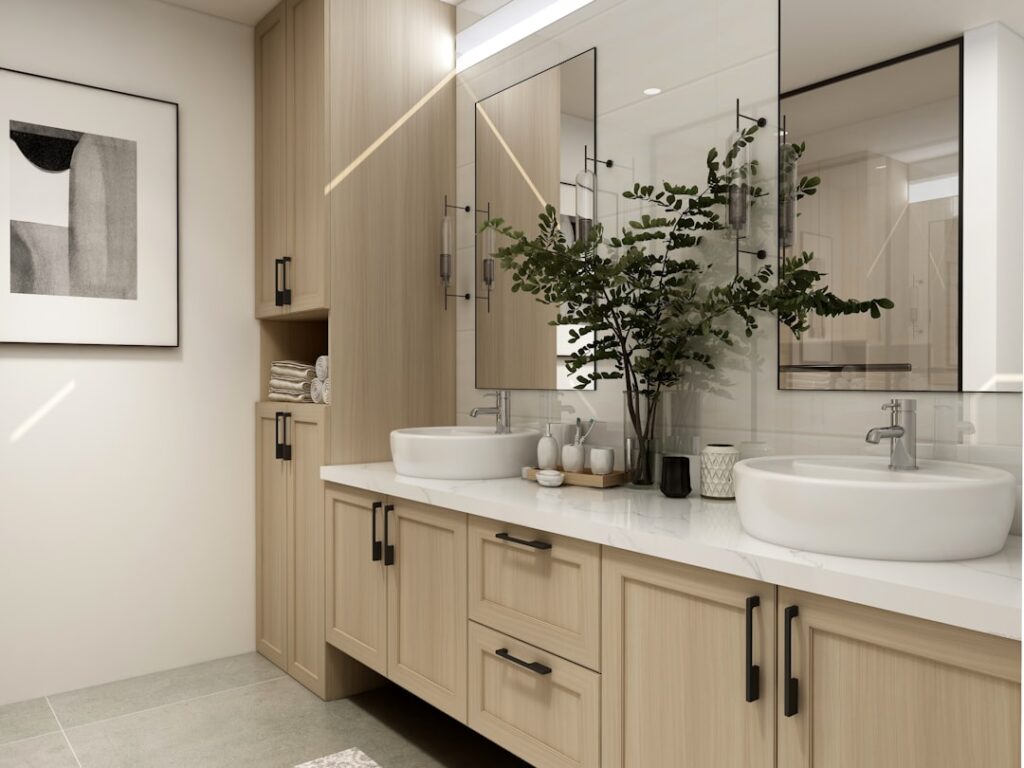
Buying a vanity top with sink as a single unit is one of the easiest wins in a bathroom remodel, because the countertop and basin arrive pre-joined, pre-drilled, and ready to drop onto your cabinet. No separate sink to seal, no fussy undermount clips, no template trip to a stone fabricator. For most homeowners replacing a tired bathroom, this is the fastest path to a clean, finished look.
Part of our Bathroom Remodeling & Flooring guide — explore the full guide →
Having installed and specified dozens of these, I will walk you through the materials, the standard sizes that fit off-the-shelf cabinets, real pricing, and the install details that keep water where it belongs.
What “Vanity Top with Sink” Means
The term usually refers to an integrated unit: the countertop surface and the sink bowl are molded or fabricated as one continuous piece with no seam between them. That seamless design is the whole appeal, because the joint between a countertop and a drop-in sink is exactly where grime collects and caulk fails. An integrated top wipes clean in one swipe and has no lip to trap water.
You will also see “3-hole” and “single-hole” versions, referring to the pre-drilled faucet holes. Standard 3-hole tops fit widespread and centerset faucets on 4-inch or 8-inch spacing. Confirm your faucet’s configuration before you buy so the holes line up.
Material Options Compared
Material drives price, durability, and looks more than anything else. Here is how the common choices stack up.
Cultured Marble
The most popular integrated vanity top by far. Cultured marble is a blend of crushed stone and resin with a gel-coat surface, molded with the bowl built in. It is affordable, comes in dozens of colors and veining patterns, and is easy to clean. The downside is the gel coat can scratch and dull over 10 to 15 years, and it is not heat-proof, so no hot curling irons resting directly on it.
Quartz
Engineered quartz tops paired with an undermount or integrated sink give you a high-end, nonporous surface that never needs sealing. Brands like Silestone and Cambria resist stains and scratches better than almost anything else in a bathroom. Quartz is heavier and pricier, and truly integrated quartz bowls are less common, so many quartz tops come with a separate undermount sink already installed.
Granite
Natural granite brings unique veining and serious durability. It handles heat and resists scratches, but it is porous and needs sealing every year or two to prevent staining. Granite vanity tops typically ship with an undermount sink already mounted from the factory. Expect more weight and a higher price than cultured marble.
Ceramic and Porcelain
Vitreous china and porcelain integrated tops give a crisp, glossy, all-white look popular in modern and transitional baths. They are extremely stain-resistant and easy to clean, though a dropped bottle can chip the glaze. These tend to come in smaller widths suited to powder rooms and compact vanities.
Standard Sizes and What Fits Your Cabinet
Vanity tops are sized to sit on standard cabinet widths with a slight overhang. The common off-the-shelf top widths are 25, 31, 37, 43, 49, and 61 inches, designed to cover 24, 30, 36, 42, 48, and 60-inch cabinets respectively. Standard depth is 22 inches to overhang a 21-inch-deep cabinet, though 19-inch shallow tops exist for tight bathrooms.
- 24-inch cabinet: 25-inch top, single sink, ideal for small baths and powder rooms.
- 30 and 36-inch cabinets: 31 or 37-inch tops, single sink, the most common master and hall bath sizes.
- 48-inch cabinet: 49-inch top, usually single sink, sometimes offered as a double.
- 60-inch cabinet: 61-inch top, the sweet spot for a true double-sink layout.
Measure your cabinet’s outside width and confirm the top overhangs about a half inch on the front and each exposed side. A top that is flush or short will look like a mistake.
Single vs Double Sink
If the cabinet is 60 inches or wider, a double vanity top with two sinks is worth strong consideration for a shared or master bath. Two basins end the morning traffic jam and add resale appeal. Below 48 inches, a double just crowds two tiny bowls with no usable counter between them, so stick with a single and enjoy the deck space. At exactly 48 inches you can go either way, but I usually recommend a single with the offset bowl to preserve a real landing zone for toiletries.
Real Pricing
Budget varies widely by material and size, but here are realistic ranges for the top-with-sink unit alone, not including the cabinet or faucet:
- Cultured marble, 31 inch: roughly $90 to $180.
- Cultured marble, 61 inch double: roughly $250 to $450.
- Quartz with undermount, 37 inch: roughly $300 to $600.
- Granite with undermount, 49 inch: roughly $350 to $700.
- Ceramic integrated, 25 inch: roughly $120 to $250.
Home centers like Home Depot and Lowe’s stock cultured marble and stone tops from brands such as Glacier Bay, allen + roth, and OVE in the common widths, and they will special-order others.
Faucet Holes and Overflow: Details That Trip People Up
Two small specs cause most of the returns I see on vanity tops. The first is faucet-hole drilling. A 3-hole top with holes on 4-inch centers fits a centerset faucet, where the spout and handles share one base. A top with holes on 8-inch centers fits a widespread faucet with a separate spout and two handles. A single-hole top fits a modern one-piece faucet. Buy the top and faucet together, or at least confirm they match, because you cannot easily add or move holes in cultured marble or stone without cracking it.
The second is the drain and overflow. Bathroom sinks usually have an overflow channel, the little hole near the top of the bowl that prevents flooding. If your top has an overflow, buy a drain assembly marked “with overflow.” If it does not, you need a non-overflow drain, sometimes called a grid drain. Mismatch them and the sink either leaks air and gurgles or the overflow does nothing. It is a $15 part, but the wrong one means another trip to the store.
Cleaning and Maintenance by Material
How you care for the top depends on what it is made of. Cultured marble and ceramic want a gentle, non-abrasive cleaner. Skip the abrasive scrub pads and harsh powders that dull the gel coat or scratch glaze. Quartz cleans with mild soap and water and needs nothing else, which is a big part of its appeal. Granite and natural marble need resealing every one to two years; test by dripping water on the surface, and if it soaks in and darkens rather than beading, it is time to reseal. Wipe up cosmetics, mouthwash, and hair products promptly on any surface, since dyes and alcohol are what actually stain bathroom tops over time.
Installation Tips
Swapping a vanity top with sink is a genuine DIY job for most homeowners, usually two to three hours. The sequence matters.
- Shut off the supply valves and disconnect the faucet supply lines and the P-trap. Have a bucket ready; there is always water in the trap.
- Break the old caulk seal with a utility knife and pry the old top free. It is often glued to the cabinet with dabs of adhesive.
- Dry-fit the new top and confirm the overhang is even before you commit any sealant.
- Run a bead of silicone adhesive along the cabinet’s top edges and rails, then set the top down and press it into place.
- Install the faucet and drain before or right after setting the top, whichever gives you better access. Reconnect the supply lines and P-trap.
- Caulk the back seam where the top meets the wall with a bathroom-grade silicone, and run a smooth bead. This is your last line of defense against water getting behind the cabinet.
Test everything by filling the bowl and draining it while you watch the connections underneath. Catch a drip now, not after the trim goes back on.
Final Thoughts
A vanity top with sink is the rare remodel component that is cheaper, faster, and easier than doing it piecemeal, and it looks better because there is no seam to fail. Match the top width to your cabinet, pick a material that fits your budget and how hard the bathroom gets used, and take your time on the caulk. Get those three right and you will have a bathroom surface that stays clean and looks sharp for years.