If you love the clean, bright look of white marble but not the babysitting that natural stone demands, Viatera Everest quartz deserves a spot on your shortlist. Made by LG Hausys, this engineered stone pairs a soft white background with gentle gray veining that reads as understated rather than busy. It gives kitchens the airy, timeless feel of Carrara marble without the etching, staining, and constant sealing. Here is everything you need to know before you sign a slab order.
Part of our Countertops guide — explore the full guide →
- What Everest Actually Looks Like
- How Viatera Quartz Is Made
- Pricing and What to Budget
- Durability and Everyday Performance
- Cleaning and Maintenance
- Where Everest Works Best
- Viatera Everest vs. Other White Quartz
- Pairing Everest with Cabinets and Fixtures
- Ordering the Right Quantity
- Warranty and Buying Tips
What Everest Actually Looks Like
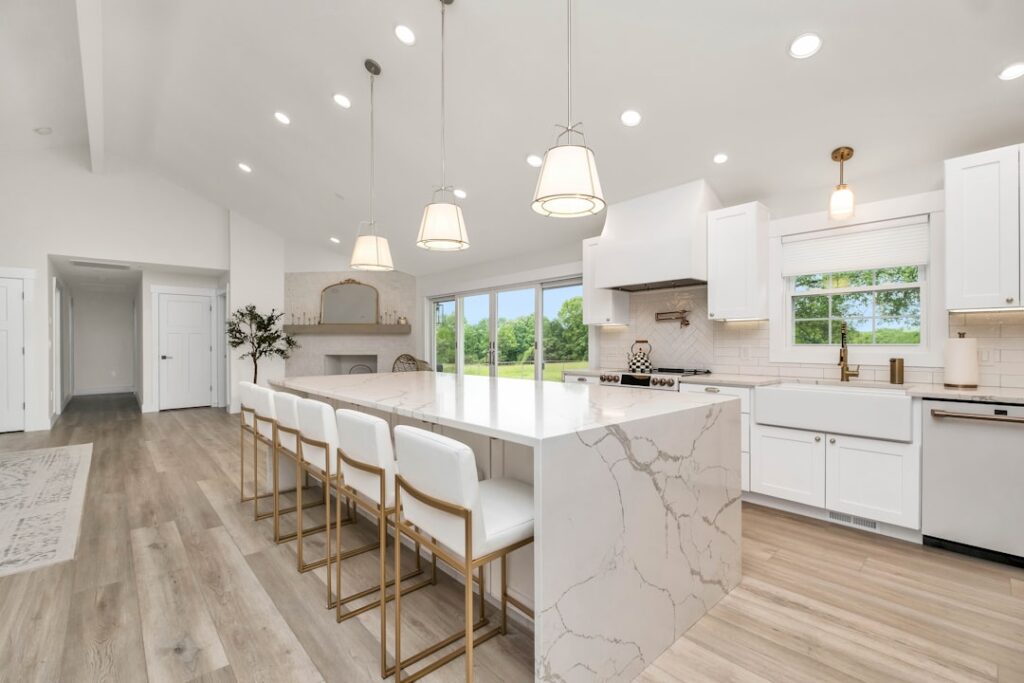
Everest sits in Viatera’s Musica-inspired white family, delivering a warm off-white base rather than a stark, clinical white. Thin, wispy gray veins drift across the surface in irregular patterns, mimicking the natural movement of quarried marble. Because it is engineered, the veining is more consistent from slab to slab than real stone, which makes bookmatching and seam planning far more predictable.
Under warm kitchen lighting, the background can pick up a faint cream undertone. Under cooler LED strips, it leans crisp and bright. Bring a sample home and look at it against your cabinets at different times of day before committing. The color you see in a showroom under fluorescent light rarely matches what you get above your own countertops.
How Viatera Quartz Is Made
Viatera is roughly 90 to 93 percent ground natural quartz bound with resins and pigments, then compacted under intense pressure and heat. That composition is what gives the material its strength and its nonporous surface. Unlike marble, which is calcium-based and reacts with acids, quartz shrugs off lemon juice, wine, and vinegar without etching.
The manufacturing process also means every Everest slab meets the same performance standard. You are not gambling on a soft vein or a hidden fissure the way you might with a natural marble slab. For homeowners who want the marble aesthetic with engineered reliability, that predictability is a major selling point.
Pricing and What to Budget
Viatera Everest typically falls in the mid-tier price bracket for quartz. Installed, expect to pay roughly $55 to $85 per square foot, though high-cost metro areas can push that past $95. A standard 30-square-foot kitchen counter therefore runs somewhere between $1,650 and $2,850 installed.
Your final number depends on several factors:
- Edge profile — a basic eased edge is included, while mitered or ogee edges add $10 to $25 per linear foot
- Slab thickness — 3cm (about 1.25 inches) costs more than 2cm but needs no plywood substrate
- Cutouts — undermount sinks and cooktops typically add $100 to $250 each
- Backsplash — a matching 4-inch quartz backsplash adds material and labor
Always get the price quoted as installed square footage, not raw slab cost. Fabrication and installation labor often equal the material price.
Durability and Everyday Performance
Quartz rates around 7 on the Mohs hardness scale, harder than granite in scratch resistance and far tougher than marble. Everest handles the daily abuse of a busy kitchen: cutting boards sliding around, pots set down without a trivet, kids doing homework with markers. It will not etch from acidic spills, which is the single biggest advantage over the marble it imitates.
The one real limitation is heat. Resin binders can scorch or discolor when a pan straight off a 400°F burner lands directly on the surface. Always use a trivet or hot pad. A permanent white ring from heat damage cannot be buffed out the way it can on granite.
Cleaning and Maintenance
Daily care could not be simpler. Wipe the surface with warm water and a few drops of mild dish soap, then dry with a soft cloth. Because the material is nonporous, it never needs sealing, and it resists bacteria and staining without any special treatment.
Avoid abrasive scrubbing pads and harsh chemicals. Bleach, oven cleaner, and high-pH degreasers can dull the finish over time. For dried-on food, let a damp cloth sit on the spot for a minute to soften it, then wipe away. Skip the scouring powder entirely. That single habit will keep your Everest counters looking new for a decade or more.
Where Everest Works Best
This color is a natural fit for kitchens chasing a light, transitional, or modern-farmhouse aesthetic. It pairs beautifully with white shaker cabinets, warm wood islands, brass or matte-black hardware, and gray-toned tile backsplashes. In bathrooms, it makes a compelling vanity top that survives cosmetics, toothpaste, and mouthwash without staining.
Because the veining is subtle, Everest also works on large islands where a busier pattern might overwhelm the room. If you want dramatic, bold movement, look at Viatera’s Aria or Calacatta-style options instead. Everest is for people who want quiet elegance.
Viatera Everest vs. Other White Quartz
Compared to Caesarstone Calacatta Nuvo or Cambria Brittanicca, Everest reads more restrained. Those competitors feature heavier, more theatrical veining. Everest’s gentle gray threads make it more versatile and less likely to clash with future decor changes.
Against real Carrara marble, the tradeoff is straightforward: you lose a little of the natural depth and translucency, but you gain stain resistance, zero sealing, and a lifetime of worry-free use. For most homeowners cooking real meals in a real kitchen, that trade lands firmly in favor of quartz.
Pairing Everest with Cabinets and Fixtures
Because Everest reads as a soft, neutral white, it plays well with an unusually wide palette. White and off-white shaker cabinets create the crisp, gallery-bright kitchen many homeowners chase, while a two-tone scheme with a navy or sage island grounds the brightness and adds depth. Warm wood tones, from white oak to walnut, bring out the faint cream undertone in the background and keep the space from feeling cold.
Hardware and fixtures are where you set the mood. Brushed brass and champagne bronze lend warmth and a touch of luxury, matte black delivers a crisp modern contrast, and polished chrome keeps things classic and understated. For the backsplash, a simple white subway tile lets the counter stay the star, while a soft gray marble-look tile echoes Everest’s veining for a coordinated, layered look.
Flooring choice matters too. Wide-plank light oak, warm-toned luxury vinyl, or a large-format porcelain in greige all complement the counter without competing with it. The goal is balance: since Everest itself is quiet, you have freedom to add personality through the surfaces and finishes around it rather than fighting a busy countertop for attention.
Ordering the Right Quantity
Before you finalize, have your fabricator measure precisely and add roughly 10 percent for waste, seams, and edge fabrication. Undersizing an order means a second slab that may come from a different production batch with slightly different veining. Confirm slab availability at your supplier early, since popular colors like Everest occasionally sell out and require a wait for the next shipment.
Warranty and Buying Tips
LG Hausys backs Viatera with a limited residential lifetime warranty covering manufacturing defects, provided the material is installed by a certified fabricator. Register your purchase and keep the paperwork. Warranty coverage typically excludes heat damage, improper installation, and outdoor use, so read the fine print.
When buying, always view the actual slabs your fabricator will cut, not just a small sample chip. Ask to see the full slab in person so you can inspect vein placement and plan seams. A good fabricator will lay out your cuts to keep veining flowing naturally across the counter. That attention to layout is what separates a professional install from a disappointing one, and it is worth choosing your shop carefully to get Viatera Everest quartz that looks its absolute best.