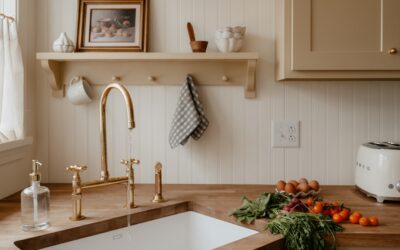
A wall mount kitchen faucet mounts to the wall above the sink rather than through the countertop or sink deck, delivering a distinctive look and practical advantages that deck faucets cannot match. Once found mainly in farmhouse and commercial kitchens, wall-mounted faucets have surged in popularity as homeowners embrace vessel sinks, apron-front basins, and clean, uncluttered counters. But the installation is more involved than a standard faucet, so it pays to understand the requirements before you commit.
Part of our Kitchen Remodeling guide — explore the full guide →
This guide explains how these faucets work, their pros and cons, the critical rough-in and spacing details, installation basics, cold-climate cautions, and realistic costs so you can decide whether a wall mount faucet fits your kitchen.
How a Wall Mount Faucet Differs
The defining difference is the plumbing location. A standard kitchen faucet mounts through holes in the countertop or sink and connects to supply lines running up from the cabinet below. A wall mount faucet mounts to the wall, and its hot and cold supply lines run inside the wall behind the sink. The spout extends out over the basin from the wall. This means the plumbing rough-in must be done in the wall, either during new construction, a remodel that opens the wall, or by cutting into and repairing the wall to add the connections.
Advantages of Wall Mount Faucets
Wall-mounted faucets offer real benefits beyond looks.
- Free counter and sink space: With no faucet holes in the deck, the area behind the sink stays open and easy to clean.
- Easy cleaning: No base plate or holes means no grime traps around the faucet; you wipe the counter in one pass.
- Flexibility with sinks: Perfect for vessel sinks, freestanding basins, and apron-front sinks that have no deck holes.
- Distinctive style: A wall faucet is a design statement, especially in farmhouse, industrial, and modern kitchens.
- Adjustable spout height: You can set the mount height to clear tall pots.
Disadvantages to Consider
The tradeoffs are mostly about installation and climate. The in-wall plumbing makes installation harder and more expensive, especially as a retrofit. In cold climates, supply lines running through an exterior wall risk freezing unless the wall is well insulated or the lines are kept to an interior wall. Repairs mean opening the wall rather than reaching under the sink. And the spout reach and height are fixed by where you rough in the valve, so precise planning is essential because you cannot easily shift it later.
Critical Rough-In and Spacing
Getting the rough-in right is the single most important part of a wall mount faucet project, because mistakes here are buried in the wall.
- Faucet center spacing: Wall mount faucets use a fixed distance between the hot and cold inlets, commonly 8 inches on center for kitchen models. The rough-in valves must match this exactly.
- Height above the sink: Mount the faucet high enough that the spout clears the sink rim and your tallest pots, typically several inches above the basin.
- Spout reach: Position the faucet so the spout delivers water into the center of the basin, not against the back wall or over the front edge.
- Backing and support: Install solid blocking between the studs so the faucet body has firm anchorage and does not loosen with use.
Because these dimensions are set in the wall, dry-fit the faucet and sink and confirm every measurement before closing up the wall.
Installation Overview
Installing a wall mount faucet is a plumbing project best suited to experienced DIYers or, more commonly, a licensed plumber, especially for a retrofit.
- Open the wall behind the sink location if not already open during construction.
- Run hot and cold supply lines to the faucet’s rough-in valve body, matching the required center spacing.
- Add blocking between studs to support the faucet and secure the valve body.
- Pressure-test the connections for leaks before closing the wall, because access will be lost.
- Close and finish the wall, then mount the faucet trim and spout to the valve.
- Test hot and cold flow and check for any weeping at the connections.
The buried, one-shot nature of the connections is exactly why professionals are often worth the cost here. A leak inside a finished wall is far more damaging and expensive than one under a sink.
Cold-Climate Cautions
In regions with hard freezes, in-wall plumbing on an exterior wall is a genuine risk. If the faucet must go on an exterior wall, insulate the wall cavity thoroughly and keep the supply lines toward the warm interior side. Whenever possible, plan the sink and faucet against an interior wall to eliminate the freeze risk entirely. A burst supply line inside a wall during a cold snap causes major water damage, so this is not a detail to overlook.
What a Wall Mount Kitchen Faucet Costs
The faucet itself ranges widely, from about $150 for a basic model to $400 to $900 or more for premium and designer brands like Kohler, Delta, and specialty makers. The bigger cost driver is installation. A retrofit that requires opening and repairing a wall, running new supply lines, and adding blocking can run $500 to $1,500 or more in labor, and more if a plumber and a drywall or tile finisher are both involved. In new construction or a gut remodel where the wall is already open, the added cost is much smaller. Budget realistically for the in-wall work, not just the faucet.
Matching the Faucet to Your Sink
Because a wall mount faucet’s position is fixed once installed, coordinating it with the sink is critical. The spout must reach far enough to deliver water into the center of the basin and sit high enough to clear the sink rim and your tallest pots. For a deep apron-front or farmhouse sink, that usually means mounting the faucet a few inches higher than you would over a standard sink. For a shallow vessel sink that sits on the counter, the faucet mounts higher still so the spout clears the vessel’s rim comfortably.
Consider the spout style too. A high-arc gooseneck spout gives generous clearance for filling and washing large pots, while a lower spout suits a shallow prep sink. Some wall mount kitchen faucets include a pull-down or side spray for rinsing, though the wall configuration can limit hose options compared with deck faucets. Dry-fit the faucet and sink together, ideally with the actual pots you use, before finalizing the rough-in height, because getting the reach and clearance right is far easier before the wall is closed than after.
Maintenance and Longevity
A quality wall mount faucet is durable, but its in-wall valve makes maintenance planning important. Choose a reputable brand with readily available cartridges and parts, because when a cartridge eventually wears and starts to drip, you want a straightforward replacement rather than a hunt for obscure components. The trim, spout, and handles are serviceable from the outside, so most repairs, cartridge swaps, aerator cleaning, handle replacement, do not require opening the wall.
Keep the aerator clean by unscrewing and rinsing it periodically, especially in hard-water areas where mineral buildup reduces flow. Wipe the finish with a soft cloth and avoid abrasive cleaners that dull it. The one scenario that does require wall access is a failure of the valve body itself, which is rare with a quality faucet but is exactly why leak-testing before closing the wall and choosing a trusted brand matter so much. With good parts and simple upkeep, a wall mount faucet can serve reliably for many years while keeping its distinctive look.
Is It Right for Your Kitchen
A wall mount kitchen faucet is an excellent choice when you are already opening the wall in a remodel, when you have a vessel or apron sink with no deck holes, or when you want the clean, open counter and distinctive style it provides. The keys to success are precise rough-in planning, solid backing, leak-testing before closing the wall, and avoiding exterior walls in cold climates. Plan carefully and, for most homeowners, hire a plumber for the connections. Get it right and you gain a striking, practical faucet and a counter that is a pleasure to keep clean.