
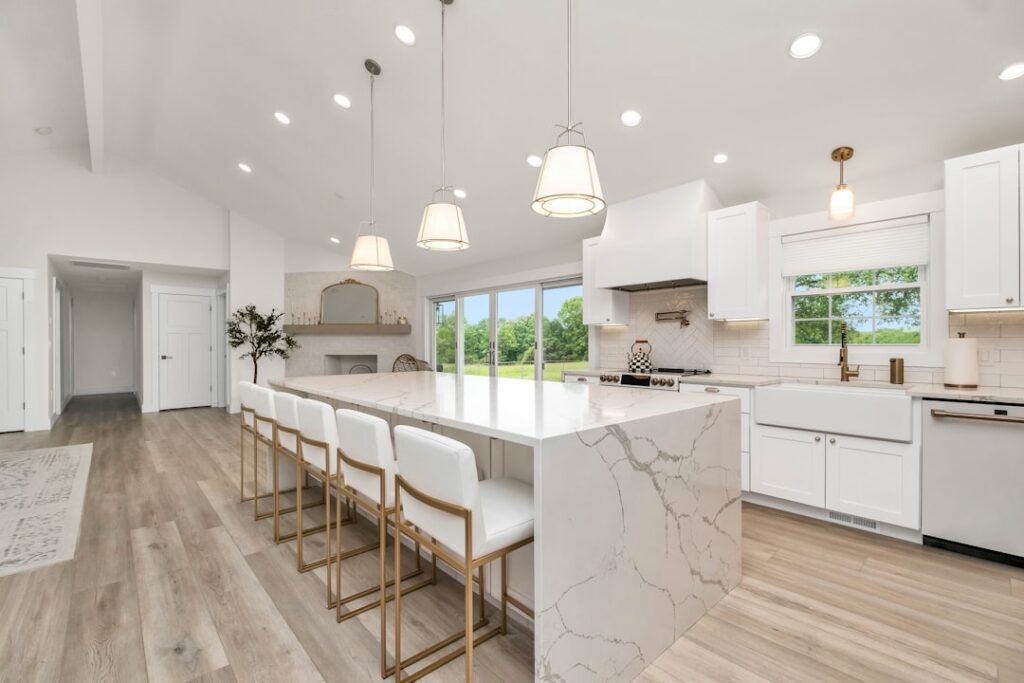
That dramatic cascade of stone running from the countertop down to the floor on a kitchen island is one of the most striking design moves in modern residential construction. A waterfall granite island uses two or three connected slabs to wrap the island in continuous stone, eliminating cabinet sides and turning the island into a sculptural focal point. Done well, the veining flows across the seam between the top and the side panel, making the stone appear to fall like a frozen waterfall. Done poorly, it’s expensive, mismatched, and looks like an obvious afterthought. Here’s what you need to know before committing.
Part of our Countertops guide — explore the full guide →
How Waterfall Edges Work Structurally
A traditional countertop ends at the cabinet face. A waterfall island extends the stone down one or both ends of the island, all the way to the floor, hiding the cabinet entirely on those ends. The top slab and the side panels are mitered at 45-degree angles where they meet, glued with color-matched epoxy, and supported by hidden steel brackets or plywood subframes.
For granite specifically, the side panels can also rest on a small ledge or angle bracket fastened to the cabinet box. Granite’s weight (typically 18 to 22 pounds per sq ft for a 1.25-inch slab) means proper structural support is non-negotiable. Skip the engineering and the side panels crack or pull away within months.
Granite vs Other Stones for Waterfalls
Quartz and quartzite are more common in waterfall installations because they ship in larger seamless slabs, but granite has unique advantages worth knowing.
Granite slabs are quarried directly from the earth, so each slab is one of a kind. The veining and grain patterns vary widely even within the same color. When you select a granite slab for a waterfall, you typically pick the entire block (mother slab) so the side panels and top match each other. This bookmatching technique creates the dramatic flowing effect that makes waterfalls so striking.
Granite costs less than quartzite ($45 to $120 per sq ft installed vs $80 to $200), holds up beautifully to heat (you can place a hot pan directly on it), and resists scratches better than marble. The downsides: porosity (annual sealing required) and harder seam-matching across cuts.
Cost Breakdown
Pricing varies sharply by granite grade, island size, and complexity. Budget realistically for these components:
- Slab material: $45 to $120 per sq ft for the waterfall portion (about twice the linear footage of a flat top)
- Fabrication and mitered edge: $20 to $45 per linear foot of waterfall edge
- Installation labor: $400 to $1,200 for a typical kitchen island
- Steel brackets, epoxy, polishing: $200 to $500
A 4-foot by 8-foot island with two waterfall ends typically runs $4,500 to $11,000 total installed. The same island in flat countertop format runs $1,800 to $4,500, so the waterfall premium is real but the visual impact justifies the cost in many kitchens.
Top Granite Colors for Waterfalls
Color choice matters more in a waterfall than in standard counter applications because the slab is on display from floor to counter. Some granites photograph and live better than others in this format.
White or light granites with bold veining (Alaska White, Colonial White, River White) work best because the vein patterns create visual movement that flows naturally between the top and the side panels. Movement is the whole point of a waterfall.
Black and dark granites (Black Galaxy, Absolute Black, Black Pearl) deliver dramatic contrast but require precise seaming because flaws show against the solid color. Honed or leather-finished surfaces help blend seams.
Medium-toned granites with strong character (Fantasy Brown, Sienna Bordeaux, Blue Pearl) create rich, traditional looks but require careful slab selection to avoid mismatched grain at the miter.
Selecting the Right Slab
Visit the stone yard in person. Stones look completely different in samples, in photos, and on full slabs under natural light. Tag the actual slab you want and have the fabricator confirm the bookmatch potential before purchasing.
Ask the fabricator to show you slab placement diagrams (templates) before they cut. Modern shops use digital layout software that lets you see exactly which portion of the slab will appear on the top, the front edge, and each waterfall panel. Adjust the layout to align the strongest veining with the visible faces.
Buy a single mother slab whenever possible. A typical granite mother slab measures 9 by 5.5 feet and provides enough material for one island with two waterfall ends. Trying to pull side panels from a different slab almost always shows in the final result.
Edge Profiles and Miter Joints
The 45-degree miter where the top meets the side panel is the most critical joint in the entire installation. The fabricator cuts both pieces at precisely 45 degrees, glues them with epoxy that’s tinted to match the stone, and polishes the seam after installation.
A good miter is nearly invisible. Run your finger across it after installation and you shouldn’t feel a step. Look at the seam from 4 feet away and you should see the veining flow uninterrupted from top to side. If the seam line is obvious or the veining stops abruptly at the joint, the fabricator either cut poorly or chose the wrong piece of the slab for the side panel.
Edge profiles for the top of the counter and the bottom of the side panel typically stay simple. A pencil edge or quarter-round eased edge keeps the focus on the waterfall geometry rather than the edge detail.
Support Brackets and Substrate
The hidden engineering that supports a waterfall island matters more than most homeowners realize. The side panels need either steel brackets bonded to the cabinet end or a full plywood substrate covering the cabinet face. Federal Brace, Original Granite Bracket, and Lowes house brand brackets all work, ranging from $25 to $90 per bracket.
For panels longer than 36 inches or thicker than 1.25 inches, ask the fabricator about adding a plywood backer to the inside face of the panel. This distributes load across the cabinet box and prevents long-term flexing at the miter joint.
Sealing and Long-Term Care
Granite is porous and needs sealing. Most modern impregnating sealers (Miracle 511, StoneTech BulletProof, Tenax Hydrex) last 12 to 36 months between applications. Test annually by placing a few drops of water on the surface. If the water soaks in within 5 minutes, reseal. If it beads, you’re fine.
Clean with mild dish soap and warm water or a granite-specific cleaner from Bar Keepers Friend or StoneTech. Avoid Windex, vinegar, and citrus cleaners — all of them etch and dull granite over time.
When a Waterfall Doesn’t Make Sense
Skip the waterfall format if your island is narrow (under 36 inches deep), if the visible end faces a wall, or if you have heavy electrical infrastructure on the island ends. Waterfalls eliminate the option of end-panel outlets and make replacing dishwashers or other appliances more complex.
For kitchens with budget under $3,000 for the island countertop, a standard flat top with a thick mitered edge can deliver visual heft without the waterfall premium. A waterfall granite island is a statement piece that pays back over decades when the slab selection, structural support, and execution all come together correctly.


