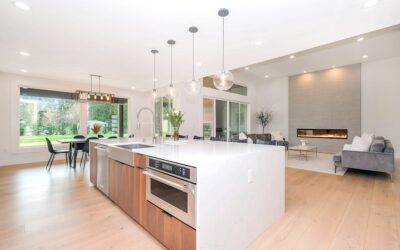
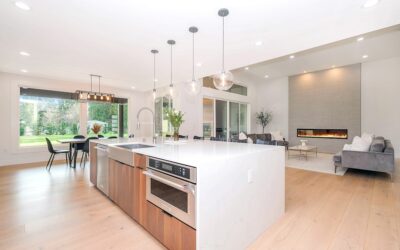
Walk through any new build in the $750,000-plus price band and you will find at least one kitchen featuring a quartz countertop that cascades vertically down the sides of the island. A waterfall quartz island turns the slab itself into the design statement and instantly reads custom. Pricing runs $90 to $175 per square foot of slab installed, with the typical kitchen island adding $3,500 to $7,500 over a standard finished-end design. This guide breaks down the brands worth considering, the seam strategy that prevents visible joints, edge profiles that hold up to kicks and chairs, and the lighting and cabinet choices that complete the look.
Part of our Countertops guide — explore the full guide →
- What a Waterfall Edge Actually Means
- Best Quartz Brands for Waterfall Islands
- Slab Yield and Why It Drives Cost
- Seam Strategy and Pattern Matching
- Edge Profiles for Real-World Wear
- Cabinet, Floor, and Cabinet-Box Compatibility
- Lighting and Surrounding Materials
- Budget Tiers and What to Splurge On
- Care and Long-Term Maintenance
What a Waterfall Edge Actually Means
A waterfall edge is a slab of countertop material mitered at 45 degrees and extended vertically down one or both ends of an island, hiding the cabinetry box behind it. The vein or pattern continues seamlessly around the corner, which is what creates the cascade effect.
The cut requires a CNC waterjet or precision miter saw at the fabricator’s shop, then careful field installation with mechanical clamps and color-matched epoxy. Most fabricators charge $200 to $500 in extra fabrication labor per waterfall end, separate from material cost.
Best Quartz Brands for Waterfall Islands
Cambria, Caesarstone, Silestone, and MSI Q dominate the residential quartz market. Cambria Brittanicca, Skara Brae, and Galloway are the top sellers for dramatic veining at $85 to $115 per square foot installed. Made in Minnesota with a lifetime warranty, Cambria runs slightly tighter color matching between slabs than imported brands.
Caesarstone Calacatta Nuvo, Statuario Maximus, and Empira Black work well in waterfall installations at $75 to $105 per square foot. Silestone Eternal Calacatta Gold and Et. Statuario use Sunlit Days technology with low silica content for safer fabrication and run $80 to $110 installed. MSI’s Q Premium Natural Quartz line undercuts the others at $60 to $85 per square foot for similar marble-look patterns.
Slab Yield and Why It Drives Cost
A standard quartz slab from any major manufacturer measures roughly 56 by 120 inches. A typical kitchen island with a 7-foot countertop plus two 36-inch waterfall sides needs at least 14 linear feet of slab, sometimes 18 feet if the vein direction forces specific cut orientation.
That demand often consumes a full slab even for a small island. Slab cost runs $1,800 to $4,500 each at brands like Cambria and Caesarstone, before fabrication. If your slab yields only 75 percent of usable material for a complex pattern match, expect to pay for two slabs even on a modest job.
Seam Strategy and Pattern Matching
The waterfall corner is the make-or-break moment of the install. A 45-degree mitered seam should show pattern continuity within 1/16 inch of alignment. Off-by-1/8 inch and the cascade looks like a mistake.
Insist on dry-fit photos before final install. The fabricator should mark slab cuts with a vein map, photograph the layout, and email you the proposed pattern continuation. Reject any quartz with veining so directional (like Cambria Brittanicca Gold) that a small misalignment will be obvious. Subtler patterns like Caesarstone Pure White or Silestone Iconic White are more forgiving and easier to seam invisibly.
Edge Profiles for Real-World Wear
A waterfall edge takes more abuse than a horizontal countertop. Kids kick it, chairs hit it, and vacuums whack it. The eased edge (a slight 1/8-inch radius softening) is the strongest choice and the industry standard, included at no upcharge by most fabricators.
Avoid sharp 90-degree edges on waterfall installs; they chip on impact and are uncomfortable to brush against. Bullnose and ogee profiles cost $15 to $40 per linear foot extra and look dated in modern kitchens. Mitered waterfall corners themselves stay sharp at the joint, but the fabricator should ease the outermost arris to prevent edge chipping over time.
Cabinet, Floor, and Cabinet-Box Compatibility
The cabinet box behind a waterfall panel never shows, so quality at that depth is irrelevant to appearance, but it must support the weight. Quartz slab at 1.25 inches thick weighs about 15 pounds per square foot. A 3-foot waterfall panel adds 135 to 175 pounds of unsupported vertical load.
Use 3/4-inch plywood cabinet ends or a custom site-built support frame behind the waterfall panel. Avoid particleboard, which fails over 5 to 10 years under the constant load. Confirm with your fabricator that the cabinet build is rated for the slab they are installing.
Lighting and Surrounding Materials
Pendant lighting overhead is the most-photographed feature of a waterfall island. Hang pendants 30 to 36 inches above the countertop with two to three lights centered. Schoolhouse and Visual Comfort sell statement pendants between $400 and $1,500 each.
Backsplash and flooring should let the island read as the hero. White oak hardwood at $7 to $11 per square foot or large-format porcelain at $8 to $14 per square foot from Daltile, MSI, or Florida Tile work without competing. Avoid pattern-heavy backsplashes; a simple zellige or honed marble subway lets the waterfall island do the talking.
Budget Tiers and What to Splurge On
A budget waterfall island using MSI Q quartz on a 6-foot island runs $5,500 to $7,500 installed. Mid-range Cambria or Caesarstone on a 7-foot island lands at $9,000 to $14,000. Premium Calacatta-pattern Cambria with bookmatched seams and double-thick edge profiles can exceed $20,000 on larger islands.
Splurge on the slab match and fabrication precision; the visible result depends entirely on the quality of the cut and seam. Save money on the cabinet box behind the waterfall, since it never shows.
Care and Long-Term Maintenance
Quartz is non-porous and never needs sealing, unlike granite or marble. Daily cleaning uses a microfiber cloth and warm soapy water with a drop of Dawn. Avoid abrasive cleaners (Comet, Soft Scrub) which can dull the resin binder over time.
Hot pans above 300°F can scorch quartz, so always use a trivet. Direct sunlight over years can yellow some white quartz patterns; UV-stabilized quartz from Cambria and Caesarstone resists this far better than budget imports. With careful brand selection, a slab-matched waterfall quartz island will look as current in 2035 as it does today, which is why builders keep specifying it.