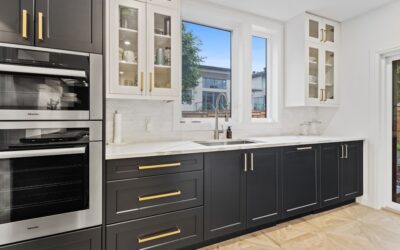
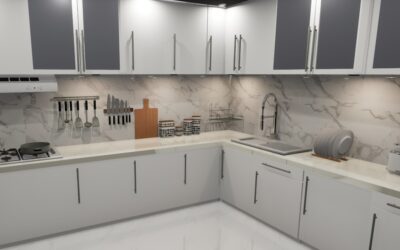
Walk through any home built or remodeled in the last 15 years and the kitchen probably has them. What are shaker cabinets exactly? They are five-piece door cabinets with a flat recessed center panel framed by four straight, square-edged stiles and rails. The look traces back to the religious Shaker movement of the late 1700s, which prized utility, durability, and zero ornamentation. The style has dominated American kitchens since 2010 because it photographs beautifully, mixes with virtually every design aesthetic, and resells faster than ornate alternatives.
Part of our Kitchen Remodeling guide — explore the full guide →
The Five-Piece Door Anatomy
True shaker doors consist of:
- Two vertical stiles (left and right edges)
- Two horizontal rails (top and bottom)
- One flat center panel that floats inside a groove cut into the stiles and rails
The floating panel is critical. Wood expands and contracts with humidity by up to 1/8 inch across a 14-inch panel. A glued or screwed center panel splits within two heating seasons. Quality shaker doors leave the panel free to move inside the groove, which is why a 200-year-old original Shaker cabinet still hangs straight today.
Shaker vs Other Cabinet Door Styles
- Slab (flat-front) — Single piece, modern look. No grooves or seams. Trends with European design.
- Raised panel — Center panel rises with a profiled edge. Traditional, formal, dated to 1990s/early 2000s.
- Beadboard — Vertical grooves replace the flat panel. Coastal and farmhouse aesthetic.
- Glass-front — Frame holds glass instead of wood. Used for upper accent cabinets.
- Inset shaker — Door sits flush within the face frame instead of overlaying it. Most premium variant. Adds 15-25 percent to cabinet cost.
Materials and Quality Tiers
Shaker doors come in radically different price points based on construction:
- Solid hardwood (maple, cherry, oak, walnut) — All five pieces solid wood. Most durable. $300-$700 per linear foot installed.
- Hardwood frame, MDF panel — Stiles and rails solid wood, center panel medium-density fiberboard for paint stability. $200-$400 per linear foot. Industry standard for painted finishes.
- All-MDF shaker — Doors entirely MDF with a thermofoil or paint finish. Budget tier. $120-$220 per linear foot. Avoid if cabinets sit near a dishwasher or sink — steam delaminates thermofoil.
- Plywood box construction — The cabinet box itself. Always specify 3/4-inch plywood sides over particleboard. Plywood holds screws longer and survives water damage that destroys particleboard.
Top Shaker Cabinet Brands by Tier
- Premium custom — Wood-Mode, Plain & Fancy, Rutt. $50,000+ for an average kitchen.
- Semi-custom — KraftMaid, Schrock, Decora. $20,000-$40,000 typical kitchen.
- Stock pre-assembled — Diamond NOW (Lowe’s exclusive), Hampton Bay (Home Depot). $6,000-$15,000 typical kitchen.
- Ready-to-assemble (RTA) — Cabinets To Go, The RTA Store, Barker Cabinets. $4,000-$10,000 with sweat equity.
- IKEA SEKTION with Bodbyn or Axstad fronts — $5,000-$12,000. Surprisingly competitive quality with 25-year warranty.
Most Popular Paint Colors
White still dominates 60 percent of new installs, but the palette has expanded dramatically since 2020:
- Sherwin-Williams Pure White SW 7005 — the safest white
- Benjamin Moore Simply White OC-117 — slightly warmer than Pure White
- Sherwin-Williams Agreeable Gray SW 7029 — neutral greige for transitional kitchens
- Benjamin Moore Hale Navy HC-154 — top navy for islands
- Sherwin-Williams Evergreen Fog SW 9130 — sage that surged in 2024-2025
- Benjamin Moore Black Beauty 2128-10 — for accent or full kitchens in modern homes
Hardware That Suits Shaker Style
Shaker’s clean lines pair with simple hardware. Three categories work universally:
- Cup pulls on drawers, knobs on uppers — the classic farmhouse pairing
- Bar pulls (4 to 6 inches on doors, 8 to 12 inches on drawers) — the modern transitional pairing
- Knobs only — simplest, lowest cost, best for very small kitchens
Skip ornate Tuscan or Victorian hardware — the visual conflict makes the shaker doors look cheap. Top finishes for 2025: matte black (still dominant), unlacquered brass (patinas naturally), and brushed champagne bronze (warmer alternative to brushed nickel).
Pros and Cons
- Pros: Timeless style, easy to clean (no fussy profiles to trap grease), works with every design genre, paints beautifully, top resale value, repairable when damaged
- Cons: Visible groove between frame and panel collects dust, painted MDF chips on hard impacts, oversaturated in the market (some buyers want something more distinctive)
Cost for an Average Kitchen
An average US kitchen has 25-30 linear feet of cabinetry. Realistic budgets:
- RTA shaker, DIY install: $4,500-$8,000
- Stock shaker, professional install: $9,000-$18,000
- Semi-custom shaker, professional install: $20,000-$40,000
- Inset custom shaker: $50,000-$100,000+
Care and Cleaning
Wipe weekly with a damp microfiber and a mild dish-soap solution. Skip abrasive cleansers like Bar Keepers Friend on painted finishes — the polish removes the satin sheen unevenly. Touch up nicks with a small brush and a matched paint sample (always order an extra quart during initial install). Re-tighten hinge screws annually; the constant cycling loosens them by 1/16 inch per year.
Mixing Shaker with Other Styles
One reason shaker has stayed dominant for over 15 years is its compatibility with other design elements. Pair shaker fronts with industrial pendants, modern slab islands, traditional farmhouse sinks, or transitional metal-and-glass open shelving and the kitchen still reads cohesive. Two-tone kitchens — white shaker uppers with navy or sage shaker lowers — have become especially popular since 2022, and the simple door profile keeps the color contrast feeling intentional rather than busy.
Common Buying Mistakes
Three pitfalls catch most first-time buyers. First, skipping plywood box upgrades to save $400-$800 — the savings disappear within 8 years when particleboard sides start sagging or absorbing moisture. Second, ordering the cheapest soft-close hinges (Blum, Salice, and Hettich are the names that hold up; off-brand hinges from Amazon fail within 2-3 years). Third, choosing a thermofoil shaker for a kitchen with a dishwasher — steam from the open dishwasher delaminates the foil within 18 months and voids most warranties.