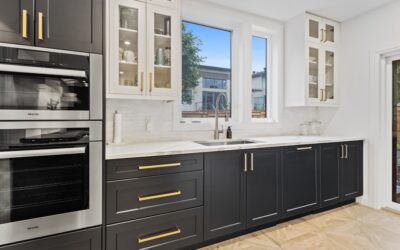
Shaker cabinets have been the most popular American kitchen style for almost two decades, and the reason has less to do with trend cycles than with the geometry. A flat-panel door with a four-piece frame reads as clean from a distance and detailed up close, which lets it work in farmhouse, contemporary, and transitional homes equally well. Shaker kitchens done right run $18,000 to $50,000 fully installed for a typical 200 sq ft cabinet layout, depending on whether you choose stock, semi-custom, or fully custom construction.
Part of our Kitchen Remodeling guide — explore the full guide →
Shaker kitchens suit everything from rental flips to high-end primary residences. The decisions that matter the most are not the door style, but what is behind it.
What Defines a Shaker Door
A true Shaker door is a five-piece construction: two vertical stiles, two horizontal rails, and a flat center panel. The frame width is typically 2 to 2.5 inches. The center panel is recessed flush or slightly below the frame face. There is no decorative profile, no raised panel, no bevel, no inset arches. That austere geometry is the entire design language.
Vendors selling MDF doors with a routed-in fake frame line are not selling Shaker. They are selling a one-piece slab pretending to be five. The difference shows up in painted finishes where the slab tends to telegraph the rout line over time and the real five-piece door does not.
Cabinet Box Construction
The door style matters less than the box behind it. Stock cabinets from Home Depot or Lowe’s run $80 to $200 per linear foot and use 3/8-inch particleboard sides with stapled joinery. Semi-custom lines like KraftMaid and Diamond run $200 to $400 per linear foot with 1/2-inch plywood sides and dowel construction. Fully custom shops run $400 to $900 per linear foot with 3/4-inch plywood or solid hardwood boxes and dovetail joinery.
For a kitchen you will keep for 15 years, semi-custom plywood boxes are the sensible minimum. Particleboard fails fast under cabinet weight at the sink, where leaks are eventual.
Paint Colors That Hold Up
The classic Shaker color is bright white, but the popular shift since 2020 has been toward warmer off-whites and muted greens, blues, and grays. Specific Sherwin Williams paint codes that suit kitchen cabinets:
- SW 7008 Alabaster: warm white that does not yellow in artificial light
- SW 9166 Drift of Mist: greige with green undertone, popular two-tone islands
- SW 6258 Tricorn Black: deep black for islands or full statement kitchens
- SW 6204 Sea Salt: muted coastal blue-green
- SW 7039 Virtual Taupe: warm earthy mid-tone gaining traction
Specify a cabinet-grade conversion varnish or post-catalyzed lacquer from the manufacturer, not a brush-applied wall paint. Field-painted cabinets show roller stipple within 90 days and chip when keys or pots hit them. Factory-finished cabinets cure to a hardness that withstands daily use for decades.
Hardware That Matches the Style
Shaker pairs with simple hardware. Cup pulls and small knobs in unlacquered brass, matte black, or polished nickel suit the geometry. Avoid ornate scrollwork or modern bar pulls longer than 8 inches, which fight the simple door profile.
Top Knobs Aspen II line, Emtek Bristol, and Rejuvenation Massey all deliver excellent quality at $12 to $35 per piece. Cheap zinc-cast hardware peels its finish within a year. Solid brass costs more up front and stays bright for decades, especially in unlacquered finishes that develop a natural patina.
Countertops That Suit Shaker Cabinets
The cleanest pairings for white Shaker cabinets are honed marble, calacatta-look quartz, or solid butcher block on an island. Marble runs $80 to $180 per sq ft installed and develops etching from acidic foods over time. Quartz like Cambria Brittanicca or Caesarstone Calacatta Nuvo at $70 to $110 per sq ft delivers the look without the maintenance.
For a Shaker kitchen in a darker green or blue, a warm-toned quartzite like Taj Mahal or a soapstone honed finish creates contrast that elevates the room. Avoid busy granites with strong veining. They fight the simple door geometry and date the kitchen quickly.
Backsplash Options
Subway tile is the safe default for Shaker, but the size and grout choice change the entire feel. Classic 3×6 subway with bright white grout reads farmhouse traditional. The same tile with charcoal grout reads transitional modern. 4×12 elongated subway with stacked vertical orientation reads contemporary.
Handmade-look zellige tile from Cle or Bedrosians delivers an artisan finish that pairs beautifully with two-tone Shaker layouts. Plan for 15 percent more material than measured for waste, since zellige has natural size variation that consumes more during install.
Layout Considerations
Shaker cabinet style works in any layout, but a few decisions amplify the look. Use full-overlay door fit rather than partial overlay or inset. Full-overlay shows mostly door faces with a 1/8 inch reveal, which keeps the eye on the geometry. Inset doors sit flush with the frame face and look beautiful but cost 20 to 30 percent more.
Tall pantry cabinets at 96 inches height (instead of 84 inches) maximize storage in the same footprint and let you fill the wall to the ceiling cleanly. The 12 to 18 inches of dead space above standard cabinets is wasted square footage that catches dust.
Installation and Lead Times
Stock cabinets ship in 1 to 3 weeks. Semi-custom runs 6 to 12 weeks from order to delivery. Fully custom can take 12 to 20 weeks. Order before you demo the existing kitchen so the new cabinets arrive within a week of being ready to install. Storing cabinets in a garage for two months risks moisture damage.
A skilled installer mounts a typical 200 sq ft cabinet layout in three to four days. Budget $50 to $90 per linear foot for installation, with countertops templated after install and fabricated separately.
The Mistake That Ruins a Shaker Kitchen
The most common error is mixing Shaker doors with traditional crown molding and ornate light fixtures. The whole point of Shaker is restraint. Pair it with simple flat or stacked crown, recessed cans plus one or two clean pendants like the Visual Comfort Hicks or Marlow series, and matte hardware.
Treat the cabinet style as setting the tone for everything else in the kitchen. A Shaker kitchen overlaid with rococo accents is a confused room that ages worse than either style would alone.